OCD: Rituals and Obsession

“I couldn’t do anything without rituals. They invaded every aspect of my life. Counting really bogged me down. I would wash my hair three times as opposed to once because three was a good luck number and one wasn’t. It took me longer to read because I’d count the lines in a paragraph. When I set my alarm at night, I had to set it to a number that wouldn’t add up to a ’bad’ number.”

“I knew the rituals didn’t make sense, and I was deeply ashamed of them, but I couldn’t seem to overcome them until I had therapy.”

“Getting dressed in the morning was tough, because I had a routine, and if I didn’t follow the routine, I’d get anxious and would have to get dressed again. I always worried that if I didn’t do something, my parents were going to die. I’d have these terrible thoughts of harming my parents. That was completely irrational, but the thoughts triggered more anxiety and more senseless behavior. Because of the time I spent on rituals, I was unable to do a lot of things that were important to me.”

People with obsessive-compulsive disorder (OCD) have persistent, upsetting thoughts (obsessions) and use rituals (compulsions) to control the anxiety these thoughts produce. Most of the time, the rituals end up controlling them.

For example, if people are obsessed with germs or dirt, they may develop a compulsion to wash their hands over and over again. If they develop an obsession with intruders, they may lock and relock their doors many times before going to bed. Being afraid of social embarrassment may prompt people with OCD to comb their hair compulsively in front of a mirror-sometimes they get “caught” in the mirror and can’t move away from it. Performing such rituals is not pleasurable. At best, it produces temporary relief from the anxiety created by obsessive thoughts.

Other common rituals are a need to repeatedly check things, touch things (especially in a particular sequence), or count things. Some common obsessions include having frequent thoughts of violence and harming loved ones, persistently thinking about performing sexual acts the person dislikes, or having thoughts that are prohibited by religious beliefs. People with OCD may also be preoccupied with order and symmetry, have difficulty throwing things out (so they accumulate), or hoard unneeded items.

Healthy people also have rituals, such as checking to see if the stove is off several times before leaving the house. The difference is that people with OCD perform their rituals even though doing so interferes with daily life and they find the repetition distressing. Although most adults with OCD recognize that what they are doing is senseless, some adults and most children may not realize that their behavior is out of the ordinary.

OCD affects about 2.2 million American adults, and the problem can be accompanied by eating disorders, other anxiety disorders, or depression.  It strikes men and women in roughly equal numbers and usually appears in childhood, adolescence, or early adulthood. One-third of adults with OCD develop symptoms as children, and research indicates that OCD might run in families.

The course of the disease is quite varied. Symptoms may come and go, ease over time, or get worse. If OCD becomes severe, it can keep a person from working or carrying out normal responsibilities at home. People with OCD may try to help themselves by avoiding situations that trigger their obsessions, or they may use alcohol or drugs to calm themselves.

OCD usually responds well to treatment with certain medications and/or exposure-based psychotherapy, in which people face situations that cause fear or anxiety and become less sensitive (desensitized) to them.

Source: http://www.nimh.nih.gov/index.shtml

cropped-christiangraffiti1 (1)

The Word Made Flesh, by Brennan Manning

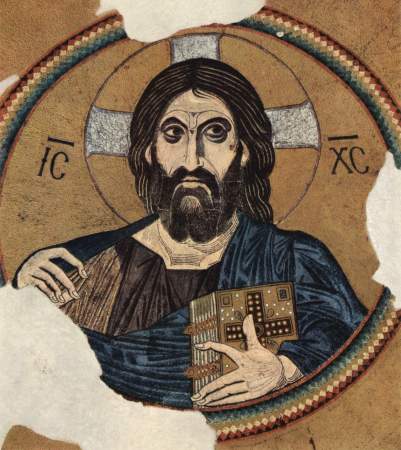
meister_von_daphni_002
Christ Pantocrator, God incarnate in the Christian faith, shown in a mosaic from Daphni, Greece, ca. 1080-1100.

One night a dear friend of Roslyn’s named Joe McGill was praying over this passage in John: “In the beginning was the Word, and the Word was with God, and the Word was God…And the Word became flesh and dwelt among us, and we have seen his glory, glory as of the only Son from the Father, full of grace and truth” (John 1:1, 14).

In the bright darkness of faith, he heard Jesus say: “Yes, the Word was made flesh. I chose to enter your broken world and limp through life with you.”

On the last day, when we arrive at the Great Mansion in the Sky, many of us will be bloodied, battered, bruised and limping. But by Christ, there will be a light in the window and a “welcome home” sign on the door.

Blessed are those who wash their robes, so that they may have the right to the tree of life and that they may enter the city by the gates.”

Revelation 22:14

From The Ragamuffin Gospel, by Brennan Manning. Copyright 1990 by Brennan Manning. Used by permission of Multnomah Publishers, Inc.


cropped-christiangraffiti1-3-1

Our View From the Tree

Jesus entered Jericho and was passing through. 2A man was there by the name of Zacchaeus; he was a chief tax collector and was wealthy.

3He wanted to see who Jesus was, but being a short man he could not, because of the crowd. 4So he ran ahead and climbed a sycamore-fig tree to see him, since Jesus was coming that way.

 5When Jesus reached the spot, he looked up and said to him, “Zacchaeus, come down immediately. I must stay at your house today.” 6So he came down at once and welcomed him gladly.

 7All the people saw this and began to mutter, “He has gone to be the guest of a ‘sinner.’ “

Luke 19:1-7

This particular story is one of my personal favorites.  Zacchaeus faced with the chance of missing Jesus shows his resourcefulness by running ahead.  He positions himself up in a tree that grew by a busy road.  Climbing up he placed himself where he could see Jesus.

I can see Jesus stopping under Zacchaeus’ tree, looks up and calls him to come down. “I must stay at your house today”, Jesus declares.  Now there is some serious protocol issues here.  A guest never invited himself to dinner, that just didn’t happen.  Also Jesus, as an esteemed religious teacher/prophet/messiah was supposed to set an example and not to associate with “sinners”. Rules are being broken.

There are many lessons here for the modern disciple.  We would do well to meditate on the many issues imbedded in the text.  The graciousness of Jesus is profound.  He is kind and yet assertive at the same time.

Imagine if this account was all  the New Testament we had, what would our mindset be like?  I think we’d all have to make some adjustments. To put it simply, Jesus is not normal.  He touches peoples hearts in unorthodox ways.

I think what blesses me the most is Zacchaeus’ decision to climb that tree.  He is a man who is “vertically challenged.” But basically he overcomes his liabilities when he commits to climb up into the branches.  He positions himself to see Jesus, and you can’t say a thing against that. Zacchaeus’ adventure is just now begun.

But isn’t that is what we do as Christians?  We put ourselves in a place where we can be close to him.  Think about the ‘disciplines’ of the Christian.  Disciplines like prayer, fasting, Bible study, tithing, baptism, serving and worship.  All of these are like branches on the Sycamore tree.  Ascending we put ourselves in place where Jesus is coming.  It is a way of seeing Jesus. But, that is surely enough.

When I pray, I do so in order to see Him more clearly.  

I can get it all confused and see it as an end in itself.  This is a common flaw in our thinking.  We forget that all these disciplines do is to help us see Jesus. Nothing more– just to see Jesus, and to be seen by Him.

Zacchaeus did not stay in the tree, you might say the tree accomplished its purpose when Jesus drew close.  Zacchaeus did not say, “Jesus, I have this wonderful spot, and it took ‘effort’ to get here. I think I will stay right here.” No, he didn’t just want to climb– he wanted to see Jesus.

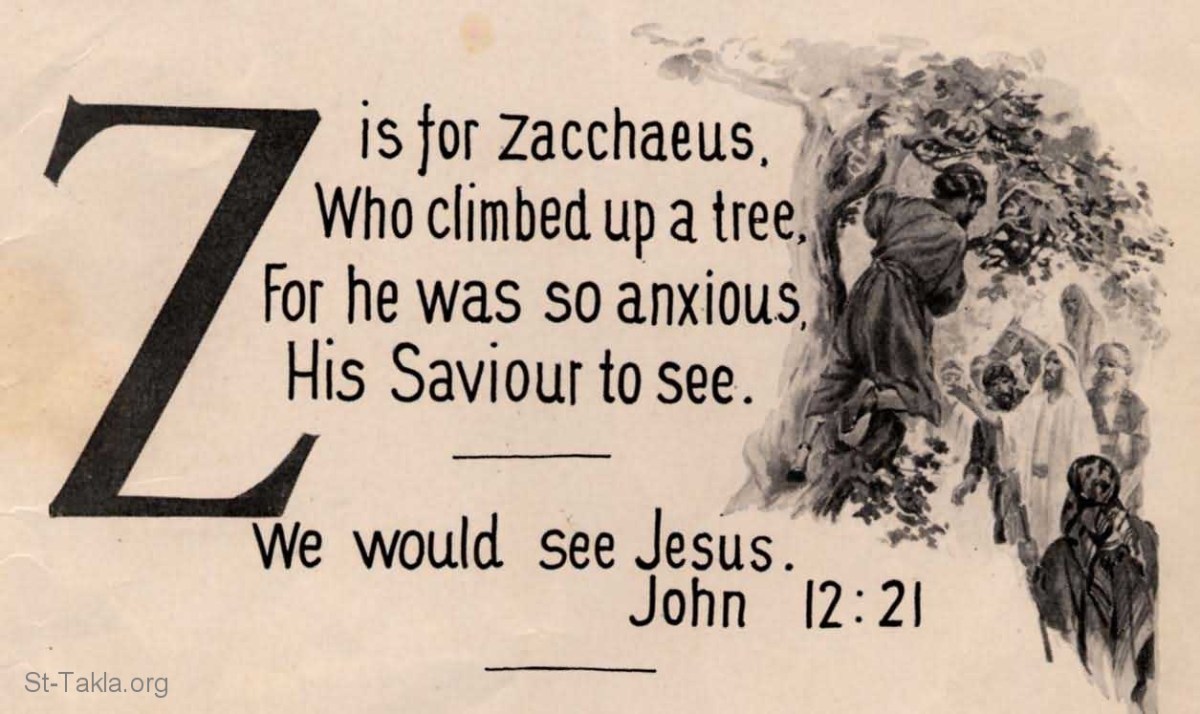
“Sir, we want to see Jesus.”  John 12:21


bry-signat (1)
cropped-christiangraffiti1.jpg 

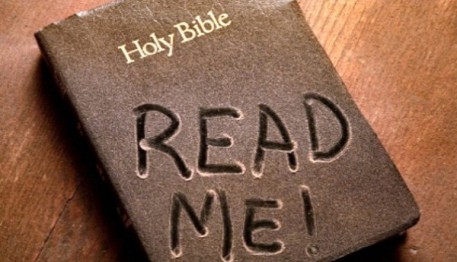
The Diary of a Bible

dusty-bible-600x345

JANUARY: A busy time for me. Most of the family decided to read me through this year. They kept me busy for the first two weeks, but they have forgotten me now.

FEBRUARY: Clean-up time. I was dusted yesterday and put in my place. My owner did use me for a few minutes last week. He had been in an argument and was looking up some references to prove he was right.

MARCH: Had a busy day first of the month. My owner was elected president of the PTA & used me to prepare a speech.

APRIL: Grandpa visited us this month. He kept me on his lap for an hour reading I Cor 13. He seems to think more of me than do some people in my own household.

MAY: I have a few green stains now. Some spring flowers were pressed in my pages. I suppose this was bound to happen– after all, it is spring!

JUNE: I look like a scrapbook. They have stuffed me full of newspaper clippings – one of the girls was married. I get to hold the “glad tidings.”

JULY: They put me in a suitcase today. I guess we are off on vacation. I wish I could stay home; I know I’ll be closed up in this thing for at least two weeks.

AUGUST: Drat. Still in the suitcase.

SEPTEMBER: Back home at last and in my old familiar place. I have a lot of company. Two women’s magazines and four comic books are stacked on top of me. I wish I could be read as much as they are.

OCTOBER: They read me a little bit today. One of them is very sick. Right now I am sitting in the center of the coffee table. I think the Pastor is coming by for a visit.

NOVEMBER: Back in my old place. Somebody asked today if I were a scrapbook.

DECEMBER: The family is busy getting ready for the holidays. I guess I’ll be covered up under wrapping paper & packages again … just as I am every Christmas.

I recently came across a statistic claiming that only about 10% of professing Christians have read the entire Bible. Does the other 90% include you? Guilt is not the reason for this post, but I do want to encourage my readers to pick it up and read. It is not an ordinary book.

16 “All Scripture is inspired by God and is useful to teach us what is true and to make us realize what is wrong in our lives. It corrects us when we are wrong and teaches us to do what is right.”

2 Timothy 3:16

“The vigor of our spiritual life will be in exact proportion to the place held by the Bible in our life and thoughts.”

— George Muller

1brobry-sig4 (2)

cropped-christiangraffiti1-3

%