Sometimes repeated forays into sin become all I can see. I am the prototypical sinner, and it’s hard to believe anyone else could be as stubborn as me. But grace is always found when I return to Him. I am certain He loves me very much.
And I do know that growing up has much to do with time spent with Him. Coming into Jesus’ presence, by faith, is my ‘life task.’ I know this to be true.
Any advice you could give me would be good. TY. I’ll tune into any comments that you leave below (I’m terrible with email.) I want this verse to be mine.
“I will bless those who have humble and contrite hearts, who tremble at my word.”
1-2 What a beautiful home, God-of-the-Angel-Armies! I’ve always longed to live in a place like this, Always dreamed of a room in your house, where I could sing for joy to God-alive!
3-4 Birds find nooks and crannies in your house, sparrows and swallows make nests there. They lay their eggs and raise their young, singing their songs in the place where we worship. God-of-the-Angel-Armies! King! God! How blessed they are to live and sing there!
Psalm 84:1-4, Message
There are some things that leave an indelible mark, and they go very deep down into our souls. For me, one instance I remember staying at Simpson College on Silver Ave. in San Francisco in June 1986. The dorms were empty and I had a whole floor to myself. The campus was gorgeous; the roses were in full bloom.
I found a little “mom and pop” corner market nearby which had an awesome deli. Here I could buy cold cuts, some excellent braunschweiger, and freshly baked sourdough bread. I returned to my room to build my sandwich, and feast.
I remember that the windows were open and there was a beautiful breeze. Food, warm sun, flowers in bloom and the Holy Spirit was about to ‘plow’ into my life. It would be a holy collision.
It was simply a moment that I captured and savored. Everything seemed to coincide, it was magical in the best and holiest sense of the word. It was beautiful, that is all I can say. That time in that dorm room has become a crystalline moment that I will never forget. Right there, it seemed I fell in love, not with a girl, but with a moment in time and place. I knew I was on holy ground.
That nostalgia lays thick on the shoulders of the writer of Psalm 84. He remembers and savors those powerful memories of his visit to the temple. He was given something at that particular moment that would follow him for the rest of his life.
The beauty of that experience was inviolable and true and could never be duplicated. This treasure was his. As he aged he could tell his grandchildren, “I walked with God.” And really mean it.
I personally believe God gives us these holy moments, wrapped in wonder and awe. When the Holy Spirit deeply touches in this way you will never, ever be the same.
The psalmist has the same hunger for God.
These moments in the temple which are so blessed have also ‘ruined’ him. Often special times of God’s presence will result in a ‘sanctified’ dissatisfaction with the present status quo. Brennan Manning once said, “Those who have the disease called Jesus will never be cured.” You can easily apply it to these verses. God’s presence “ruins” us forever.
But when we finally make our way to Jesus, life takes on a special and curious wonder. When the rain finally comes to the barren desert, an explosion of life bursts out. In much the same way, our lives are ‘watered’ by Jesus. Things get very green and lush as we live in the Spirit. All of this is in contrast to our dry and desperate life without His presence.
I want to become hungry for His presence.
I so want to be in the center of wherever He is at. I admit that His grace and love has spoiled me. But the love of Jesus does this. Normal life seems to be nothing more than a boring journey into ‘black & white’, but somehow He turns it all into stunning color.
The psalmist practically begs to be returned to the temple. He wants to be there, more than anything else. It is now his true home. He will not be satisfied with anything less.
I say to the Lord, “You are my Lord. Apart from you, I have nothing good.”
When Susanna Wesley prayed, God listened. I came across this and knew it was meant to be shared on Brokenbelievers. I hope you read it and it spurs you to pray as well. We all need encouragement and this is pretty potent stuff. I know of no higher call than to pray and then teach another believer how to pray.
Heavenly Father,
“I have much need in humbling myself before you, the great and holy God because of the sins I am daily guilty of, in thought, word and deed against your holy majesty. Help me overcome the levity and to shun vain and impure thoughts which, though they do not make their abode for any long period of time, yet in their passing through leave a tincture of impurity.”
“Enable me to keep my heart with all diligence, my thoughts, and affections, for out of them are the issues of life. How often I have offended in this kind! Cleanse me from secret faults, for out of the abundance of the heart the mouth speaks. Help me to guard against vain and unnecessary words, and to speak of you, O my God, with that reverence, that humility, that gravity that I ought.”
“Susanna experienced many hardships throughout her life. Her husband left her and the children for over a year because of a minor dispute.
To her absent husband, Susannah Wesley wrote:
“I am a woman, but I am also the mistress of a large family. And though the superior charge of the souls contained in it lies upon you, yet in your long absence I cannot but look upon every soul you leave under my charge as a talent committed to me under a trust.”
“I am not a man nor a minister, yet as a mother and a mistress I felt I ought to do more than I had yet done. I resolved to begin with my own children; in which I observe the following method: I take such a proportion of time as I can spare every night to discourse with each child apart. On Monday I talk with Molly, on Tuesday with Hetty, Wednesday with Nancy, Thursday with Jacky, Friday with Patty, Saturday with Charles.”
**
“Only God Himself fully appreciates the influence of a Christian mother in the molding of character in her children.”
Have you ever heard someone say those words? “Sorry, not sorry.” It’s kind of annoying. It’s said following a statement or action the speaker knows is unkind or won’t be appreciated by someone else, but they just don’t care. It’s worse than not saying sorry at all.
We humans have a terrible time admitting when we are in the wrong. There’s always some justification for our actions, often that we were wronged first, or we had no choice, or some such nonsense. Misunderstandings escalate into disagreements, which quickly become heated arguments, and nobody really wins in the end. Sometimes good friends end up enemies, all because no one will say those two simple, yet truly difficult, words: “I’m sorry.”
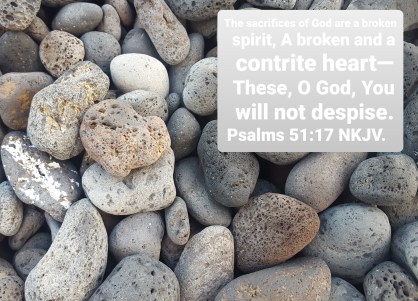
We sometimes have the same problem with God. We know we have not acted as we should, but we can’t let go of pride and say we are sorry. Scripture reveals the truth: a contrite heart is all God wants from us. He desires for us to admit when we’ve missed the mark.
The stories of King David and King Saul illustrate this principle. Both were in the wrong. David committed adultery, and then had the husband of the woman he slept with sent to the front lines of a battle, knowing he would be killed. But when the prophet Nathan brought David’s transgressions to his attention, David’s response was a remorseful attitude. He immediately fell to his knees and confessed his sin. And God forgave David.
Saul, on the other hand, committed a transgression that seems much less serious. He counted his army. Doesn’t sound like much of a sin, does it? But the heart of Saul’s transgression was a lack of trust in God. He didn’t believe he would win a battle even though God had promised him victory. Not only did Saul not trust God, he refused to confess his lack of trust. Instead he made excuses, tried to justify his actions. As a result, God took away Saul’s kingdom and gave it to David. And God did not forgive Saul.
David is remembered as a man after God’s own heart in spite of his many sins because a relationship with God was most important to him. Saul is not remembered so kindly.
What have we lost because we refuse to say we are sorry? A kind word, an admission of our own contribution to a dispute, can go a long way toward healing relationships. Is there someone you need to say “I’m sorry” to today? What’s holding you back? Is it a stubborn nature, like what often holds me back? What do you have to lose? What do I have to lose? More importantly, think what we have to gain.
What about your relationship with God? Is there some transgression you need to confess to restore the intimacy you once enjoyed with your Savior? What do you have to lose? You have the best God intends for you to gain.










 From Wikipedia:



 Broken Believers