Making a Trade

“How poor was Jacob’s motion, and how strange 

His offer! How unequal was th’ exchange!

A mess of porridge for an inheritance?

Why could not hungry Esau strive t’ enhance

His price a little? So much underfoot?

Well might he give him bread and drink to boot:

An easy price! The case is even our own;

For toys we often sell our Heaven, our Crown.”

Francis Quarles, (May 1592 – September 1644)

Reading this dusty old poem isn’t really my favorite thing to do. Contrary to public opinion, I don’t walk around the house quoting Shakespeare or even Milton. (Just so you know, right now I’m listening to baseball on the radio and thinking about a hotdog, with onion and mustard.)

But this brief poem (the best kind!) really resonated in me. I sensed the Holy Spirit focus me on the words, and deliver to me something special. I would like to think that this is going to happen to you as well. But that is not a certainty.

Quarles’ poem sketches out the story in Genesis 25, of Jacob and Esau. For many years I have been moderately perplexed by Esau’s actions and Jacob’s conniving. Esau seems stupid, and Jacob manipulates him.

“Look, I’m dying of starvation!” said Esau. “What good is my birthright to me now?”

 “But Jacob said, “First you must swear that your birthright is mine.” So Esau swore an oath, thereby selling all his rights as the firstborn to his brother, Jacob.”

“Then Jacob gave Esau some bread and lentil stew. Esau ate the meal, then got up and left. He showed contempt for his rights as the firstborn.”

Genesis 25:32-34, NLT

The issue seems to be that I am very much like Esau. And I also seem to have the manipulative style of Jacob. I can trade off my “inheritance” as quick as anyone alive. Depending upon my mercurial moods, I will trade my supernatural peace and hope for swill. And I can do this without a second thought.

Quarles poem ends with this,

“An easy price! The case is even our own;

For toys we often sell our Heaven, our Crown.”

Toys, trinkets, trifles. I trade away the things are most precious for “swill.” But I am hoping that my heart will change, and I will stop trading off what is eternal.

ybic, Bryan

You Are Complete In Him

“Beware lest anyone cheat you through philosophy and empty deceit, according to the tradition of men, according to the  basic principles of the world, and not according to Christ.

For in Him dwells all the fullness of the Godhead bodily, and you are complete in Him, who is the head of all principality and power.”  

Colossians 2:8-10

I’ve heard about how accessories can complete a look.

Lord, thank You for completing us!  And here’s a simple poem . . .

All the Fullness

We are complete in You                                                                       
for that is what You do
coming to us who are unfinished
and filling us with truth.

We are complete in You
it’s not something we can do
for nothing else can fill us
but the fullness of You.

By Debbie, her link should be a blessing, http://iftodaywehear.wordpress.com/

Pain and Prayer in Poetry

This poem is an acrostic of sorts. When I originally wrote it I titled it Prayer, but the acrostic letters that begin each stanza spell PAIN. It was written at a time I was in a lot of physical and emotional pain, and found that prayer was the best way to find relief, if not physically at least mentally and emotionally.

Prayer

Prayer finds me
seeking You for
comfort and healing
here on my knees

As I come to You
my mind is turned
to others who need
what I seek for me

Immanuel, You
are with me now
as I focus on You
instead of my pain

Never to forsake me
You have promised
I find it is true
when You I seek

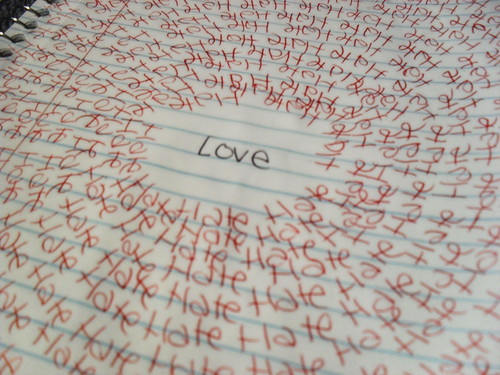
Looking at the Flip Side of Love


The other day Pastor Bryan posted an article titled “Making Some Sense of a Deep and Kind Love: 1 Corinthians 13.” It reminded me of a poem I recently wrote on my own blog, Linda Kruschke’s Blog. So I decided to offer it up here for your consideration.

This poem was born as I was pondering 1 Corinthians 13, and it occurred to me that I might gain a better understanding of what love really is if I looked at it from the opposite side. Taking each description of love in this wonderful passage of scripture, I turned it on its head and saw what hate is. Afterall, hate is the opposite of love.

So here is my poem illustrating what the opposite of 1 Corinthians 13 looks like. (I don’t want to spoil anything, but the final line is my favorite.)

Hate Is . . .

Hate is impatient,
toe tapping, eye-rolling,
in a hurry for instant gratification

Hate is mean,
treating others unkindly,
bullying, and insulting

Hate is envious,
not happy for others’ prosperity,
wanting what others have,
and for them not to have it

Hate is boastful,
puffed up, pointing to self-accomplishments,
not recognizing contributions of others

Hate is not humble,
but is arrogant, filled with hubris
proudly thinking oneself better than all,
pretentious and vain, always vain

Hate is rude,
abusive and insulting, vulgar,
disrespectful, and never caring for others

Hate is self-seeking,
it’s-all-about-me attitude,
selfish and egotistical, self-important

Hate is easily angered,
irritated by the slightest mistake,
hot-headed, unwilling to forgive

Hate keeps a record of wrongs,
every little sin catalogued and indexed,
ready as part of its arsenal of hostility

Hate delights in evil,
revels in rebelling against authority,
is pleased to go its own way

Hate despises truth,
closes its ears to teaching,
refuses instruction and correction

Hate attacks,
harms loved ones and strangers alike,
injures all in its way without care

Hate distrusts,
lacks faith in God or anything,
doubts there is anything good

Hate despairs,
has no hope for a future,
lives in misery and sorrow

Hate gives up,
at the smallest obstacle it gives in,
is defeated by the tiniest tribulation

Hate never wins

Always remember that last line. Hate never wins. Satan never wins. And love never fails, ever! God’s love prevail for all of us on the cross.