
Living in darkness no color I see a hint of deep blue maybe red– but no, only blackness
Tears flood the darkness trying to wash away the blackness to reveal the color I know must be near
I’ve heard stories of vibrant yellow sunshine smiling green trees happiness in rainbows streaming across a pale blue sky
But in the darkness these colors are but myths draped in blackness obscured by the pain I feel
Then suddenly the Light comes dim colors revealed to my eyes for my heart to see
The Light drawn by my tears came to wash away the blackness tears alone could never heal
The colors of my world brighten day by day as the Light illuminates the truth of colors that were always just outside the darkness
“Land of Zebulun and land of Naphtali, the way to the sea, along the Jordan, Galilee of the Gentiles— the people living in darkness have seen a great light; on those living in the land of the shadow of death a light has dawned.”
Matthew 4:15-16 (NIV).
This poem was originally posted on my blog, Linda Kruschke’s Blog, about my own struggles with major depression and the Light who has helped me see the beautiful colors depression had obscured.
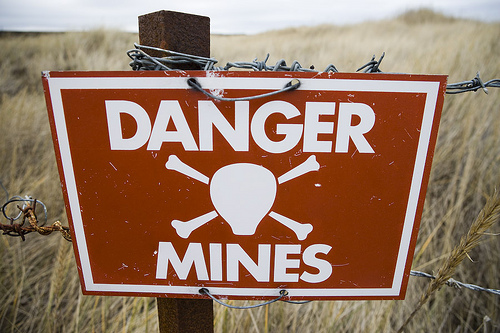
Landmines are a very interesting form of warfare. Buried and essentially unseen, they lay waiting for the enemy. Trained as a Combat Engineer at Fort Leonard Wood, Missouri, I was taught that there were things to counteract other things like mines. I knew how to operate a ‘minesweeper’. I was also taught how to probe with a stick to find mines that could not be detected. In the heat of an Ozark summer, I would be coated with a red mud after crawling on my belly through the Missouri dirt.
There are landmines in the Church.
Buried they simply wait on a believer to step on it. Wisdom would tell us to advance with caution, but the counsel is not always taken. They only await our careless step. We can know they exist, yet we can step on them without thinking. It is a definite form of deception. There are definite things which can cripple us spiritually.
Mines such as fear, doubt, unforgiveness, jealousy, lust, pride and selfishness lay waiting for us. When you step on a mine, you’ll hear a distinct click. This is the downward signal that you have engaged the mechanism of the mine. At this point it gets grim. It is highly unlikely that you can move quickly enough to get away from the explosion.
We are incredibly vulnerable to the mines of our walk as a believer. However, the Holy Spirit holds the maps that can enable us to transverse that which is ahead of us. His presence gives us a safe awareness to progress difficult ground. He is there to direct us to pass through the danger.
Too many people are getting blown up.
They make a misstep and the resulting blast is awful. Unless we listen to the Spirit’s direction we will find ourselves in a very hard place, full of difficulty and danger.
We need the Holy Spirit to help us navigate difficult places.
Without Him present we will step in places that are extremely detrimental, and very dangerous. He must guide us, step by step, through the danger that surrounds us. He will do this, if we only ask.
“The wise people will shine like the brightness of the sky. Those who teach others to live right will shine like stars forever and ever.”
Daniel 12:3, NCV
“So our faces are not covered. They show the bright glory of the Lord, as the Lord’s Spirit makes us more and more like our glorious Lord.”
2 Corinthians 3:18, CEV
In my teenage years, my mom and I attended a series of services in a Christian commune. (This would’ve been in 1972 -73.) They all lived in a single house and had started a Christian rock and roll band. And they knew how to pray.
I was impressed with what I saw.
When they gathered together for worship, they began to ‘glow’. I would stare at them and they became ‘illuminated.’ I had never seen anything like this before. The presence of Jesus was there making Himself known in the hearts of His disciples. I had been given eyes to see the supernatural.
Since then I have heard many testimonies of that same dynamic at work. Confessing believers engaged in prayer and worship, have their countenance changed while in the Lord’s presence. Peace and joy and confidence affects them in a profound way. Their physical appearance is altered, and they proclaim ‘a peace that passes understanding’ that can’t be explained in any other way.
Since I became a Christian in 1982, I have retained those images in my thinking. I’m now very aware of the “witnessing presence’ of Jesus in the lives of His people. And scripture itself, on several occasions, points to this wonderful dynamic in action in the lives of consecrated believers.
When the light comes, it can’t help but transform those of us in darkness. Our faces, hearts, and countenances change. We’re the human vessels for peace and joy (especially knowing our sins are forgiven).
The prophet Daniel talks about ‘shining like a star’. This isn’t possiblein the mechanics of normal life as an unbeliever (at least for any real length of time). That simply can’t be manufactured. The only possible answer is the Christian’s faith. Namely, that Jesus Christ who is indwelling every believer, reflects His presence out into a dark world.
A few winters ago I was out walking on the Alaska Bible Institute campus. Twilight was settling in and 20-30 yards ahead I saw a child’s sled left in a snow pile. In the monochromatic world of an Alaskan winter, the ‘shining’ sled glowed and couldn’t be missed. I saw it from a distance–it was lit up and shone out into the falling night.
You and I who bear His presence are to be fluorescent.
His activity in our hearts is to make us astonishingly conspicuous. We can’t hide His presence (even with sin). We have been irrevocably changed by the Spirit’s residence. We have become ‘glow-in-the-dark’.
Perhaps this is how it supposed to work?
“You are the light of the world. A city on top of a hill can’t be hidden.”
Words matter. Our choice of words, whether speaking or writing, makes a difference.
And words have meaning. That’s what dictionaries are for—to tell us what words mean. When we try to use words to mean something other than what they really mean, it causes confusion.
Sometimes people do this on purpose. One such misuse of a word that I have encountered lately is the use of the word “true” to substitute for “believe.” A person will say “such and such is true for me” when what they really mean is “I believe such and such.”
According to the dictionary, the word “true” means “being in accordance with the actual state or conditions; conforming to reality or fact.” Truth is not relative and is not affected by what any one person believes. Truth is external, and belief is internal, in origin.
Many years ago, when I was suffering from major clinical depression, there were a number of things I believed about myself. I believed I would always be depressed based on how long I had been depressed already and my doctor telling me I would always have bouts of major depression for the rest of my life. I also believed I would never be able to hold down a full-time job. I believed no one liked me and that I was worthless. In the parlance of relativism, these things were true for me.
But they weren’t true. They aren’t true and they never were, no matter how deeply I believed them.
And trust me, I deeply believed these things about myself.
But here I am, 18 years later, and I haven’t had a bout of major depression since God showed me how to be free. I’ve had the same good-paying full-time job for almost 12 years, and I had a different full-time job that paved the way for this one for 5 1/2 years before that. On top of my full-time job, I’m actively involved in my church and Bible Study Fellowship, have self-published two poetry books, and take care of my family. And I have a lot of friends, people who like me (and some who even love me).
As I look back over the past 20 years, I see God’s hand in my life, lifting me up and leading me to see the truth. I believe that. But it’s not my belief that makes it true. In fact, I could be dead wrong, but I don’t believe I am.
Whether God is real and cares about His creation enough to do all I believe He has for us is either true or not. It can’t be true for me and not for you, or vice versa. Truth is. As humans, our greatest purpose is to seek the truth. To say that truth is relative—that what is objectively true for me is different from what is objectively true for you—negates that essential human drive to know truth, to know our Creator, to know where we come from, and to know our reason for being.