You know how unsuitable I am. Were it not for your guidance I would have brought everything to destruction. I wish to give my heart and mouth to your service. I desire to teach your people, and long to be taught your work.
Use me as your workman, dear Lord. Do not forsake me; for if I am alone I shall bring all to nought. Amen.
***
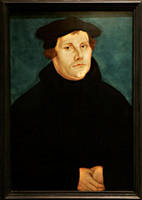
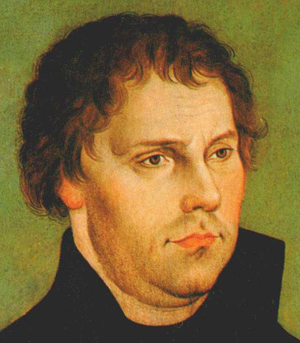
A written prayer by Martin Luther, (b. November 10, 1483 – d. February 18, 1546) Catholic Monk, Reformer, Theologian, Writer.
________________
Some General Quotes by Luther:
“Faith is a living and unshakable confidence, a belief in the grace of God so assured that a man would die a thousand deaths for its sake.”
“So when the devil throws your sins in your face and declares that you deserve death and hell, tell him this: “I admit that I deserve death and hell, what of it? For I know One who suffered and made satisfaction on my behalf. His name is Jesus Christ, Son of God, and where He is there I shall be also!”
“Either sin is with you, lying on your shoulders, or it is lying on Christ, the Lamb of God. Now if it is lying on your back, you are lost; but if it is resting on Christ, you are free, and you will be saved. Now choose what you want.”
“In our sad condition our only consolation is the expectancy of another life.”
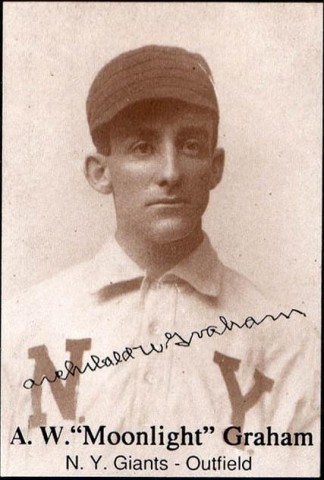
Archibald Wright “Moonlight” Graham (November 10 1879 – August 25 1965) was an American professional baseball player who appeared as a right fielder in a single major league game for the New York Giants on June 29, 1905.
His story was popularized by “Shoeless Joe,” a novel by W. P. Kinsella, and the subsequent 1989 film, “Field of Dreams.”
On June 29, the Giants were the visiting team against Brooklyn. For the bottom of the eighth inning, Graham was sent in to play right field, replacing George Browne. In the top of the ninth inning, Graham was on deck (scheduled to be the next batter) when his teammate Claude Elliott flied out resulting in the third and final out. Graham played the bottom of the ninth in right field but never came to bat, and that game turned out to be his only appearance in the major leagues.
“Moonlight” Graham got his nickname because the sum total of his career was that singular fleeting moment, which passed by too quickly. Technically, I guess he played one game at MLB level, But he never had the chance to bat and never even touched the ball. He would never again play in the majors, but since he was recorded on an umpire’s ‘batting order’ list, technically he played MLB.
How incredibly sad. I pulled out my baseball encyclopedia to verify his career and yes he is there. He had his moment in the moonlight, it passed and left him with no compassion or mercy. He has been forever marked in baseball as someone “who might have been”.
Dr. Archibald “Moonlight” Graham, went to college and became a physician. In the movie “Field of Dreams”, Graham (Burt Lancaster) declares this– “You know we just don’t recognize the most significant moments of our lives while they’re happening. Back then I thought, well, there’ll be other days. I didn’t realize that that was the only day.”
Often, there is just a short window of time to respond to God’s grace. We think we can just put it off, and later make a decisive decision. But this moment maybe all you have.
“God says,
“At the right time I heard your prayers. On the day of salvation I helped you.” (Isaiah 49:8)
I tell you that the “right time” is now, and the “day of salvation” is now.“
2 Corinthians 6:2, NCV
For some reason we think somehow we have arrived and life will always be this way. But the only sure thing, the one solid definite fact, is the love of God for our souls. That is the only thing that will stay with us. Our circumstances are always changing. But perhaps we need to be faithful in this singular moment. I think “Moonlight” Graham would agree.
The hymn A Mighty FortressIs Our God gloriously celebrates God’s power. It was penned by the great 16th-century reformer Martin Luther, who believed God’s power could help believers overcome great difficulties — even depression. Given his pastoral heart, he sought to bring spiritual counsel to struggling souls. His compassion for those souls shines in numerous places, including his sermons, lectures, Bible commentaries and ‘table talks’. In addition, he devoted many letters to counseling troubled folk.
Luther’s writings reveal his knowledge of various emotional difficulties. For example, in August 1536 he interceded for a woman named Mrs. Kreuzbinder, whom he deemed insane. He described her as being “accustomed to rage” and sometimes angrily chasing her neighbor with a spear.
In addition, Luther’s wife, Kate, struggled with pervasive and persistent worry indicative of generalized anxiety disorder. Prince Joachim of Anhalt, to whom Luther often wrote, exhibited signs of obsessive-compulsive disorder, and he believed he had betrayed and crucified Christ. Conrad Cordatus, a pastor and frequent guest at Luther’s table, exhibited signs of hypochondriasis, a disorder involving preoccupation with fears of having a serious disease.
Besides observing mental difficulties in others, Luther had a compelling reason to affirm their reality. Luther himself endured many instances of depression. He described the experience in varied terms: melancholy, heaviness, depression, dejection of spirit; downcast, sad, downhearted. He suffered in this area for much of his life and often revealed these struggles in his works. Evidently he did not think it a shameful problem to be hidden.
Satan as the “accuser of the brethren,” causes Christians to dwell on past sins. Such thoughts induce melancholy and despair. Concerning a friend’s depressive thoughts, Luther wrote, “Know that the devil is tormenting you with them, and that they are not your thoughts but the cursed devil’s, who cannot bear to see us have joyful thoughts.”Luther recognized a spiritual truth about depression. One can expect Satan’s persistence until faith is destroyed, but in the midst of depression God is with us. He never leaves us alone. In the midst of trouble He draws near to us.
Sometimes the invisible God draws near through visible people, and they become the bearers of God’s comforting and strengthening words to troubled souls. What’s more, God seeks to assure us of His love and esteem. And through His Word, He counters Satan’s lies with His truth.
Some Martin Luther Quotes
Luther’s Seal
“All who call on God in true faith, earnestly from the heart, will certainly be heard, and will receive what they have asked and desired.”
“Faith is a living and unshakable confidence, a belief in the grace of God so assured that a man would die a thousand deaths for its sake.”
“Christ took our sins and the sins of the whole world as well as the Father’s wrath on his shoulders, and he has drowned them both in himself so that we are thereby reconciled to God and become completely righteous.”
*
“A Mighty Fortress is Our God,” by Luther
1. A mighty fortress is our God, a bulwark never failing; our helper he amid the flood of mortal ills prevailing. For still our ancient foe doth seek to work us woe; his craft and power are great, and armed with cruel hate, on earth is not his equal.
2. Did we in our own strength confide, our striving would be losing, were not the right man on our side, the man of God’s own choosing. Dost ask who that may be? Christ Jesus, it is he; Lord Sabaoth, his name, from age to age the same, and he must win the battle.
3. And though this world, with devils filled, should threaten to undo us, we will not fear, for God hath willed his truth to triumph through us. The Prince of Darkness grim, we tremble not for him; his rage we can endure, for lo, his doom is sure; one little word shall fell him.
I bind unto myself today
The strong name of the Trinity
By invocation of the same,
The Three in One and One in Three.
I bind this day to me forever,
By power of faith, Christ’s incarnation,
His baptism in the Jordan River,
His cross of death for my salvation,
His bursting from the spiced tomb,
His riding up the heavenly way,
His coming at the day of doom,
I bind unto myself today.
I bind unto myself today
The virtues of the starlit heaven,
The glorious sun’s life giving ray,
The whiteness of the moon at even,
The flashing of the lightning free,
The whirling wind’s tempestuous shocks,
The stable earth, the deep salt sea,
Around the old eternal rocks.
I bind unto myself today
The power of God to hold and lead,
His eye to watch, his might to stay,
His ear to hearken to my need,
The wisdom of my god to teach,
His hand to guide, his shield to ward,
The Word of God to give me speech,
His heavenly host to be my guard.
I bind unto myself the name,
The strong name of the Trinity
By invocation of the same,
The Three in One and One in Three,
Of whom all nature has creation,
Eternal Father, Spirit, Word.
Praise to the Lord of my salvation;
Salvation is of Christ the Lord!