1 My heart is confident in you, O God; no wonder I can sing your praises with all my heart! 2 Wake up, lyre and harp! I will wake the dawn with my song. 3 I will thank you, Lord, among all the people. I will sing your praises among the nations. 4 For your unfailing love is higher than the heavens. Your faithfulness reaches to the clouds. 5 Be exalted, O God, above the highest heavens. May your glory shine over all the earth.
6 Now rescue your beloved people. Answer and save us by your power.
–Psalm 108:1-6, NLT
David has tapped into strength and significance. The astounding part of it is–it’s a Person, not a method. He has a relationship that alters the reality around him. David is outrageously enthusiastic about this. He exudes a confidence that can’t be contained. Our strength is in a person! (Not religion, a moral code, ethics or even discipleship.) It’s Jesus, it is a relationship, that is personal–a intimate friendship.
David refers to a ‘harp and lyre.’ These are obsolete for the most part. But I think any musical instrument can be used. A piano or a guitar, (even a cherry red Stratocaster) is quite acceptable. But there is an interesting shift. David’s heart and soul is his musical instrument! Worship starts right there, not in a set of drums. His heart is the primary place of worship. That is where worship must happen. And we can easily confuse this.
King David understands innately the significance of worshipping God. He visualizes going out to all the peoples of the world–not as a diplomat, but as a worshipper. That is his central thought and theme. No trade treaties, or ambassadors or even peace envoys. But Jehovah God is his ingrained purpose.
And worshipping Him is a reasonable thing. David proclaims two attributes that are ‘sparkplugs’ for his spiritual life, (v.4).
Love
Faithfulness
These ignite his love and worship. When King David thinks about them, he can’t help but sing and worship. And they are extremely significant for us as well. When you think of God’s love and His unceasing faithfulness–and if they are properly seen, and understood, you too will worship. As a matter of fact the existence of heart worship is evidence of a healthy spiritual heart.
David wants to God to show Himself to the whole earth–everyone! Far jungle tribesman and Eskimos, all need to see God! Everybody gets to see Him. That is the wonderful purpose of Christian missions. David wants desperately to share this with all. He has a true zeal (and sometimes that scares us).
Verse 6 hints of the existence of sin and evil. These are things so engrained and prevalent in our society, and in our hearts–we need a deliverer and a savior. Jesus has to step in. We have no other options, and our creator has got to be our Savior. When we begin to realize our desperate predicament, all the vanity (an old fashioned word) and emptiness, we are halfway there. I encourage you to worship, everyday.
How many families in your church have a loved one who struggles with mental health problems? That’s kind of a trick question. People don’t talk about mental health problems. You’re more likely to hear them describe their child’s condition as “something like autism,” as the elder of one church we know says.
Or they might cover up entirely, as does an elder’s wife in another congregation. When her bipolar disorder swung into mania after childbirth, her family, already managing the added responsibilities of a newborn, had to manage her condition as well. But because her condition is a secret, they did so without any support beyond the usual “new baby” dinners.
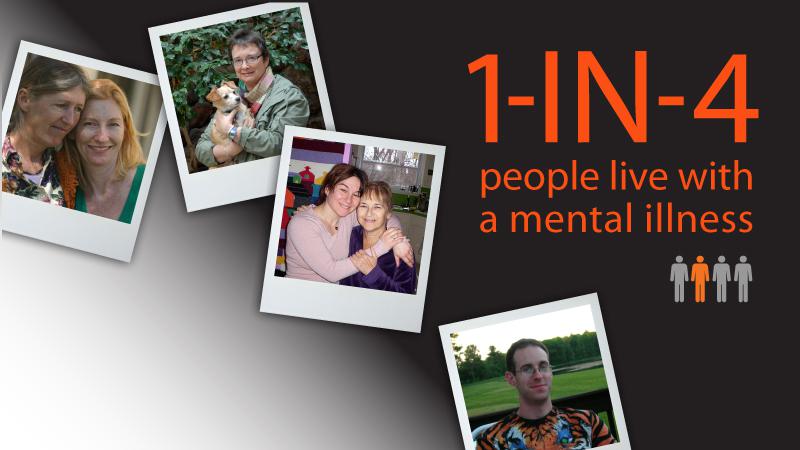
The answer to the question is, if your congregation is representative of the U.S. population, one in four households will struggle with someone’s mental health problems over their lifetime. That’s schizophrenia, bipolar disorder, obsessive compulsive disorder, disabling chronic depression, and various anxiety disorders. Look at the faces seated around you this Sunday. Someone is probably hurting. And they’re probably afraid to tell you.
The least acceptable disability
Out of Control
A study where people ranked disabilities by their “acceptability” returned these results, in order–most acceptable: obvious physical disabilities, blindness, deafness, a jail record, learning disabilities, and alcoholism.
Least acceptable: mental health problems. People with mental health problems frighten us because when people become mental ill, they become someone we don’t know. A bright boy who was his family’s bright hope may find he just can’t cut it anymore as schizophrenia turns him paranoid, disoriented, unmotivated in the extreme, and overwhelmed by delusional voices that tell him, over and over, how worthless he is.
Or, in the case of bipolar disorder, a girl who was a well-liked and active member of her Teen Challenge group may suddenly turn promiscuous, run away from home, and make a new home in the streets of a strange city. Laziness. Promiscuity. Violence. Sin. That’s what many people see when they look at those with mental health problems. It’s hard to believe that people may behave in such unacceptable ways and not be in control of their behavior.
Having a mental health problem is a lot like being on alcohol or drugs, without being able to stop. Medications “work” for about two-thirds of us. That means that a third of us can’t ever get off the chemical ride that our brains produce.
For those of us who can use medications, the side effects can be daunting. I have lost about 20 percent of my small motor functionality as a result of one of the five medications I take for bipolar disorder. I prefer that to losing large motor control and having another auto accident, being so disoriented I can’t find my way home from the store, losing bowel control in a busy bookstore, gaining 45 pounds, or any of dozens of side effects I’ve experienced on other medications.
Many people become so frustrated with side effects that they stop taking medications. Only about half of us accept treatment. Even when we are treated, not everyone regains their status as a fully functioning adult. In our extended family, six people have diagnoses. Those with bipolar disorder and chronic depression are successfully medicated and work full-time. Those with panic disorder and schizophrenia are on permanent disability. Nothing has pulled them through.
What the Bible says
The Bible talks about mental illness, as well as physical illness.
It describes a king who was made mentally ill until he would recognize the sovereignty of God (Dan. 4:29-34).
It describes demonized men who lived among the tombs and terrorized everyone until Jesus set them free (Matt. 8:28-33).
It also describes as demonized a young boy that most scholars today say had epilepsy (Matt. 17:15-18). Jesus delivered him, too.
What was once believed
What does this tell us about illness?
First, that God is able to heal. Second, that some physical and mental illnesses are caused by demons. Third, that some mental illnesses are caused by sin. But are all mental illnesses caused by demons or sin, and is seeking God our sole resource for physical and mental healing?
Since the 1950s, we have usually sent church members with epilepsy to doctors for effective treatment with anti-convulsant drugs. In a similar way, we’ve learned that medicines can effectively treat many cases of mental illness. So if all mental illnesses were caused by demons and sin, medicine would be exorcising demons and turning hearts to repentance. That is certainly untrue, for those are the works of the Holy Spirit.
Instead, we now know that most if not all mental illnesses are biological in origin, with environmental factors possibly triggering an existing genetic predisposition to the illness. Mental illnesses, just like epilepsy, are biological disorders of the brain.
What can the church do?
Compassionate service is one of our core charges as Christians. We observe it almost daily in the experience of one man we know with schizophrenia. His life is confined almost entirely to his home due to the fear, indecision, and lethargy that have become the shape of the illness in his body. But neighbors bring him occasional meals. The secretary of his small church talks to him by telephone every weekday. Several other members take weekly calls at designated times to help break his isolation. If he doesn’t feel up to driving to his Bible study meeting or Sunday services, some member will give him a ride. Nearby relatives help him plan and manage his finances, and come by to clean occasionally and for DVD “movie nights.” Phone cards given as gifts allow him to call his mother nightly. There’s much more that could be done—more frequent house cleaning and more meals and more visits—but he enjoys far more contact with many more loving people than many shut-ins.
The challenging good news is that when people with mental illness turn to someone outside “the system” for help, the church is first to get the call 40 percent of the time. Is your church ready?
…………………..
Carlene Hill Byron is the former Director of Communications for Vision New England. Through NAMI—the Nation’s Voice on Mental Illness, she and her husband, James, train churches to effectively serve people within the congregation with mental health problems and also teach NAMI’s class for families of people with mental health problems. They are members of Asbury United Methodist Church in Raleigh, North Carolina, where James serves on staff. First published by Vision New England’s Ministries with the Disabled, Acton, Massachusetts.
I just want to encourage you to consider something. Specifically, your relationship with your wife. Whether you acknowledge it or not, she has been specifically given (assigned?) to you for a solid purpose. A couple of simple thoughts.
You made a covenant before God and His people to love, serve and honor her– in sickness or health, for richer or poorer. This obligates you for the remainder of your life on earth.
Your wife is a compliment to your self. She enhances and enriches you as a person. Your sins and flaws (I’m sure there is a few) are covered and protected by your “help-meet.” You’ve been ‘graced’ by her. (And you also bless her.)
All other sisters, are forever off-limits. You are your wife’s exclusive partner. The ring you wear on your left hand must be a reminder of your status; it must ‘speak’ to you of this special covenant always.
The girls that you dated before your wedding were special, but they were pretty much there to prepare (hone and polish) you, for your wife. You are a different person because of them. Don’t fantasize about how different life would be if you connected someway with ‘x’ or ‘y’ or ‘z.’ Don’t mess with reality.
You are meant to serve your wife. The definite way you honor her is the solid way you serve the Lord God. When you pour out on her, you are pouring out on the Lord Himself.
Never, ever compare your wife to anyone else. You are foolish if you do. She is ‘unlike’ anyone else.
You must lead your wife, and family to the Lord. You are a priest of your home, completely responsible. You must be an intercessor for them, for they are in your care.
God’s grace will meet you, and if you ask for it He will give it to you. All of this should overwhelm you, and if it doesn’t you don’t understand. The Holy Spirit knows all that you need, and He will guide you into the truth.
Your children are there as a result of your love for your wife. They are looking to you for guidance. They depend on you at every turn.
“Everyone sings the blues, and everyone plays the fool.” You will sin, and fall. There will be serious seasons of doubt, and confusion. There will be seasons when you are disoriented about your wife. But stay the course, and all will be well.
I do want to stress that to be a true and faithful husband will demand as much of God’s grace as it would take to pastor a “mega-church.” I surely would not advise you to do the ‘status-quo’ as a husband and father. You can do it, but I think you will regret it later.
As a husband (and father) means you are in the ministry, as much as a pastor, or church leader. You must be faithful and humble. What you do, or think affects far more people than you realize. I encourage you to discover other men who share this calling.
“The master of the banquet tasted the water that had been turned into wine. He did not realize where it had come from, though the servants who had drawn the water knew. Then he called the bridegroom aside.”John 2:9
Jesus Christ performs the first miracle of his short ministry. He will perform thousands of them in his brief work on planet Earth. This miracle was done silently, there was absolutely no fanfare or hoopla. (What a contrast for ministry today!)
Silently, quietly, much like he does today, he touches the hearts of thousands of men and women. I wouldn’t have done it this way, I would’ve advertised, had the 12 disciples out doing some PR work, maybe some autographs and definitely make it quite the show!
He is not in the storm, or the fire, or an earthquake. That is not the way he operates (but he can). He comes quietly in a still, small voice to our confused hearts. Silently help comes to us, and silently the answers to our prayers glide down to us. Not a shred of ostentation; no gaudy bows or ribbons. When Jesus is ministering to someone who is in a horrible fix, he does it peaceably–quietly and calmly. He is infinitely gentle.
It is significant that “the servants who had drawn the water knew”. Often those who minister for Christ get to see his omnipotence and his power, they know it first-hand. As a young man, I worked as a full-time evangelist in San Francisco. I saw God change people! Addicts, gays and transvestites would often come for the Bible studies, and God would work and they were changed. As you and I mature and step into service, we are privy to the work of Jesus. We are no longer strangers but friends, and he lets us see his wonders for ourselves. I have been allowed to see up close his workings in a twisted heart of a lost soul. The water is turned into wine. I simply stand in awe.
The master of the feast did not know what had happened. Is this not the same with us quite often? We cannot explain where the blessings come from. It happens quickly and quietly. Look, over there, see the confused woman as she desperately seeks an intervention. She sobs out in prayer, imploring the Lord for mercy. Suddenly, through faith something happens, and it is completely supernatural. And no trumpets sounded, for these are common, regular everyday miracles.
We drink the wine, but we don’t quite grasp the miracle. But that’s okay. Our limited understanding handles these quiet miracles and we will step into the light that grace leaves behind. The water has become wine and we are changed as well, forever, by the quiet power of Jesus.






 Broken Believers