O Lord, God of my salvation, I cry out day and night before you. 2 Let my prayer come before you; incline your ear to my cry! 3 For my soul is full of troubles, and my life draws near to Sheol. 4 I am counted among those who go down to the pit; I am a man who has no strength, 5 like one set loose among the dead, like the slain that lie in the grave, like those whom you remember no more, for they are cut off from your hand. 6 You have put me in the depths of the pit, in the regions dark and deep.
Psalm 88:1-6, ESV
I definitely needed this Psalm today. Yesterday I went to the doctor and was blindsided by news that really isn’t good, at all. Of course, I also have this ongoing struggle with depression. Today I feel like I’m running a marathon with ‘leg weights’ on.
This particular Psalm is radically different than the others.
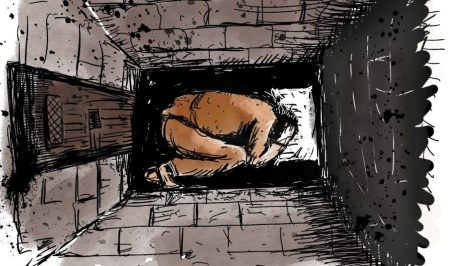
This Psalm has no kind words, and no praise to God for deliverance. It is a singularly sad song. Imagine if you will, a huge stone fortress in the mountains. Every room has a door, and every room a window. All except one. No light enters this room. There is no entrance or exit, no way to get free. Psalm 88 describes living that torturous experience.
I like my Psalms to be strengthening or encouraging.
But then comes this one! Life unravels and frays. Everything gets confusing. Life comes apart. The thought of being one who is irretrievably lost and damned, it saturates my thinking. The despair is beyond belief, I have no words to describe its special variety of darkness.
Anyone who has walked into this hell will understand.
Am I ‘less’ a Christian because of this vicious despair? Some would say so. The writer in verse 1-2, calls out to God. (I guess this what you are supposed to do). There is a sense of consistency in his cry. In verses 3-5, we see him evaluating his position. Again, there is a underground current of despair.
There is simply no help, no deliverance for him.
It’s a bitter and painful place to be. There are no explanations why life has gotten so nasty and bitter and out-of-control. But one thing that Psalm 88 does quite well, it strips you of any dignity that you have left.
(Does this make any sense at all?)
There is so much embedded in the book of Psalms. Comfort, faith, victory and hope are what we find. But in Ps. 88, we find a black pearl, the only one of its kind. Somehow, we dare not leave it behind, just because we don’t understand it.
I’m convinced that it has tremendous power to the disciple who is in endless pain. Just vocalizing this Psalm does something to us. These real words help. This Psalm is ours.
“Lord Jesus Christ, you are for me medicine when I am sick; you are my strength when I need help; you are life itself when I fear death; you are the way when I long for heaven; you are light when all is dark; you are my food when I need nourishment.”
Our theology makes all the difference in fighting depression, writes Kathryn Greene-McCreight, Author of “Darkness, Is My Only Companion” and Episcopal priest.
Here is an excerpt where she introduces the depression of Christians:
In his Problem of Pain, C. S. Lewis says that suffering is uniquely difficult for the Christian, for the one who believes in a good God. If there were no good God to factor into the equation, suffering would still be painful, and ultimately meaningless.
For the Christian, who believes in the crucified and risen Messiah, suffering is always meaningful. It is meaningful because of the one in whose suffering we participate, Jesus. This is neither to say, of course, that suffering will be pleasant, nor that it should be sought. Rather, in the personal suffering of the Christian, one finds a correlate in Christ’s suffering, which gathers up our tears and calms our sorrows and points us toward his resurrection.
In the midst of a major mental illness, we are often unable to sense the presence of God at all. Sometimes all we can feel is the complete absence of God, utter abandonment by God, the sheer ridiculousness of the very notion of a loving and merciful God. This cuts to the very heart of the Christian and challenges everything we believe about the world and ourselves.
I have a chronic mental illness, a brain disorder that used to be called manic depression, but now is less offensively called bipolar disorder. I have sought help from psychiatrists, social workers, and mental health professionals; one is a Christian, but most of my helpers are not. I have been in active therapy with a succession of therapists over many years, and have been prescribed many psychiatric medications, most of which brought quite unpleasant side effects, and only a few of which relieved my symptoms. I have been hospitalized during the worst times and given electroconvulsive therapy treatments.
All of this has helped, I must say, despite my disinclination toward medicine and hospitals. They have helped me to rebuild some of “myself,” so that I can continue to be the kind of mother, priest, and writer I believe God wants me to be.
During these bouts of illness, I would often ask myself: How could I, as a faithful Christian, be undergoing such torture of the soul? And how could I say that such torture has nothing to do with God? This is, of course, the assumption of the psychiatric guild in general, where faith in God is often viewed at best as a crutch, and at worst as a symptom of disease.
How could I, as a Christian, indeed as a theologian of the church, understand anything in my life as though it were separate from God? This is clearly impossible. And yet how could I confess my faith in that God who was “an ever-present help in trouble” (Ps. 46:1) when I felt entirely abandoned by that God? And if this torture did have something to do with God, was it punishment, wrath, or chastisement? Was I, to use a phrase of Jonathan Edwards’s, simply a “sinner in the hands of an angry God”?
I started my journey into the world of mental illness with a postpartum depression after the birth of our second child. News outlets are rife with stories of women who destroy their own children soon after giving birth. It is absolutely tragic. Usually every instinct in the mother pushes toward preserving the life of the infant. Most mothers would give their own lives to protect their babies. But in postpartum depression, reality is so bent that that instinct is blocked. Women who would otherwise be loving mothers have their confidence shaken by painful thoughts and feelings.
Depression is not just sadness or sorrow.
When I am depressed, every thought, every breath, every conscious moment hurts.
And often the opposite is the case when I am hypomanic: I am scintillating both to myself, and, in my imagination, to the whole world. But mania is more than speeding mentally, more than euphoria, more than creative genius at work. Sometimes, when it tips into full-blown psychosis, it can be terrifying. The sick individual cannot simply shrug it off or pull out of it: there is no pulling oneself “up by the bootstraps.”
And yet the Christian faith has a word of real hope, especially for those who suffer mentally. Hope is found in the risen Christ. Suffering is not eliminated by his resurrection, but transformed by it. Christ’s resurrection kills even the power of death, and promises that God will wipe away every tear on that final day.
But we still have tears in the present.
We still die. In God’s future, however, death itself will die. The tree from which Adam and Eve took the fruit of their sin and death becomes the cross that gives us life.
The hope of the Resurrection is not just optimism, but keeps the Christian facing ever toward the future, not merely dwelling in the present. But the Christian hope is not only for the individual Christian, nor for the church itself, but for all of Creation, bound in decay by that first sin: “Cursed is the ground because of you … It will produce thorns and thistles for you …” (Gen. 3:17-18).
This curse of the very ground and its increase will be turned around at the Resurrection. All Creation will be redeemed from pain and woe. In my bouts with mental illness, this understanding of Christian hope gives comfort and encouragement, even if no relief from symptoms. Sorrowing and sighing will be no more. Tears will be wiped away. Even fractious [unruly, irritable] brains will be restored.
“Darkness: My Only Companion”
Kathryn Greene-McCreightis assistant priest at St. John’s Episcopal Church in New Haven, Connecticut, and author of Darkness Is My Only Copanion: A Christian Response to Mental Illness (Brazos Press, 2006).
A tiny purple alyssum and a scraggly white alyssum. Two mini daisies. A wee snapdragon with a single bloom. Each had volunteered in various annual pots left on our deck over the winter. As spring sprung, so did these tenacious sprouts.
We wanted to plant new, healthy flowers in the old pots. But I couldn’t bear to toss my little band of misfits. Somehow I knew they held such promise. They were of hearty stock, small though they were. So I replanted them all in what I dubbed my planter of misfits.
Kind of pitiful, isn’t it? Still, this silly planter grew dear to my heart.
Jesus’s Band of Misfits
The disciples that Jesus called to follow him were a lot like the sprouts in this planter. They were a motley collection of misfits. A few fishermen. A tax collector. A zealot and a thief. None were learned men. Not quite what we would expect the God of the Universe to choose for his followers.
But choose them, he did. And at times they were quite pitiful. They misunderstood his teachings. They jockeyed among themselves for position. They doubted—oh, how they doubted. Then they all scattered when he was arrested.
Still, Jesus knew somehow that they held promise. They had potential. With a little training, some time with the Master, and an infusion of the Holy Spirit, they would become a great band of disciples. Pointing others directly to God and his Messiah, they would start the Church—his Church—that would still exist 2,000 years later.
My Lovely Band of Misfits
I doubt my little planter will still be in existence in 2,000 years, or even two. But with a little care and watering, an infusion of fertilizer and sunshine, it has grown into a beautiful planter of flowers.
The purple, yellow, and white overflow the pot and provide beauty to my deck railing. I am delighted that I had faith in the ability of these sprouts to blossom into something extraordinary.
We Are All Misfits
Have you felt like a misfit, too? I know I have on many occasions. I struggle to fit in and I doubt—oh, how I doubt—my own potential. When depression threatens, I even doubt God’s love and my own worth in this world.
But God knows our potential. We who follow Jesus are his people, called to bring him glory. We are called to sprout and grow in beauty and faith. We may be a motley band of misfits, but we are his misfits. And we are dear to his heart.
Every time you cross my mind, I break out in exclamations of thanks to God. Each exclamation is a trigger to prayer. I find myself praying for you with a glad heart. I am so pleased that you have continued on in this with us, believing and proclaiming God’s Message, from the day you heard it right up to the present.
There has never been the slightest doubt in my mind that the God who started this great work in you would keep at it and bring it to a flourishing finish on the very day Christ Jesus appears.
“Bear one another’s burdens, and so fulfill the law of Christ.”
Galatians 6:2
“Gently encourage the stragglers, and reach out for the exhausted, pulling them to their feet. Be patient with each person, attentive to individual needs.”
1 Thessalonians 5:14, Message
“A word spoken at the right time is like gold apples in silver settings.”
Proverbs 25:11
Proverbs tells us that giving good counsel is more valuable than gold or silver. I have met many people who have an opinion about my problems, but few really know how to listen. Discernment is pretty much crucial, and maybe 1 of every 40 will really understand me.
Sometimes I must unload my issues and be understood by someone.
Personally, I need someone who has been profoundly depressed and finally stumbled out into the light. It’s not that I don’t love certain believers, but they haven’t been “checked out” on this particular problem.
It’s like flying a plane or operating heavy equipment, skills that are learned by experience.
It seems to me that it’s not only a gift, but a skill or capability that can be developed over time. Handling God’s Word intelligently and carefully under the direction of the Holy Spirit is a mark of a rainy day believer.
I’m also convinced that good counsel invariably comes from a good person.
At one time I thought any mature Christian believer had a right to give guidance, but that really wasn’t always the case. Now I believe God can use anyone He chooses, but He also employs those who He has given specific gifts to. I’m glad He’s done it this way.
I don’t diminish relationships, but I do know that certain people are not tested on certain problems. This may be simplistic, or a little harsh, but when I had my brain tumor, I did not want my car mechanic to fix me, I wanted a neurosurgeon. Someone who knew and discerned what was really happening.
“The Lord God has given me the tongue of those who are taught, that I may know how to sustain with a word him who is weary.”
Isaiah 50:4, ESV
Choose your rainy day people carefully. Build a connection. Mark them out before things get out of hand.
If you’re reading this, and you have an issue that’s starting to escalate, you need to reach out. The enemy wants you to withdraw. Ask the Holy Spirit for His help in this. He is the Comforter and the Wonderful Counselor. He’ll direct you, and help you. That is what He does. That is His job.
“Rainy day people always seem to know when it’s time to call,
Rainy day people don’t talk, they just listen till they’ve heard it all. Rainy day lovers don’t lie when they tell ‘ya they’ve been down like you.
Rainy day people don’t mind if you’re crying a tear or two.”














 Broken Believers