
 Do the different “M&M’s”® colors taste different?
- Why does caregiver and caretaker mean the same thing?
- Who was the first person to look at a cow and say, “I think I’ll squeeze these dangly things here, and drink what ever comes out”?
- If you dig a tunnel straight through the earth, will you come out with your feet first?
- Why are pennies bigger than dimes?
- Why do most cars have speedometers that go up to at least 130 when you legally can’t go that fast on any road?
- Why do banks leave the door wide open but the pens chained to the counter?
- What would happen if an Irresistible Force met an Immovable Object?
- If a Man is talking in the forest and there is no woman there to hear him, is he still wrong?
- Why is it that when a person tells you there’s over a million stars in the universe you believe them, but if someone tells you there’s wet paint somewhere, you have to touch it to make sure?
- If Barbie is so popular, then why do you have to buy her friends?
- How come you press harder on a remote control when you know the battery is dead?
- How do they get a deer to cross at that yellow road sign?
- How do you know when yogurt goes bad?
- If a cat always lands on its feet, and buttered bread always lands butter side down, what would happen if you tied buttered bread on top of a cat?
- If a chronic liar tells you he is a chronic liar do you believe him?
- If you were traveling at the speed of sound and you turned on your radio would you be able to hear it?
- If all those psychics know the winning lottery numbers, why are they all still working?
- Is it progress if a cannibal learns to eat with a fork?
- Do the air bubbles that are created when you fart in water, smell when they pop?
- Do stuttering people stutter when they’re thinking to themselves?
Month: June 2010

Photo: Night Sky
The heavens tell us about the Glory that God has. We look up and see a universe that was created, and is now on display. I remember on an isolated beach in Mexico. One night, the entire Milky Way was revealed. I laid on the sand transfixed by it all. Suddenly, I got afraid and had the sensation of being very, very small. That awareness has never left me.

Combat’s Hidden Toll: 1 in 10 Soldiers Report Mental Health Problems
Soldiers Report PTSD Symptoms and Other Mental Health Problems

By KIM CAROLLO
ABCNews Medical Unit
ABCNews Medical Unit
June 9, 2010
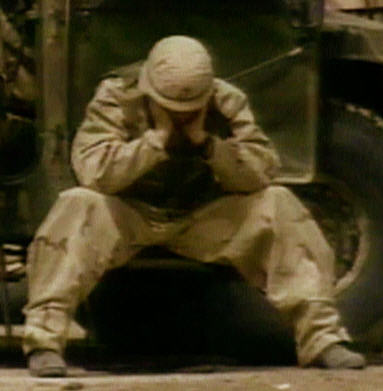 Even though he’s retired from active military duty, CSM Samuel Rhodes still suffers from deep emotional wounds.
“I had to take this afternoon off from work today because of anxiety,” he said. “And sometimes, if I’m going through a really tough time, I think about suicide.”
He spent nearly 30 years in the Army and recently spent 30 straight months deployed in Iraq where he, like many soldiers, witnessed some of the horrors of war.
“In April 2005, it started to eat me up because I started losing one soldier after another,” Rhodes said. “We lost 37 soldiers that were in my unit.”
He was in charge of the brigade of 37 soldiers, and as time wore on, the loss of life wore him down.
“In April 2007, it came full circle. I considered suicide as an option. I felt guilty about losing those soldiers, even though I had no control over it,” he said.
“And I was sleepwalking. I had to tie myself to my cot to prevent it,” he added.
Later, during his 24th month in Iraq, he was found unconscious, and doctors diagnosed him with exhaustion. At that time, the combat stress doctor told him he was also suffering from post-traumatic stress disorder.
“He started explaining it to me, and I realized he was right,” Rhodes said.
And according to a new study conducted by researchers at Walter Reed Army Institute of Research, Rhodes’ mental health problems are common among soldiers returning from Iraq.
Between 2004 and 2007, researchers gave out anonymous surveys to four active duty brigade combat teams and two National Guard combat team three months and 12 months after deployment. The surveys screened soldiers for PTSD, depression, alcohol misuse and aggressive behavior and asked them to report whether these problems impacted their ability to get along with others, take care of things at home or perform their job duties.”A high number of those that had symptoms of PTSD and depression also reported some aspect of impairment,” said Jeffrey L. Thomas, one of the study’s co-authors. “The range was about 9 to 14 percent.” Depression rates ranged from 5 percent to 8.5 percent.
But by using a less stringent definition of PTSD, they found between 20 and 30 percent of soldiers showed symptoms of PTSD, while they found between 11.5 to 16 percent of them were depressed.
Full article, please go to: http://abcnews.go.com/Health/MindMoodNews/10-soldiers-fought-iraq-mentally-ill/story?id=10850315&page=2

Photo: Haiti From the Sky


