Memories That Shame Us

And they heard the sound of the LORD God walking in the garden in the cool of the day, and the man and his wife hid themselves from the presence of the LORD God among the trees of the garden. But the LORD God called to the man and said to him, “Where are you?” 10 And he said, “I heard the sound of you in the garden, and I was afraid, because I was naked, and I hid myself.” 

Genesis 3:6-10, ESV

There is a good chance that some of your memories are pretty awful.

When we get looking back we can see shameful, dark things.  Some of us carry things that are profoundly evil, and they go with us wherever we go.

It’s no secret that guilt and mental illness travel hand in hand, for they are brothers. They have tormented us for a terribly long time. They are like playground bullies who have no fear– they only have hatred for us.

I’m quite convinced that the only way to move on is to have Jesus Christ fully cleanse you, and that includes your dark humiliations.  The human tendency is for concealment. We take considerable effort to conceal and cloak our past lives. (Both Adam and Eve understood personal shame.)

I remember back when my dad discovered that one of our dogs had killed a chicken.  He took that dead chicken and wired it around that dog’s neck. That dog wore that chicken for weeks.  It was awful, and it began to putrefy. The smell was terrible.  I can still see that dog, staggering and tongue lolling out and slobbering.  My dad said it was the only cure for a “chicken killer.”  The dog would get very sick, attached to this rotting carcass.  It was a sobering lesson for a young boy to see.

Somehow, that is what our past disgrace has done to us.  

Sure we have moments when we can almost forget.  But, for the most part, it is just a temporary reprieve.  We slide back and rediscover the pain; it’s just waiting for us.   The cost of our mental health is staggering.  

Many of us are driven by a mad movement toward drugs and alcohol.  We are compelled to escape the pain, and for a little while it seems to work. (This is called “co-morbidity.” Which is ‘fancy talk’ for a dual problem.)

It’s like filling a bucket with corrosive acid.  It will eat its way out.

Most of us would quickly trade this mental pain, this misery;  for a physical one. Something shameful that was done 20 or 30 or 50 years ago continues its destructive work.  Our conscience will not allow us to dispose of our self-disgust in this easy, cavalier manner.  We need a ‘hazmat’ crew to help us clean up mentally and spiritually.

You have to forgive yourself.  

You must, or you will destroy yourself and those closest to you as well!

Often we believe these things are simply moldy walls; they seem to just need a coat of paint. Our problem is that it will only cover for a short time.  After 20-30 layers are applied, we realize this isn’t really the answer. Nothing we can do is ever enough.  We must have Jesus– we must!

-Bryan Chapell

Full repentance is critical. Don’t scuff off this first step.  The blood of Jesus isn’t some nicety. It is foundational for salvation. We are to, by faith, start the obedience. Our blistering sin and guilt are absorbed in Jesus’ death and resurrection.

“When someone becomes a Christian, he becomes a brand new person inside. He is not the same anymore. A new life has begun!”

2 Corinthians 5:17, LB

Defining Depression

There seems to be three distinct varieties of depression. 

I’ve thought about this for some time now, and I’m coming to the point where I want to share.

1)  There is a depression that comes from guilt

There’s a corrosive place that eats us up, it’s where we sin, and continue to sin.  We fully understand our guilt and our sin.  Sin, will always will stain us.  Banks will often place “dye packets” into stacks of money.  A robber grabs the money, only to find that something explodes on him.  He then, is marked indelibly.  There isn’t anything he can do; he has been stained.  The following verses explain this dynamic.

“When I kept things to myself,
       I felt weak deep inside me.
       I moaned all day long.
4 Day and night you punished me.
My strength was gone as in the summer heat. 

5 Then I confessed my sins to you
       and didn’t hide my guilt.
    I said, “I will confess my sins to the Lord,”
       and you forgave my guilt. “

Psalm 32, NCV

2)  There is a depression that is organic. 

It simply resides in us as if it were eye color, or a talent to play music.  This type of depression is hard wired in us.  It is just a natural inclination, or propensity toward melancholy.  We typically gravitate toward a negative outlook.  We are not ‘a cheery lot.’  The glass is always half empty, and that is our certain perspective.

Some have diabetes, and others are deaf.  We have been saddled with certain issues.  We did nothing to warrant such challenges.  They are just the part and parcel of the human condition.  We need to see our depression as sort of diabetes of the emotional world.  Very often we will need to take meds to restore our sense of balance and wholeness. Sometimes all we need is to rest, as fatigue can become a serious issue.

3)  There is a depression that is reactionary. 

We find ourselves responding to trials and difficulties, and they just overwhelm us.  Persecution and attacks slam into us, and our reaction is to hide, or shut down.  Paul had to endure major attacks. This ‘depression’ is found in situations and issues. It can come about by Satan or ungodly authorities.

We will respond to the death of someone close, loss of a job, bankruptcy or whatever–you can fill in the blank:_________________________. But we must remember, if there is a way in, there must be a way out. If we can only put some trust in God, we can believe he will lead us out. Eccl. 3:1-8 describes “seasons” that every person goes through. Perhaps, this is just a time?

“So we do not give up. Our physical body is becoming older and weaker, but our spirit inside us is made new every day.17 We have small troubles for a while now, but they are helping us gain an eternal glory that is much greater than the troubles.18 We set our eyes not on what we see but on what we cannot see. What we see will last only a short time, but what we cannot see will last forever.”

2 Cor. 4:16, 18, NCV

Summary

As we look at ourselves, we can determine which of the three kinds of depression that we’re facing.  It seems we can have all three working in our lives.  But it’s very helpful to find our particular variety, or our certain inclination.   Seldom will we identify with just one ‘type’, as all three can be working at once. Understanding the three will hopefully give us a definite advantage.

We can ask ourselves: Is this depression coming from sin or guilt?  Is this something organic or ‘hardwired’ in me?  Could it be that I’m reacting to the evil that is coming at me so fast?  Distinguishing between these three can be very useful, and direct us as we build our discipleship.


My Scapegoat

“And Aaron shall lay both his hands on the head of the live goat, and confess over it all the iniquities of the people of Israel, and all their transgressions, all their sins. And he shall put them on the head of the goat and send it away into the wilderness by the hand of a man who is in readiness.”

Leviticus 16:21

The ritual was profoundly simple. Every year two goats were brought into the Temple. Goat #1 was sacrificed for the sins of the high priest. Goat #2 was not killed, but became the “scapegoat.” The priest would lay his hands on its head, and the nation’s sins would be transmitted and then carried to the desert.

This ritual finds fulfillment in Jesus Christ, for He absorbs our sin and carries it away.

Scripture is clear on this. Maybe this might help. Back in the 1970s I remember sponges printed with a politician’s advertising his platform/promises. At first the sponge was paper thin. But when you added water it expanded into a full-size sponge.

For some weird reason that communicates what happened at the cross. Jesus received my sin, darkness, and iniquity. He absorbed it all, and I’m free. He is my scapegoat. He carries all of my dark darkness.

“Surely He has borne our griefs (sicknesses, weaknesses, and distresses) and carried our sorrows pains [of punishment], yet we [ignorantly] considered Him stricken, smitten, and afflicted by God [as if with leprosy].”

Isaiah 53:4, Amplified

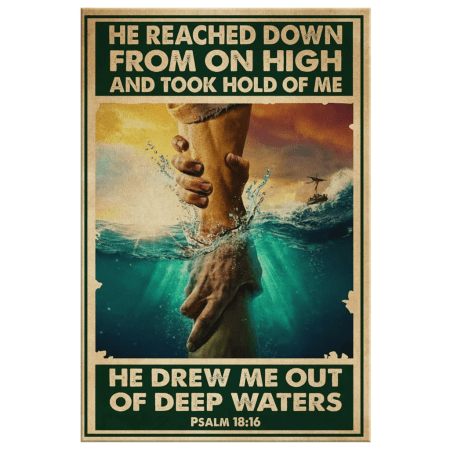
Are You Drowning?

painting of a person swimming underwater
“For we do not want you to be ignorant, brethren, of our trouble which came to us in Asia:

   2 Corinthians 1:8

“We should all fortify ourselves against the dark hours of depression by cultivating a deep distrust of the certainties of despair. Despair is relentless in the certainties of its pessimism.”
“But we have seen again and again, from our own experience and others’, that absolute statements of hopelessness that we make in the dark are notoriously unreliable. Our dark certainties are not sureties.”

John Piper

It is my deliberateness, and not the impulsiveness that scares me.   I know despair.  I know what it is like to be ‘backed into a corner’ and then feel a totally empty desperation.  But you must understand, there can also be a weird seductiveness to ‘being lost,’ a strange sort of nobility, a twisted kind of weird honor when it comes to despair.

Some people are convinced they are never going to change. They embrace the ‘dark certainties’ of knowing they are profoundly flawed and therefore damned. It’s these dear ones that Jesus especially came for.

Now, this really seems rather bizarre, that people could do this intentionally, deliberately.  But I’m afraid to tell you that it happens all the time.  Despair is chosen over the option of life. This is the ‘lostness’ of the race of Adam.

Perhaps suicide begins before the action? Perhaps it starts days, weeks or months before we actually do the deed?

Pop culture has given us words, albeit in a rather simplistic form.  I just happened to think right now of an old AC/DC  song, ‘Highway to Hell‘.  The lyrics are pretty basic and very simple, but the lead singer seems to really have a chronically, decided dedication to being one of the irretrievably lost. 

The songwriter formats a ‘certain glory’ to being part of the damned.  This is a simplistic approach to the next stop– a more advanced case of stark-white despair, suicide. (We can call this ‘spiritual hubris,’ or even, “sex, drugs, and rock-n-roll.”)

In dealing with sin we can make two mistakes. One is to make light of it. The other is to be overwhelmed, throw up our hands, and surrender.

When we decide to live this kind of living, we’re pulled into a vortex of a black melancholy with a dash of fatalism, which makes it reasonable and weirdly heroic in some perverse way. We love the dark, and we embrace a fatal life–it becomes our identity.

To escape this ‘drowning despair’ we must first dethrone our right to personal sovereignty.  And secondly, we need to grab the concept that God’s grace has an ultimate power that supersedes our notions of a ‘deserved’ love.  (It’s completely undeserved.)

We must believe that somehow, someway, God chooses us out of a pile–a pile of the worst and ugliest that has ever existed.  And somehow, He delights in doing this, and after all, He is the Lord.

We’re meant to be the people of true hope. 

Our problems, our addictions, force us to clearly renounce our evil folly of despair.  Our issues make us vulnerable.  I’ve discovered that there is a seductiveness to giving up and taking up the sin of despair.  There can be a ‘weird romance’ that lures those who walk out this living DEATH. 

But honestly, is it not even more heroic to live in hope? To live a life full of joy?

“Why are you downcast, O my soul? Why so disturbed within me?  Put your hope in God, for I will yet praise him, my Savior and my God. My soul is downcast within me; therefore I will remember you.”

Psalm 42:5-6