When He Questions You

  1. “But what about you?” he asked.
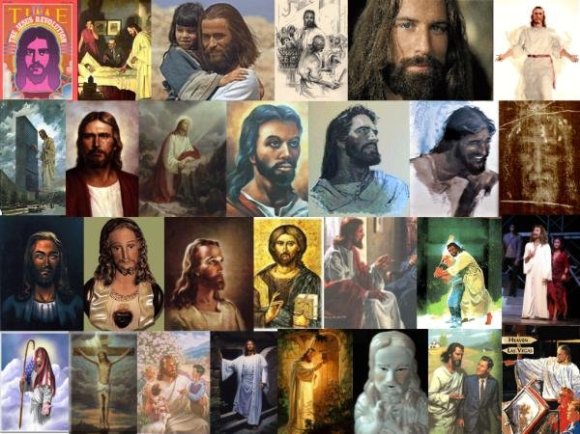
  2. “Who do you say I am?”

Matthew 16:15, NIV

I would suggest to you, that these two questions are quite pivotal and critical.  Nothing explains a man or woman more.  Nothing means more, or is of greater consequence than how you answer these two questions. One by one, we are led to this particular place, and it is required of us to explain ourselves.  And essentially that is what will happen.  We have to come to a decision.

“What about you?”  The first question asked, reduces us and causes us to come to a place of personal responsibility.  We dare not sidestep, or look for an emergency exit.  The issue, front and center is “you.”  It must be stated that questions like this one is not a way to stay popular.  You don’t win people’s hearts like this.  “What about you?”  In my mind this is a whole lot of personal decision-making.  Commitment is not easy.  (And if it is too easy, be very alert.)

The second question, “Who do you say that I am?” is masterful.  Jesus is speaking to those close disciples.  Essentially he is asking them to decide, once and for all, his placement into their lives. 

  • Is he a good teacher?
  • A healer?
  • A revolutionary or social catalyst?
  • A prophet?

He is all of these–but much more.  It’s interesting that Jesus never took a lesser position.  He was the “Son of God.”  He comes to us, and asks us to decide for ourselves.

The decision awaits us.  When we gather up information to evaluate him, it isn’t “Trivial Pursuit.”  Our decisions are quite significant and defining.  This here are the ultimate “fork in the road.”  Our lives will extrapolate out and then take us to places we never thought we would be.  Jesus knows this, he understands us.

In conclusion, another question.  Are you even ready to be addressed with these two ultimatums?  Are you in a “good place” where you are even approachable?  We all must go through this gauntlet of blazing truth, and decide for oneself.  Truly blessed is the person who will not stumble in this place of decision.

 “Today I have given you the choice between life and death, between blessings and curses. Now I call on heaven and earth to witness the choice you make. Oh, that you would choose life, so that you and your descendants might live!

Deut. 30:19, NLT
recite-25825-95458975-1jznxku

Coincidence: When God Hides

coincidence1

“‘O Sovereign Lord, you have only begun to show your greatness and the strength of your hand to me, your servant. Is there any god in heaven or on earth who can perform such great and mighty deeds as you do?”‘

Deuteronomy 3:24, NLT

I knew God had a sense of humor when I hesitantly answered the ringing K-Mart payphone, only to hear my best friend, who had misdialed my home phone number, on the other end.

When God really does speak, He will often use circumstance to align His grace and power to you. Seldom are we untouched by this work, but the act of our personal reflection turns it into gold.

Once I prayed for my young son who had a blazing fever. Five minutes later, I laid hands on him. He was completely cool; his fever had completely broken. He was well.

I think God can do these things, and more. This is really His control over circumstances, and events that we see as firmly set, and concretely beyond our own actions. But He moves miraculously intervenes. There comes a moment when all the cosmic tumblers fall into place, and the key can be turned; the door is opened.

Walking with friends from Alaska, we wormed our way down Telegraph Ave. in Berkeley. The streets and sidewalks were jammed, and our little village in Alaska was like on a different planet. Suddenly, my friend turned around to see his captain, the owner of his fishing boat come out a door of a coffee house and into the throng. Monte yelped and turned to meet his boss. They meet 5000 miles from home in one implausible moment.

These things seem a strange and supernatural “sequences of events.” But the Bible clearly teaches that one attribute of His nature is that of omnipotence. Another attribute is that of sovereignty. Together they teach us that God is fully in control and can do all things. He is so much more, but He is solidly in charge of His universe. And our lives.

 “How great you are, O Sovereign Lord! There is no one like you. We have never even heard of another God like you!;”

2 Samuel 7:22

“O Sovereign Lord, the strong one who rescued me,
    you protected me on the day of battle.”

Psalm 140:7

Coincidence is God’s way of remaining anonymous.

Albert Einstein

A “Zucchini-Blasted” Faith

Too much zucchini!
Too much zucchini!

I have been rightly branded as a pessimist.  My struggles are such that I must continue to press into joy, to continue over and over, shaking off the grave clothes, and step into the sunshine.  I need to spontaneously sing once in a while, and pick flowers. I know this.

For there’s an abundance in the kingdom of our Father.  The currency of that place is joy (and love).  The spiritual economy of heaven is solely based a free and lavish grace that is poured on criminals like me.  It’s outrageous!  And most of us do know it– far, far too well.

So fantastical are our perceptions of this awesome grace, that we can’t believe it is true.  It’s easy to doubt—to add things, make adjustments to this completely radical faith.  But as sick people we defy it all, and will often neuter the strong promises of God, making those verses eunuchs–without any power or vitality. I have done this repeatedly.

“And may you have the power to understand, as all God’s people should, how wide, how long, how high, and how deep his love is. 19 May you experience the love of Christ, though it is too great to understand fully. Then you will be made complete with all the fullness of life and power that comes from God.”

20″ Now all glory to God, who is able, through his mighty power at work within us, to accomplish infinitely more than we might ask or think.”

Ephesians 3:19-20, NLT

Knowing God’s love for you will totally change your life.  The promises in the Bible are additionally enhanced by the Spirit’s active presence.  When he enters your life, its like finding a 220 volt electrical line just when you have stepped out the shower.  You will be energized!  Watch the progression of thought in the very next verse.  It builds and broadens on this “grace thought.”

And God will generously provide all you need. Then you will always have everything you need and plenty left over to share with others.

2 Corinthians 9:8, NLT

zucchini3As I kid, I remember one year we hit the zucchini  jackpot.  They seemed to ripen all at once.  We canned and froze, but just couldn’t handle this harvest.  We gave away so much, until I resorted to putting full boxes in people’s cars– while they were in the store shopping! (Captain Zucchini strikes again!)

God is like that, we just would like our bucket filled and he fills up a dozen wheelbarrows for us.  We are super-abundantly, mammothly overwhelmed and “zucchinied-blasted” by forgiveness and grace.  This is just how things work in our Father’s Kingdom.

recite-25825-95458975-1jznxku

Two O’ Clock in the Morning Poetry, #7

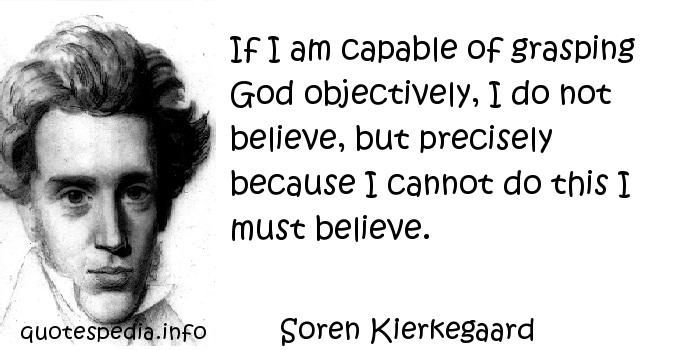
soren_kierkegaard_god_6322


Søren Aabye Kierkegaard (/ˈsɔrən ˈkɪərkəɡɑrd/ or /ˈkɪərkəɡɔr/Danish: [ˈsɶːɐn ˈkiɐ̯ɡəɡɒːˀ] ( listen)) (5 May 1813 – 11 November 1855) was a Danish philosophertheologianpoetsocial critic, and religious author who is widely considered to be the first existentialist philosopher.[5] He wrote critical texts on organized religionChristendommoralityethicspsychology and philosophy of religion, displaying a fondness for metaphor, irony and parables. Much of his philosophical work deals with the issues of how one lives as a “single individual”, giving priority to concrete human reality over abstract thinking, and highlighting the importance of personal choice and commitment.[6] He was a fierce critic of idealist intellectuals and philosophers of his time, such as Swedenborg,[7] HegelGoetheFichteSchellingSchlegel, and Hans Christian Andersen.

Kierkegaard’s Insight into Creative People

“A poet is an unhappy being whose heart is torn by secret sufferings, but whose lips are so strangely formed that when the sighs and the cries escape them, they sound like beautiful music and then people crowd about the poet and say to him: “Sing for us soon again;” that is as much as to say, “May new sufferings torment your soul.”‘

For a person who gives out creatively means to sweat drops of blood; it is torment that teaches us new words. Pain comes surely as the morning sun rises. There maybe a hint of duplicity as the patron sees the pain– but demands his art, nevertheless.

Søren Kierkegaard

Some of Kierkegaard’s key ideas include the concept of Truth as Subjectivity, the knight of faith, the recollection and repetition dichotomyangst, the infinite qualitative distinction,faith as a passion, and the three stages on life’s way. Kierkegaard’s writings were written in Danish and were initially limited to Scandinavia, but by the turn of the 20th century, his writings were translated into major European languages, such as French and German. By the mid-20th century, his thought exerted a substantial influence on philosophy,[16]theology,[17] and Western culture.[18]

Soren-Kierkegaard-quote“Revelation is marked by mystery, eternal happiness by suffering, the certitude of faith by uncertainty, easiness by difficulty, truth by absurdity; if this is not maintained, then the esthetic and the religious merge in common confusion. … The religious lies in the dialectic of inwardness deepening and therefore, with regard to the conception of God, this means that he himself is moved, is changed. An action in the eternal transforms the individual’s existence.”

This was part of Kierkegaard’s theory of “indirect communication.” He wrote:

“No anonymous author can more slyly hide himself, and no maieutic can more carefully recede from a direct relation than God can. He is in the creation, everywhere in the creation, but he is not there directly, and only when the single individual turns inward into himself (consequently only in the inwardness of self-activity) does he become aware and capable of seeing God.” Concluding Unscientific Postscript, Hong 1992 p. 243

Despite everything people ought to have learned about my maieutic carefulness, in addition to proceeding slowly and continually letting it seem as if I knew nothing more, not the next thing — now on the occasion of my new upbuilding discourses they will probably bawl out that I do not know what comes next, that I know nothing about sociality. You fools! Yet on the other hand I owe it to myself to confess before God that in a certain sense there is some truth in it, only not as men understand it — namely, that when I have first presented one aspect sharply, then I affirm the other even more strongly. Now I have my theme of the next book. It will be called: Works of LoveJournals of Soren Kierkegaard VIII 1A4 ~~source, Wikipedia

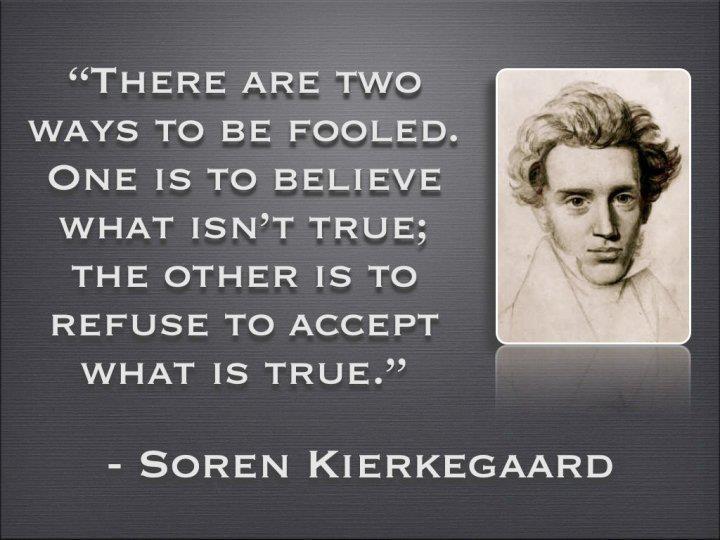
Soren-Kierkegaard_Design-Crush