First, You Die

I tell you the truth, unless a kernel of wheat is planted in the soil and dies, it remains alone. But its death will produce many new kernels—a plentiful harvest of new lives. 25 Those who love their life in this world will lose it. Those who care nothing for their life in this world will keep it for eternity.” 

John 12:24-25, NLT

flourish1

We kick it off with a basic knowledge of farming.  Not every farmer knows this, but all his seed sown in the ground will die.  Now it is possible this fact may discourage some, but the wise farmer accepts the dead seed, knowing that green growth will sprout from this death into a harvest of 1000x times or more for every dead seed.

“He that loves his life will lose it”.  This is one of the first ‘laws of the spirit’ we must learn.  It is the basis of so much that we have to know.  For years I have preached this message just before Easter Sunday.  “There can be no resurrection without a crucifixionThere is simply no resurrection power without crucifixion weakness”.

Alas, we must die before we can live.  There is no way around this, and no waiver can be given to avoid this truth.  You have to die, it is a profound necessity.  But often we become adept at ‘life support’ systems.  Doing what we can do to keep the ‘old man’ alive.  So much of what we find in religion is nothing more than a way to put the ‘old man’ on life support.

Unless we die, we will never, ever live.  If we try to save our life, we will die.  Choosing then to die is really your best option.  But what does that entail?  Every Christian is to submit to carrying his/her cross daily.  That cross is intended, not for a showy display, but to die upon.  Our self-life must choose to die, when we are ‘crossed’ by someone else.  Someone insinuates that something is wrong with us, and we die when we just humbly accept it without rancor or anger.

Resurrection life is what happens when we finally decide to die.  Doing so, we become incredibly fruitful for one.  We start to live the life Jesus had intended for us.  You will start to make the connections that were not possible before, you become spiritually diversified, reaching a very broad spectrum of people.

But most of all, the most of everything, you will connect with others on this fresh level.  Your spirituality will not become a hindrance to others.  In a very real way you’ll become like Jesus.  And that can’t be at all bad.

1brobry-sig

***

Fear God Only

fear god only

“—for you shall not worship any other god, for the Lord, whose name is Jealous, is a jealous God—”

Exodus 34:14

“And remember that the heavenly Father to whom you pray has no favorites. He will judge or reward you according to what you do. So you must live in reverent fear of him during your time as “foreigners in the land.””

1 Peter 1:17, NLT

flourish2

A frequent issue confronted by disciples is that between fear and faith.  The question posed to us concerns “fearing God”, and trusting Him.  Can intimacy be built on the foundation of fear?  Deep within, we understand the need for fear, at least a reverence.

We are now sons and daughters of a loving God who just happens to be holy and just. It’s as if our faith is reduced to an uneasy contact with someone who is quite dangerous. We don’t easily find the balance; it drives us to a false sense of relationship. Often we are either resentful and cower, or we blatantly disregard Him. (Or somewhere in between.)

Yet fear has a place.  Our Father reveals to us that He is not just some mere tribal deity over a specific group of people.  Rather, Jehovah God is the Creator, and the Sustainer of this terrestrial ball, and everything that works itself out in the here-and-now.  We are to fear, but with a legitimate fear.  He is a loving God who happens to hate sin and iniquity. These things continue to destroy His creation. It defiles all that is right and perfect. He would not be just, or right to overlook sin.

I am certain that He loves me with a “crazy-love”.  His affection for me pushes the boundaries of anything logical. He is not reasonable with His intense love.  He directed His Son to come for me, and lift me out of my ugliness, sinfulness and perversity.  His love goes beyond anything rational. But I fear Him. It is a fear that I might offend Him and somehow harm His kingdom. (That is a legitimate possibility, but it also strengthens me to obey Him.)

So, do I fear or do I love?  I think the wrestling with this will work itself into me.  It is fear and love combined, worked into my heart like yeast is worked in bread dough.  There will be a resulting effect. I have a faith that should grow this up. It needs to advance as I mature in Him. I choose to love Him fiercely, and fear Him conclusively.

aabryscript

A Deep Crisis of Faith

faith-mental-illness

Church response to the mentally ill

By Peter Andres

Are people of faith with a mental illness different from those who have a physical illness? Much about mental illness still remains a mystery. That’s one of the reasons people are tempted to spiritualize the problem. They hope that the person with mental illness would be able to gain spiritual strength and thus gain victory over the illness.

What remains hard for many to understand is that having a mental illness and being a strong person of faith is no different than having a serious physical illness and being a strong person of faith.

How can church leaders encourage support of people with a mental illness? What does a person with a mental illness need to help him or her feel accepted and part of the congregation? How does the Christian message and experience take on meaning under these circumstances? What exactly is mental illness, anyway?

Marja Bergen, in her book, Riding the Roller Coaster (Northstone, 1999), describes her experiences living with bipolar disorder. She talks about the many important factors that helped make her life with this illness tolerable and manageable. Having a supportive husband, friends, and service systems were critical, but she also acknowledges the importance of a spiritual home.

Her church friends learned to understand her illness and provided spiritual nurture, especially during difficult times. She speaks about friendships which include a common belief as being the most valuable ones she’ll have. But she also admits that she was fortunate in this regard.

Sadly, many people with mental illness who look for spiritual help during difficult times face ignorance, stigma, avoidance, and judgment. The spiritual counsel and prayer these people receive frankly do more harm than good.

Understanding mental illness, even from the professional, scientific perspective, is still very much a work in progress. Schizophrenia and its related disorders, bipolar disorder (also known as manic depression), major depression, panic and obsessive-compulsive disorders, are all considered mental illnesses. It is estimated that between 15 percent to 20 percent of North Americans will, at some time in their lives, experience a mental illness. Most of these will suffer debilitating depression.

Evidence suggests there are probably organic (biochemical) reasons for the illness, or psycho-social origins — or a combination of the two. Treatments that deal with the symptoms include medications, psychotherapy or a blend of both.

What is clear to people working in the field is that the experience of the illness goes far beyond living with the symptoms. While a person who has a physical illness — even cancer — suffers discomfort and anxiety related to the illness, those who have a mental illness suffer from a constellation of additional issues. These all affect their ability to return to wellness. One of them is stigma, both internally and externally imposed. There’s also the loss of self-worth and self-efficacy that might come with a loss of job, friends, marriage and the feelings of being separated from God.

How can the church assist someone in a situation as devastating as this?

1. Church leaders and church members need to know that a mental illness is not the same as a spiritual crisis. Nor is the absence of healing, especially after fervent prayer, a sign of judgment or lack of faith.

2. There should be no judgment about the use of mood altering medications. Medications are commonly needed to treat the bio-chemical causes for the disorder and radically help many keep their symptoms under control.

3. Quality of life for a person suffering from mental illness does not depend on a complete remission from the illness.

What church members need to know is that many experience a recovery which allows them to return to an active and fulfilling life — but still continue to experience times that are difficult. Recovery from mental illness means: the return of a positive sense of self, usually through meaningful endeavour (work, vocation), a circle of meaningful relationships, a place to live that the person can call his or her own, and a spiritual life that feels a reconnection with God.

The recovering person can be experiencing personal brokenness and limitations, yet have valuable gifts to offer to the church community.

Peter Andres is a regional director for MCC Supportive Care Services, a non-profit charitable organization which supports people with disabilities — including people with mental health issues. He can be contacted at peter@mccscs.com.


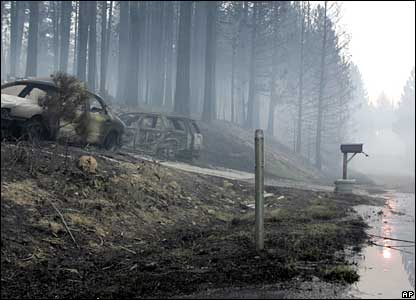
Charred Cinders

fire1
Aftermath of a forest fire in California

“When you pass through the waters, I will be with you;
And through the rivers, they will not overflow you.
When you walk through the fire, you will not be scorched,
Nor will the flame burn you.”

Isaiah 43:2, NASB

This will not be a typical commentary on this verse. (But it will be brief.)

The word I emphasize is “through.” I feel it is the salient point of the whole thought. Through implies a temporary state of being. We “pass through.” In a sense it is the state of being ‘between,’ and it is rarely, or ever comfortable.

Life is all about transitions– a job, children, marriage, health. We’re fine when things are steady and sure. However we feel the strain when things suddenly change. We are compelled to go through some things. Plain and simple. There are three simple things to think about.

  1. God is very present in those moments.
  2. Seldom do they vanish.
  3. They are never welcome.

The One who made the intricacies of our hearts stands by. Floods rage, trees float by. Fires get hot, and all becomes a blackened and charred cinder. Still God holds you. You will pass through this, and come out to the other side. Wiser and more compassionate.

recite-4295-45802551-tvf8xa (1)