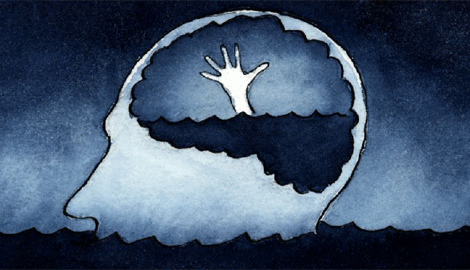
OCD: Rituals and Obsession

“I couldn’t do anything without rituals. They invaded every aspect of my life. Counting really bogged me down. I would wash my hair three times as opposed to once because three was a good luck number and one wasn’t. It took me longer to read because I’d count the lines in a paragraph. When I set my alarm at night, I had to set it to a number that wouldn’t add up to a ’bad’ number.”

“I knew the rituals didn’t make sense, and I was deeply ashamed of them, but I couldn’t seem to overcome them until I had therapy.”

“Getting dressed in the morning was tough, because I had a routine, and if I didn’t follow the routine, I’d get anxious and would have to get dressed again. I always worried that if I didn’t do something, my parents were going to die. I’d have these terrible thoughts of harming my parents. That was completely irrational, but the thoughts triggered more anxiety and more senseless behavior. Because of the time I spent on rituals, I was unable to do a lot of things that were important to me.”

People with obsessive-compulsive disorder (OCD) have persistent, upsetting thoughts (obsessions) and use rituals (compulsions) to control the anxiety these thoughts produce. Most of the time, the rituals end up controlling them.

For example, if people are obsessed with germs or dirt, they may develop a compulsion to wash their hands over and over again. If they develop an obsession with intruders, they may lock and relock their doors many times before going to bed. Being afraid of social embarrassment may prompt people with OCD to comb their hair compulsively in front of a mirror-sometimes they get “caught” in the mirror and can’t move away from it. Performing such rituals is not pleasurable. At best, it produces temporary relief from the anxiety created by obsessive thoughts.

Other common rituals are a need to repeatedly check things, touch things (especially in a particular sequence), or count things. Some common obsessions include having frequent thoughts of violence and harming loved ones, persistently thinking about performing sexual acts the person dislikes, or having thoughts that are prohibited by religious beliefs. People with OCD may also be preoccupied with order and symmetry, have difficulty throwing things out (so they accumulate), or hoard unneeded items.

Healthy people also have rituals, such as checking to see if the stove is off several times before leaving the house. The difference is that people with OCD perform their rituals even though doing so interferes with daily life and they find the repetition distressing. Although most adults with OCD recognize that what they are doing is senseless, some adults and most children may not realize that their behavior is out of the ordinary.

OCD affects about 2.2 million American adults, and the problem can be accompanied by eating disorders, other anxiety disorders, or depression.  It strikes men and women in roughly equal numbers and usually appears in childhood, adolescence, or early adulthood. One-third of adults with OCD develop symptoms as children, and research indicates that OCD might run in families.

The course of the disease is quite varied. Symptoms may come and go, ease over time, or get worse. If OCD becomes severe, it can keep a person from working or carrying out normal responsibilities at home. People with OCD may try to help themselves by avoiding situations that trigger their obsessions, or they may use alcohol or drugs to calm themselves.

OCD usually responds well to treatment with certain medications and/or exposure-based psychotherapy, in which people face situations that cause fear or anxiety and become less sensitive (desensitized) to them.

Source: http://www.nimh.nih.gov/index.shtml

cropped-christiangraffiti1 (1)

Traveling Mercies, [The Journey]

Things can get pretty grim just living life.  But add a disability, and suddenly blam! It gets worse.  A mental illness intensifies life, and the weird concoction of symptoms and hospitals, therapists and medications and family/friends is a bit daunting for anyone. Imagine, that it’s a bit like running through the wilderness slathered in ‘bacon grease,’ trying to stay ahead from the bears (I’m writing this from Alaska, hence the bear imagery, lol.)

My walk with Jesus has extreme variations (at least, on my part.)  I’m up, and then I’m down.  I’m on fire and then I’m cold.  I struggle to attempt at least a modicum of consistency, wishing I could just put two ‘good days’ together.  I am ashamed by this volatility.  The apostle Peter, or David are probably the only guys in scripture I can really understand.

The impulsivity of my mental illness has driven me to turn my credit cards over to Lynn.  I try to avoid liquor stores, porn sites, and urges to strip off my clothes and run down Pioneer Avenue.  I definitely try to go to Church, read the Bible and pray.  But I have been known to hallucinate, I hear things, and get awfully paranoid.  I’m always, it seems just one step ahead of my psychiatrist in avoiding the hospital.  (And I want to keep it that way.) And suicidality is an almost real monster– always lurking for me under my bed.

But I have also learned many other things from being a mentally ill believer:

  • When its really dark, His love always comes through. He understands me. He intentionally ‘looks’ for me. He’ll never quit on me.
  • My discipleship is not about the externals of my theology, but it’s about romance from my heart.
  • In my pathetic brokenness, He is my strength and my shield. Always.
  • Worship and prayer are more like invasive “medical procedures” that keep me alive.
  • Love. I’m learning to be kinder and more aware of others then ever before.
  • I want to live in the Light and respond to others in Christlike way. Never out of my fallen sinfulness.

I suppose I could add more, if I thought about it.  Ultimately, it all comes down to the presence of Jesus Christ coming to meet me, to forgive me and to change me.  This simple blog is saturated with posts that other Brokenbelievers can wade through, and some just might help, lol.

The title of this post alludes to a quote I found. I’ve gently modified it. Not sure where I found it. But it gives the explanation for all that I’ve said:

“Life should NOT be a journey to heaven with the
intention of arriving safely in an attractive and well
preserved body, but rather to skid in sideways,
with bruises and band-aids, and some tears as well, body thoroughly used up, totally worn out and screaming… “WOO HOO what a ride!”

bry-signat (1)

cropped-christiangraffiti1.jpg


Relapsing [Without Being a Moron About It]

 A Bumpy Road: Dealing with Relapse

There may not ever be a last episode, but there are ways to fend off and mitigate the next one.

By Jodi Helmer

Doctors never talked to Elly L. about RELAPSE.

Although she was hospitalized during a manic episode and diagnosed with bipolar disorder, doctors never mentioned that it could happen again. Instead, Elly was stabilized, handed a prescription for mood stabilizers and discharged. She had no idea that she’d be battling mania and depression for the rest of her life.

“I was told that as long as I took my medications, I’d be okay,” recalls Elly, a mental health coach in Toronto, Ontario.

Elly experienced at least eight relapses between her diagnosis in 1978 and 1991. Each time, she was hospitalized, often placed in restraints and taken to the psychiatric ward in a police car or ambulance. Upon discharge, Elly always promised herself it would be her last hospital admission-but she had no idea how to stave off future relapses.

In bipolar disorder, relapse is defined as the return of depression or a manic or hypomanic episode after a period of wellness. According to a 1999 study published in the American Journal of Psychiatry, 73 percent of those diagnosed with bipolar disorder experienced at least one relapse over a five-year period; of those who relapsed, two-thirds had multiple relapses.

“You can never say that someone with bipolar disorder has had their last episode; relapse is part of the illness,” explains Alan C. Swann, MD, professor and vice chair for research in the Department of Psychiatry and Behavioral Sciences at The University of Texas Medical School at Houston and director of research for the University of Texas Harris County Psychiatric Center. “Relapse is self-perpetuating; once it happens, the more likely it is to happen again.”

Searching for Answers

It’s possible to do all of the right things- follow a proper medication regimen, eat well, exercise, minimize stress and get enough sleep-and still experience relapse. Unfortunately, there is no clear understanding of why this happens.
“There may be changes in the cellular level that cause cycling but their cause is unknown,” says Joseph R. Calabrese, MD, director of the Mood Disorders Program at the Case Western Reserve University School of Medicine in Cleveland, Ohio.

While the neurological causes of relapse are unknown, a few things are certain: Those who are diagnosed with bipolar II are more likely to relapse than those with bipolar I. Their episodes of depression, mania or hypomania are often shorter than the episodes experienced by those with bipolar I but tend to return more often, according to Calabrese. It’s also far more common to relapse into depression than into mania or hypomania. Calabrese estimates that in bipolar II, there is a 40-to-1 ratio of depression to mania; the ratio of depression to mania drops to 3-to-1 in bipolar I.

“The key to recovery is a low tolerance for relapse,” says Calabrese.

In fact, Dr. Roger S. McIntyre, MD, associate professor of psychiatry and pharmacology at the University of Toronto and head of the Mood Disorders Psychopharmacology Unit at the University Health Network, believes that even the mildest symptoms of depression and mania should be treated as potentially hazardous.

“The takeaway message is that we need to seek complete elimination of symptoms as our treatment objective,” he says…

Click here to read the full article, “A Bumpy Road: Dealing with Relapse”

“bp Magazine” is a wonderful “shot in the arm.”  I would suggest that you get a subscription, and for a friend as well.

 cropped-cropped-cropped-christiangraffiti1-11.jpg

Join NAMI today!

When you become a member of NAMI, you become part of America’s largest grassroots organization dedicated to improving the lives of persons living with serious mental illness. And now you can join online.

http://www.nami.org/template.cfm?section=About_NAMI

The Inertia, [Apathy]

Customer-Inertia-2

“Science may have found a cure for most evils; but it has found no remedy for the worst of them all – the apathy of human beings.”

Helen Keller

—————————————-

As I suffer with manic depression I have come to see that much grief comes not from mania, and not from the debilitating depression. These are both substantial, but my biggest issue has to do with the inertia that lies between these two poles. There is a paralysis– an apathy that immobilizes me. And this is as bad as any other state of mind.

“And Elijah came to all the people, and said, “How long will you falter between two opinions? If the Lord is God, follow Him; but if Baal, follow him.” But the people answered him not a word.”

1 Kings 18:21

My passivity is disturbing, and bipolar disorder is as much of “detachment” as it is of extremes. I sit and stare, not able to motivate myself to get up and do something. I’m not really depressed, but nor am I manic– I’m just “there” unable to find energy to do anything. Life just rolls over me.

Perhaps the most deadly sin is this “faltering between two opinions?” We are content to just sit and watch with no commitment. We’re content to let things just roll on by as we sit in our inertia and passiveness. This is the part of my BP that scares me the most (or at least it should.)

If you suddenly went up in flames I wouldn’t stir. Yes, it would get my attention, but I probably wouldn’t do anything, (I’d probably just take notes for my book.)

Inertia is not just a part of a mental illness. It effects normal people as well, and there are degrees of it. The average person it seems will avoid making a real decisive decision at all costs. Inertia can be encountered in any church (ask a pastor who tries to get volunteers) or workplace.

In his day, Elijah cried out for a decision from the Israelite people. I have to believe he was disturbed not only by the idolatry– but by the passiveness of the bystanders. Their neutrality was a big issue.

Joshua would call out to a passive people these words:

“But if you refuse to serve the Lord, then choose today whom you will serve. Would you prefer the gods your ancestors served beyond the Euphrates? Or will it be the gods of the Amorites in whose land you now live? But as for me and my family, we will serve the Lord.”

Joshua 24:15

I know my own heart, and I know my own spiritual paralysis. Rather than commit myself, I would rather settle down on a sofa and just let things happen. I’m quick to point out how those in the arena are doing it all wrong. I’m ready to criticize, but unwilling to volunteer.

Mental illness is filled with ordinary things, but often in the wrong proportions. When we do things it is extreme or not at all. My own apathy is just a mirror of what happens in the hearts of normal people.

I may be excessive, but my own issues have made me aware of what is happening in others.

—————————————–

“It is not the critic who counts; not the man who points out how the strong man stumbles, or where the doer of deeds could have done them better. The credit belongs to the man who is actually in the arena, whose face is marred by dust and sweat and blood; who strives valiantly; who errs, who comes short again and again, because there is no effort without error and shortcoming; but who does actually strive to do the deeds; who knows great enthusiasms, the great devotions; who spends himself in a worthy cause; who at the best knows in the end the triumph of high achievement, and who at the worst, if he fails, at least fails while daring greatly, so that his place shall never be with those cold and timid souls who neither know victory nor defeat.”

–Theodore Roosevelt

bry-signat (1)

cropped-christiangraffiti1.jpg