We’re Pretty Much Scum

a1705366707_10

“To this very hour we go hungry and thirsty, we are in rags, we are brutally treated, we are homeless. 12 We work hard with our own hands. When we are cursed, we bless; when we are persecuted, we endure it; 13 when we are slandered, we answer kindly. We have become the scum of the earth, the garbage of the world—right up to this moment.”

1 Corinthians 4:11-13, NIV

The apostle Paul isn’t ashamed to be called ‘scum.’ He realizes that this is his ‘standing’ in this world’s opinion. He is regarded as a nobody and of little value by the ‘powers-that-be.’ A tension exists between the believer and the world system. The expectations that the world has is part of the package that we have been given. The message of the Cross is the ultimate foolishness. Jesus told his own disciples that:

“If the world hates you, remember that it hated me first. 19 The world would love you as one of its own if you belonged to it, but you are no longer part of the world. I chose you to come out of the world, so it hates you.”

John 15:18-19, NLT

 The world hates us because we belong to Jesus.

It is his reproach we bear. We should not see the trial and sorrows as our issue, and we shouldn’t get upset by the world’s snub. The tension is real and we can expect being ostracized. In fact, we might do well to be concerned if we don’t see it.

After all, hatred is such a hard word.

And the stigma should humble us— it has a supernatural origin. We shouldn’t expect otherwise. To follow Jesus means we will only experience what he is already gone through. Some of us will follow him even to martyrdom. The hardships and challenges do not invalidate our walk, rather they confirm what he said would happen. The world is under seige by Satan,  it is his spirit that controls the unbelieving world.

“Here on earth you will have many trials and sorrows. But take heart, because I have overcome the world.”

John 16:33

*********

Father of all comfort, please come to your servants who are suffering for their faith in you. Meet them and hold them close to you. Give them boldness and awareness. Seek them out and make them your witnesses in a hostile world. Give them the Spirit of Jesus and help them overcome by their love. ~In Jesus Name, Amen


bry-signat (1)


Pulling the King’s Carriage

A post of prophetic meaning especially for younger Christians.

“Before God can commit a ministry into a person’s hands they must submit themselves to the discipline of the Lord letting Him truly be the Lord of their entire lives. We have long since dealt with the question of open sin but now God is dealing with the inward rebellion of our own wills.” 
by Bill Britton

“I SAW THE KING’S CARRIAGE “

On a dirt road in the middle of a wide field stood a beautiful carriage, something on the order of a stagecoach but all edged in gold and with beautiful carvings. It was pulled by six large chestnut horses: two in the lead, two in the middle and two in the rear. But they were not moving, they were not pulling the carriage, and I wondered why. Then I saw the driver underneath the carriage on the ground on his back just behind the last two horses’ heels working on something between the front wheels on the carriage. I thought, “My, he is in a dangerous place; for if one of those horses kicked or stepped back, they could kill him, or if they decided to go forward, or got frightened somehow, they would pull the carriage right over him.”

But he didn’t seem afraid for he knew that those horses were disciplined and would not move till he told them to move. The horses were not stamping their feet nor acting restless, and though there were bells on their feet, the bells were not tinkling. There were pom-poms on their harness over their heads but the pom-poms were not moving. They were simply standing still and quiet waiting for the voice of the Master.

THERE WERE TWO YOUNG COLTS IN THE FIELD 

As I watched the harnessed horses I noticed two young colts coming out of the open field and they approached the carriage and seemed to say to the horses: “Come and play with us, we have many fine games, we will race with you, come catch us.” And with that the colts kicked up their heels flicked their tails and raced across the open field. But when they looked back and saw the horses were not following they were puzzled. They knew nothing of the harnesses and could not understand why the horses did not want to play. So they called to them: “Why do you not race with us? Are you tired? Are you too weak? Do you not have strength to run? You are much too solemn, you need more joy in life.” But the horses answered not a word nor did they stamp their feet or toss their heads. But they stood, quiet and still, waiting for the voice of the Master. 

Again the colts called to them: “Why do you stand so in the hot sun? Come over here in the shade of this nice tree. See how green the grass is? You must be hungry, come and feed with us, it is so green and so good. You look thirsty, come drink of one of our many streams of cool clear water.” But the horses answered them not so much as a glance but stood still waiting for the command to go forward with the King.

COLTS IN THE MASTER’S CORRAL 

And then the scene changed and I saw lariat nooses fall around the necks of the two colts and they were led off to the Master’s corral for training and discipline. How sad they were as the lovely green fields disappeared and they were put into the confinement of the corral with its brown dirt and high fence. The colts ran from fence to fence seeking freedom but found that they were confined to this place of training. And then the Trainer began to work on them with His whip and His bridle. What a death for those who had been all their lives accustomed to such a freedom! They could not understand the reason for this torture, this terrible discipline. What crime had they done to deserve this? Little did they know of the responsibility that was to be theirs when they had submitted to the discipline, learned to perfectly obey the Master and finished their training. All they knew was that this processing was the most horrible thing they had ever known.

SUBMISSION AND REBELLION 

One of the colts rebelled under the training and said, “This is not for me. I like my freedom, my green hills, my flowing streams of fresh water. I will not take any more of this confinement, this terrible training.” So he found a way out jumped the fence and ran happily back to the meadows of grass. I was astonished that the Master let him go and went not after him. But He devoted His attention to the remaining colt. This colt though he had the same opportunity to escape decided to submit his own will and learn the ways of the Master. The training got harder than ever but he was rapidly learning more and more how to obey the slightest wish of the Master and to respond to even the quietness of His voice. And I saw that had there been no training, no testing, there would have been neither submission nor rebellion from either of the colts. For in the field they did not have the choice to rebel or submit, they were sinless in their innocence. But when brought to the place of testing and training and discipline, then was made manifest the obedience of one and the rebellion of the other. And though it seemed safer not to come to the place of discipline because of the risk of being found rebellious, yet I saw that without this there could be no sharing of His glory, no Sonship.
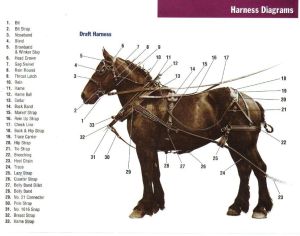
INTO THE HARNESS 

Finally this period of training was over. Was he now rewarded with his freedom and sent back to the fields? Oh no. But a greater confinement than ever now took place as a harness dropped about his shoulders. Now he found there was not even the freedom to run about the small corral for in the harness he could only move where and when his Master spoke. And unless the Master spoke he stood still.

The scene changed and I saw the other colt standing on the side of a hill nibbling at some grass. Then across the fields, down the road came the King’s carriage drawn by six horses. With amazement he saw that in the lead, on the right side, was his brother colt now made strong and mature on the good corn in the Master’s stable. He saw the lovely pom-poms shaking in the wind, noticed the glittering gold bordered harness about his brother, heard the beautiful tinkling of the bells on his feet — and envy came into his heart. Thus he complained to himself: “Why has my brother been so honored, and I am neglected? They have not put bells on MY feet nor pom-poms on MY head. The Master has not given ME the wonderful responsibility of pulling His carriage, has not put about ME the gold harness. Why have they chosen my brother instead of me?” And by the Spirit the answer came back to me as I watched: “Because one submitted to the will and discipline of the Master and one rebelled, thus has one been chosen and the other set aside.”

flourish2

Continue reading “Pulling the King’s Carriage”

To Be Despised by All, but God

I’m working my way through Ezekiel in the Old Testament, and before that I was reading Jeremiah. These are challenging books to read and to apply to our daily lives. Here and there is a nugget with direct – and easy – application, but I think these books are there for a much bigger purpose. The Old Testament prophets show us what is important to God. As I read, I find that God is concerned with two things:

  1. That His people trust in Him, and not in idols of their own making. This seems reasonable, since He alone is trustworthy. An idol made of stone or gold – or as we often trust in these days, of paper in the form of money and stocks – cannot protect us or provide a sure and trustworthy future. Only God can do that.
  2. That His people care for the “widow and the orphan,” that is, the less fortunate of society who are in need of a helping hand. This seems reasonable, too, since those of us who have been blessed should not find it a burden to bless others in return.

These are simple principles. When asked what the greatest commandment was, Jesus echoed these two principles when He answered, “’Love the Lord your God with all your heart and with all your soul and with all your mind.’ This is the first and greatest commandment. And the second is like it: ‘Love your neighbor as yourself.’”

Matthew 22:37-38 (NIV).

And yet the prophets were hated and ridiculed for telling the Israelites that they would suffer and were suffering exile and death, war and famine, because they failed to follow these two simple principles. Instead of loving and trusting the God who had seen them through so much and protected them, they trusted in idols and the ways of their neighbors. Instead of loving their neighbors and caring for the downtrodden, they cared only for their own gain and gluttony. The Israelites were warned over and over by the prophets. I believe that the message of the prophets – that these two principles are paramount – is just as relevant for our world today as it was for ancient Israel.

The other day I received this wonderful quote in my Quotemeal email from Heartlight.org. I believe it illustrates not only the struggle the Old Testament prophets faced, but also the struggle those who trust in Christ alone for salvation and seek to share His expectation that we love our neighbors with the world face today.

“To be forged upon the anvil of God’s purpose, to be at once His hammer, His tongs, and His molten iron; to hear words that rend the heart, see visions that pierce the chest; to be emptied like an urn, again and again and again until one desires only rest, only an end to the refilling — and to know one cannot live without the refilling. To be given words that one dare not speak, and to feel those words churning and boiling in the belly until one must speak them aloud, or die. To be despised, soon or late, by everyone except Adonai — and to desire it so, while hating it. This is to be a prophet.”

— Thom Lemmons

I’m not suggesting that I am a prophet, but there have been times in my life when I was compelled to speak, or to write, words I did not wish to say or write. I have had words churn and boil in my mind and in my heart, felt the fear of saying or writing them, but had to push through that fear and let those words fly and land wherever God desires.

Just writing that last paragraph makes it seem all so dramatic, but really it just is. Sometimes I don’t push through the fear and I fail to share the words that are on my heart. Although I have not yet died as a result, a small part of my spiritual growth does whither. Perhaps my faith would be stronger and more souls would have been saved if I had always spoken up.

But, in the end, I know that God loves me and knows I am being sanctified daily, though sometimes more slowly than I would like.


Love, Linda


Linda’s blog is at http://lindakruschke.wordpress.com/.  Please check out all she has to say.  Linda tells me that it is absolutely guaranteed to bless, or your money back!


But I Do It Anyway

A collapsed church, a struggling life

“And I know that nothing good lives in me, that is, in my sinful nature. I want to do what is right, but I can’t.  I want to do what is good, but I don’t. I don’t want to do what is wrong, but I do it anyway. But if I do what I don’t want to do, I am not really the one doing wrong; it is sin living in me that does it.”

Romans 7:18-20, NLT

I hesitate to tell you this, but I have not found any hidden secrets to becoming a holy person.

To be sure, I wish I had figured this out sooner. I would very much like to come to you with the secret formula of godliness. I would easily latch on to this idea of a “magic wand” for every hurt. I think it would be good–and then again, maybe not. I’m certain it would be too much power for me to wield.

But the authentic Christian life is hardly formulaic. It seems to defy any attempt to explain, and then guide anyone else into that special place of true obedience or holiness. I’m supposing that you are just like me. I truly want to be right. I would love to be holy. But it ain’t happening. I always seem to end up back in the place I started from. Always, defeat and failure. (Rats!)

Romans 7 is not an excuse to sin, but it seems to be an observation of our present condition.

I’ve always been mystified by the conundrum that is Romans 7. You see, I really want chapter 8, but I’ll settle for 6, and even 5 would be good. But poor Romans 7 never gets considered. It’s been in limbo, I don’t really know what to do with it. (I honestly avoid it, after all chapter 8 is so good!) But way deep down, I have a strong sense I’m missing something vital and important.

Many good teachers and preachers view chapter 7 as parenthetical. They suggest that Paul is describing his life before coming to Christ, and certainly not in a ‘present-tense’ discipleship. (Definitely a brain-twister.)

When I look at the Gospels, I see, across the board that those– the healed, forgiven, cleansed and made whole were always the most desperate. They have nothing, they bring nothing– they meet no requirement, but stepping out into pure poverty. They are the “zeroes.”

I don’t believe, at this point anyway, that there is a singular doctrine of sanctification.

Perhaps we can truly do nothing in precise alignment. There is no such thing as a microwavable discipleship, and no instant breakfasts to be had. We truly come with a desperate faith– and we will end up with just a desperate faith.

This should be incredibly humbling to us all. It seems it takes some real repetitive lessons to learn humility as we meander down the way of God’s road of discipleship.

“I have discovered this principle of life—that when I want to do what is right, I inevitably do what is wrong. I love God’s law with all my heart. But there is another power within me that is at war with my mind. This power makes me a slave to the sin that is still within me. Oh, what a miserable person I am!”

Romans 7:21-24, NLT

Please (someone?– anyone?!) challenge me on this. I tell you, chapter 7 chafes, and then disrupts my comfortable life. Will I always be so misaligned? Or am I just a lousy excuse for a Christian disciple? If I’m out of line and screwed up– please let me know. “Simon Peter answered him, “Lord, to whom shall we go? You have the words of eternal life,” (John 6:68.)  This happens to be my cry at this present moment.

“The power of the Church is not a parade of flawless people, but of a flawless Christ who embraces our flaws. The Church is not made up of whole people, rather of the broken people who find wholeness in a Christ who was broken for us.”

–Mike Yaconelli

%

bry-signat-1-1