Relapsing [Without Being a Moron About It]

 A Bumpy Road: Dealing with Relapse

There may not ever be a last episode, but there are ways to fend off and mitigate the next one.

By Jodi Helmer

Doctors never talked to Elly L. about RELAPSE.

Although she was hospitalized during a manic episode and diagnosed with bipolar disorder, doctors never mentioned that it could happen again. Instead, Elly was stabilized, handed a prescription for mood stabilizers and discharged. She had no idea that she’d be battling mania and depression for the rest of her life.

“I was told that as long as I took my medications, I’d be okay,” recalls Elly, a mental health coach in Toronto, Ontario.

Elly experienced at least eight relapses between her diagnosis in 1978 and 1991. Each time, she was hospitalized, often placed in restraints and taken to the psychiatric ward in a police car or ambulance. Upon discharge, Elly always promised herself it would be her last hospital admission-but she had no idea how to stave off future relapses.

In bipolar disorder, relapse is defined as the return of depression or a manic or hypomanic episode after a period of wellness. According to a 1999 study published in the American Journal of Psychiatry, 73 percent of those diagnosed with bipolar disorder experienced at least one relapse over a five-year period; of those who relapsed, two-thirds had multiple relapses.

“You can never say that someone with bipolar disorder has had their last episode; relapse is part of the illness,” explains Alan C. Swann, MD, professor and vice chair for research in the Department of Psychiatry and Behavioral Sciences at The University of Texas Medical School at Houston and director of research for the University of Texas Harris County Psychiatric Center. “Relapse is self-perpetuating; once it happens, the more likely it is to happen again.”

Searching for Answers

It’s possible to do all of the right things- follow a proper medication regimen, eat well, exercise, minimize stress and get enough sleep-and still experience relapse. Unfortunately, there is no clear understanding of why this happens.
“There may be changes in the cellular level that cause cycling but their cause is unknown,” says Joseph R. Calabrese, MD, director of the Mood Disorders Program at the Case Western Reserve University School of Medicine in Cleveland, Ohio.

While the neurological causes of relapse are unknown, a few things are certain: Those who are diagnosed with bipolar II are more likely to relapse than those with bipolar I. Their episodes of depression, mania or hypomania are often shorter than the episodes experienced by those with bipolar I but tend to return more often, according to Calabrese. It’s also far more common to relapse into depression than into mania or hypomania. Calabrese estimates that in bipolar II, there is a 40-to-1 ratio of depression to mania; the ratio of depression to mania drops to 3-to-1 in bipolar I.

“The key to recovery is a low tolerance for relapse,” says Calabrese.

In fact, Dr. Roger S. McIntyre, MD, associate professor of psychiatry and pharmacology at the University of Toronto and head of the Mood Disorders Psychopharmacology Unit at the University Health Network, believes that even the mildest symptoms of depression and mania should be treated as potentially hazardous.

“The takeaway message is that we need to seek complete elimination of symptoms as our treatment objective,” he says…

Click here to read the full article, “A Bumpy Road: Dealing with Relapse”

“bp Magazine” is a wonderful “shot in the arm.”  I would suggest that you get a subscription, and for a friend as well.

 cropped-cropped-cropped-christiangraffiti1-11.jpg

Join NAMI today!

When you become a member of NAMI, you become part of America’s largest grassroots organization dedicated to improving the lives of persons living with serious mental illness. And now you can join online.

http://www.nami.org/template.cfm?section=About_NAMI

Different Ways to Fall Out of a Tree

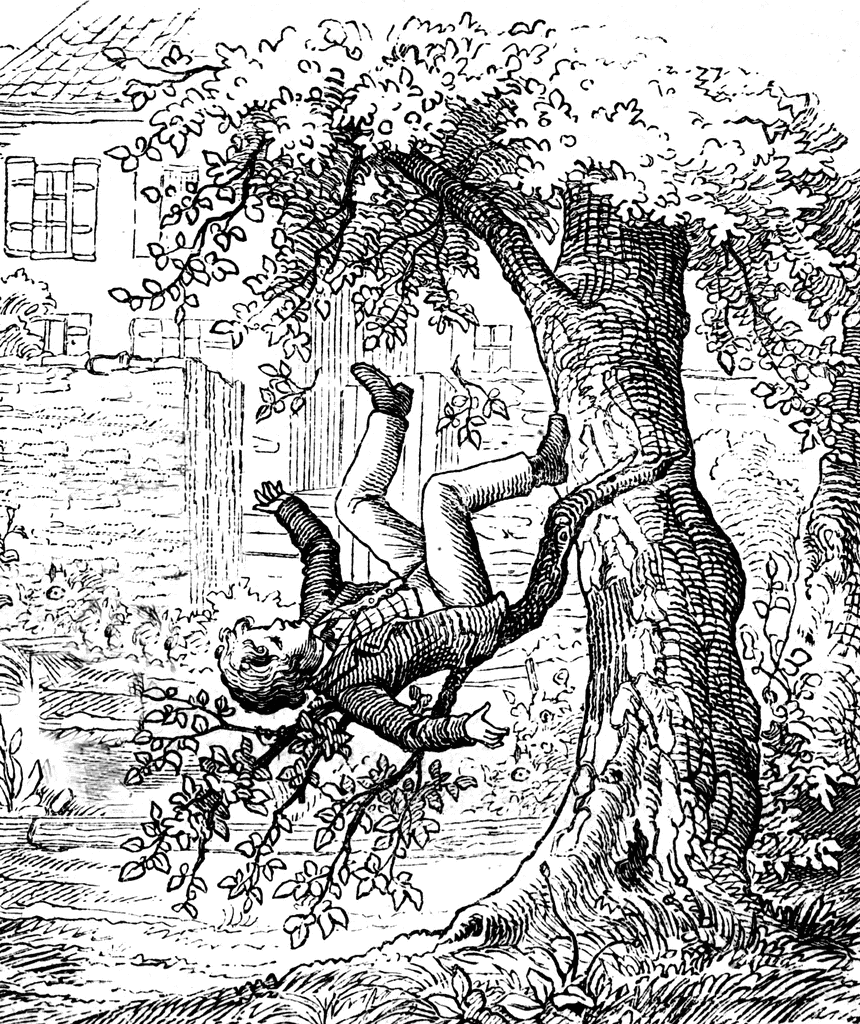
boy-falling
Imagine climbing up to the top of a very tall tree. You work your way up to the highest point– you can go no further. The view is completely glorious, it’s more than you hoped for. You want to post it on Facebook, so you dig into your pocket to get your camera-phone. You suddenly slip, and because your arms are occupied getting your camera, you fall. And you fall fast.

As you plummet, you realize that you’re hitting every branch on the way down. The smaller ones break, and the bigger ones, well– you just bounce off. The trip down is very fast, and perhaps even a bit illuminating.

  1. First, you think of death.
  2. Then you think about the pain each branch causes, and wonder about your imminent arrival on terra firma.
  3. Perhaps you consider how stupid you are, and how you are going to explain it.
  4. Lastly, I suppose, you wonder if you have clean underwear on, like your mother always told you to wear.

This is how my life has gone, the last 20 years. This metaphor is a good way for me to process things, and to find some understanding. I now believe that some of us go through life sideways, or horizontal. We careen off of every branch on the way down, and it seems we are hitting branches that we didn’t even know were there. Tree limbs are snapping, as we are dropping.

Others who are wiser (or maybe more experienced,) try to fall more vertically. As they fall, they use their hands to try to slow their descent. (This does work!) They will take their fair share of jolts, no doubt. But their journey to the forest floor is way less traumatic. They may end up in the hospital– but not in emergency surgery like the first guy.

It sometimes seems like every trouble I have faced I have gone into it sideways. I have broken a lot of branches on my way down. I suppose I’ve entertained some who have watched me plummet, and seen me careen and spiral my way to the bottom. These have been some painful times, I have inflicted considerable amount of bruises on myself.

People who go through life sideways will invariably suffer. They seem to hit every obstacle and trial that could be in their flight path. The existence of pain in this life cannot be disputed.

“I have told you all this so that you may have peace in me. Here on earth you will have many trials and sorrows. But take heart, because I have overcome the world.”

John 16:33, NLT

Jesus understands. Especially if you are one of those people who are “trial magnets” going through life horizontal. (You just seem to collect them.) My hope for you that as you break your branches on the way down (for maybe the 100th time). You will try to plummet vertically. Not that it is any easier, life will hurt. But perhaps it won’t be as agonizing. And I suppose that would be a good thing.

“Now unto him that is able to keep you from falling, and to present you faultless before the presence of his glory with exceeding joy,”

Jude 24

Just hanging on!bry-signat (1)

cropped-christiangraffiti1.jpg


kyrie elesion.

Led Aside by Jesus, [Consideration]

“He took the blind man by the hand and led him outside the village. When he had spit on the man’s eyes and put his hands on him, Jesus asked, “Do you see anything?”

–Mark 8:23, NIV

Here I can imagine the gentleness and the kindness of Jesus–we see Him leading this man out of town to a quieter place. Showmanship?  Not on your life.  Jesus has made the decision to avoid the theatrics of a blind man given sight, and ducked the paparazzi for a moment to touch this man.

In a way, we are all like this blind man.  We stumble around and try to make our way.  But it is raucous confusion– the fields of philosophy, religion, psychology, politics and art are not much more than a blind men tapping with his cane, trying to find their way into the light.  This may be rather simplistic, but I believe it’s more true then we care to admit.  The entire social history of humans is based on confusion and conflict.

We grope in the gloom, and there is none to take our hand and lead us out of the darkness.  We stumble and fall, and come no closer to understanding then when we first started.  It is hopeless.  Our striving borders on madness and insanity.

The blind man in Mark 8 entrusted himself to Jesus’ care.  He willingly went with Jesus, following down the path and out of the village.  Jesus carefully leads him by the hand, which is quite remarkable.  (I guess I’m envious.)  Jesus would have led this man past every obstacle.

Each of us have to encounter Jesus for ourselves.

We are born blind, having no awareness (zero, zilch, nada) of spiritual truth.  We must be taught to see.  At the airport in Salt Lake City recently, I saw a young blind man being led through large crowd.  I was fascinated by his trust in his guide as people jostled to try to make their connections.  There was a quiet composure in him.  (In his place, I would be terrified.)

We must trust Jesus, with that same composure and grace.  When we cannot see, we must trust.

“I do not try to see my way,
Before, behind, or left, or right;
I cannot tell what dangers gray
Do haunt my steps, nor at what height
Above the sea my path doth wind:
For I am blind. 

“Yet not without a guide I wend
My unseen way, by day, by night;
Close by my side there walks a Friend,——
Strong, tender, true: I trust His sight;
He sees my way before, behind,
Though I am blind.”

by an Unknown Author

bry-signat

cropped-christiangraffiti1-3


So You Wanna Go Back to Egypt?


1867_edward_poynter_-_israel_in_egypt

God has always wanted to lead His people. I think that He is almost catatonic with joy when we allow Him to do this. Throughout the ages, and all through Israel’s history, we see Him reaching out to people,  who are stubborn and selfish in their choices. But He reaches out to them anyway.

Israel had been sovereignly led out of Egypt. Miracle after miracle had made this happen. A dramatic exodus from slavery would make the front page that day. People from every generation would know that God was setting His people free.

God didn’t tell them the way, but rather showed them the path Himself. He led them with “a cloud by day and a pillar of fire by night” (Exodus 13:20-22). The people, however, repeatedly refused to trust their Deliverer-Shepherd. They hardened their hearts and rebelled against Him.

“Our fathers were unwilling to be obedient to him, but repudiated him and in their hearts turned back to Egypt, 40 saying to Aaron, ‘Make for us gods who will go before us; for this Moses who led us out of the land of Egypt—we do not know what happened to him.’”

Acts 7:39-40, NASB

They made the choice themselves, they would turn around. They would go back in slavery to Egypt. (Actually in their hearts, they had already done so!) They were rejecting and renouncing God, and turning their backs on Him.

But we are given what we want. Even if it takes us into bondage again.

When we begin to follow, God starts to lead. He takes an active role to guide and direct us, and to bring us into victory. When we try to go back to Egypt, we will experience His discipline.

“So Christ has truly set us free. Now make sure that you stay free, and don’t get tied up again in slavery…” 

Galatians 5:1, NLT

“Because of their unbelief they were not able to enter His rest” (Hebrews 3:19). Then the author draws a clear distinction: “They didn’t share the faith of those who listened to God. For only we who believe can enter His rest” (Hebrews 4:2-3).

There is a wonderful and real rest. But I am tempted to turn back. Will I decide to let God lead me?

1brobry-sig4 (2)

k

k

cropped-christiangraffiti1-3-1