Love is an Action Verb

When I first started writing this post in my head, before I had posted it on my blog, Linda Kruschke’s Blog, back in 2009, in my head the title was “Love Is an Action Verb.” But as I thought more about it I realized there is more than one kind of love, and that love AS as an action verb was just one – and in my opinion the best – form of love.

In our impoverished English language, we use the word love in many different ways. I love my spouse, I love my dog, I love chocolate, I love my new shoes, I loved that movie I watched last night, and I love God.

Surely we don’t have the same feelings about all of these things, yet we use the same word. In the parts of the Bible that were originally written in Greek, there are four different Greek words that we translate as love:

  • Storge – refers to the love that is felt between family members and close relatives.
  • Philia – refers to the love that is between friends.
  • Eros – refers to deep emotion or passion that is felt between lovers and spouses.
  • Agape – refers to the kind of love that God has for us and is what I mean by love as an action verb.

Agape is a kind of love that is about giving, not about getting.

God showed us what agape is by His incarnation as Jesus Christ and by His death on the cross to pay for our sins. Agape is not just a feeling, it is what God is. He acts towards us in the way that He does not because of how He feels about us, but because of who He is; because He chooses to love us with agape love.

Agape is a type of love that we can, if we choose, combine with any one of the other three kinds of love. We can go beyond how we feel about others and truly love them in the way that God loves us. C.S. Lewis put it this way in his wonderful book Mere Christianity:

“The rule for all of us is perfectly simple. Do not waste time bothering whether you love your neighbor; act as if you did. As soon as we do this we find out one of the great secrets. When you are behaving as if you loved someone, you will presently come to love him.”

Agape and Philia

A couple of years ago, I went to the beach with some old friends and had an opportunity to practice agape with someone towards whom I feel philia. Before I left home for the weekend, I received an email from one of my friends saying it would be really great if the house we were renting was all warmed up, with the water turned on and 7-layer bars baking in the oven, when they arrived. These friends had a much longer drive than I did, and she knew I would arrive at the house several hours before they did.

I can tell you that I did not feel like driving by myself at night in the pouring rain to Cannon Beach, I did not feel like hunting around outside in the wind and rain for the water valve to turn on the water, and I really did not feel like baking cookies in the gas oven in a kitchen I am unfamiliar with. But I chose to do all of those things anyway because I love my friends and wanted to make them happy. I combined the philia I felt with agape I have learned from God and received blessings in return.

Agape and Eros

In our society today a high percentage of marriages end in divorce. Often the reason cited is that one spouse doesn’t love the other anymore; that feeling they had when they met is gone. The type of love that can disappear in a relationship is eros.

Now eros is important for couples to be attracted to each other and get married, but it cannot, by itself, sustain a lifelong commitment. To create a lasting marriage, a couple must combine eros with agape. Each spouse must act as if they love the other even when they don’t feel like it or are angry or annoyed by the other spouse. A simple text to say “I love you,” a special dinner that your spouse likes, doing housework to lighten the other’s load, a hug and a kiss at the beginning and end of each day – all of these actions are examples of agape.

Who do you need to love (agape) today?

Each day we need to make a conscious effort to incorporate agape love into our interactions with those around us. Who is God calling you to love today? Don’t feel like it? As Nike would say, “Just do it.” After all, love as an action verb can be a blessing to others that is returned to you in an even greater measure than you give.

Romans 12:10

I Agape You,

Linda K

anotherfearlessyear.net

When There’s No Exit: Psalm 88

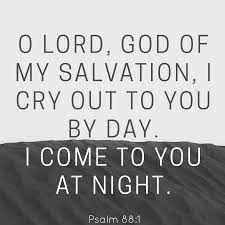
  Lord, God of my salvation,
    I cry out day and night before you.
Let my prayer come before you;
    incline your ear to my cry!
For my soul is full of troubles,
    and my life draws near to Sheol.
I am counted among those who go down to the pit;
    I am a man who has no strength,
like one set loose among the dead,
    like the slain that lie in the grave,
like those whom you remember no more,
    for they are cut off from your hand.
You have put me in the depths of the pit,
    in the regions dark and deep.

Psalm 88:1-6, ESV

I definitely needed this Psalm today. Yesterday I went to the doctor and was blindsided by news that really isn’t good, at all.  Of course, I also have this ongoing struggle with depression.  Today I feel like I’m running a marathon with ‘leg weights’ on. 

This particular Psalm is radically different than the others. 

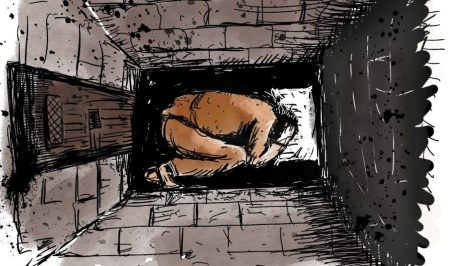
This Psalm has no kind words, and no praise to God for deliverance.  It is a singularly sad song.  Imagine if you will, a huge stone fortress in the mountains.  Every room has a door, and every room a window.  All except one.  No light enters this room.  There is no entrance or exit, no way to get free.  Psalm 88 describes living that torturous experience.

I like my Psalms to be strengthening or encouraging. 

But then comes this one!  Life unravels and frays.  Everything gets confusing. Life comes apart.  The thought of being one who is irretrievably lost and damned, it saturates my thinking.  The despair is beyond belief, I have no words to describe its special variety of darkness. 

Anyone who has walked into this hell will understand.

Am I ‘less’ a Christian because of this vicious despair?  Some would say so.  The writer in verse 1-2, calls out to God.  (I guess this what you are supposed to do).  There is a sense of consistency in his cry.  In verses 3-5, we see him evaluating his position.  Again, there is a underground current of despair. 

There is simply no help, no deliverance for him.

It’s a bitter and painful place to be.  There are no explanations why life has gotten so nasty and bitter and out-of-control.  But one thing that Psalm 88 does quite well, it strips you of any dignity that you have left. 

(Does this make any sense at all?)

There is so much embedded in the book of Psalms.  Comfort, faith, victory and hope are what we find. But in Ps. 88, we find a black pearl, the only one of its kind.  Somehow, we dare not leave it behind, just because we don’t understand it. 

I’m convinced that it has tremendous power to the disciple who is in endless pain.  Just vocalizing this Psalm does something to us.  These real words help.  This Psalm is ours. 

God has provided it for us.


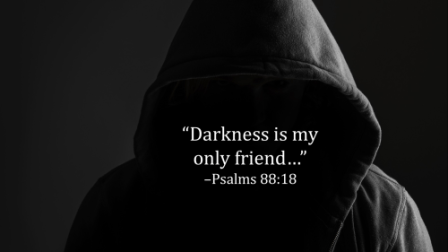
“Darkness is My Only Companion”

Ambrose of Milan (340-397)

Our theology makes all the difference in fighting depression, writes Kathryn Greene-McCreight, Author of “Darkness, Is My Only Companion” and Episcopal priest.

In his Problem of Pain, C. S. Lewis says that suffering is uniquely difficult for the Christian, for the one who believes in a good God. If there were no good God to factor into the equation, suffering would still be painful, and  ultimately meaningless.

For the Christian, who believes in the crucified and risen Messiah, suffering is always meaningful. It is meaningful because of the one in whose suffering we participate, Jesus. This is neither to say, of course, that suffering will be pleasant, nor that it should be sought. Rather, in the personal suffering of the Christian, one finds a correlate in Christ’s suffering, which gathers up our tears and calms our sorrows and points us toward his resurrection.

In the midst of a major mental illness, we are often unable to sense the presence of God at all. Sometimes all we can feel is the complete absence of God, utter abandonment by God, the sheer ridiculousness of the very notion of a loving and merciful God. This cuts to the very heart of the Christian and challenges everything we believe about the world and ourselves.

I have a chronic mental illness, a brain disorder that used to be called manic depression, but now is less offensively called bipolar disorder. I have sought help from psychiatrists, social workers, and mental health professionals; one is a Christian, but most of my helpers are not. I have been in active therapy with a succession of therapists over many years, and have been prescribed many psychiatric medications, most of which brought quite unpleasant side effects, and only a few of which relieved my symptoms. I have been hospitalized during the worst times and given electroconvulsive therapy treatments.

All of this has helped, I must say, despite my disinclination toward medicine and hospitals. They have helped me to rebuild some of “myself,” so that I can continue to be the kind of mother, priest, and writer I believe God wants me to be.

During these bouts of illness, I would often ask myself: How could I, as a faithful Christian, be undergoing such torture of the soul? And how could I say that such torture has nothing to do with God? This is, of course, the assumption of the psychiatric guild in general, where faith in God is often viewed at best as a crutch, and at worst as a symptom of disease.

How could I, as a Christian, indeed as a theologian of the church, understand anything in my life as though it were separate from God? This is clearly impossible. And yet how could I confess my faith in that God who was “an ever-present help in trouble” (Ps. 46:1) when I felt entirely abandoned by that God? And if this torture did have something to do with God, was it punishment, wrath, or chastisement? Was I, to use a phrase of Jonathan Edwards’s, simply a “sinner in the hands of an angry God”?

I started my journey into the world of mental illness with a postpartum depression after the birth of our second child. News outlets are rife with stories of women who destroy their own children soon after giving birth. It is absolutely tragic. Usually every instinct in the mother pushes toward preserving the life of the infant. Most mothers would give their own lives to protect their babies. But in postpartum depression, reality is so bent that that instinct is blocked. Women who would otherwise be loving mothers have their confidence shaken by painful thoughts and feelings.

Depression is not just sadness or sorrow.

When I am depressed, every thought, every breath, every conscious moment hurts.

And often the opposite is the case when I am hypomanic: I am scintillating both to myself, and, in my imagination, to the whole world. But mania is more than speeding mentally, more than euphoria, more than creative genius at work. Sometimes, when it tips into full-blown psychosis, it can be terrifying. The sick individual cannot simply shrug it off or pull out of it: there is no pulling oneself “up by the bootstraps.”

And yet the Christian faith has a word of real hope, especially for those who suffer mentally. Hope is found in the risen Christ. Suffering is not eliminated by his resurrection, but transformed by it. Christ’s resurrection kills even the power of death, and promises that God will wipe away every tear on that final day.

But we still have tears in the present.

We still die. In God’s future, however, death itself will die. The tree from which Adam and Eve took the fruit of their sin and death becomes the cross that gives us life.

The hope of the Resurrection is not just optimism, but keeps the Christian facing ever toward the future, not merely dwelling in the present. But the Christian hope is not only for the individual Christian, nor for the church itself, but for all of Creation, bound in decay by that first sin: Cursed is the ground because of you … It will produce thorns and thistles for you …” (Gen. 3:17-18).

This curse of the very ground and its increase will be turned around at the Resurrection. All Creation will be redeemed from pain and woe. In my bouts with mental illness, this understanding of Christian hope gives comfort and encouragement, even if no relief from symptoms. Sorrowing and sighing will be no more. Tears will be wiped away. Even fractious [unruly, irritable] brains will be restored.

“Darkness: My Only Companion”

Kathryn Greene-McCreight is assistant priest at St. John’s Episcopal Church in New Haven, Connecticut, and author of Darkness Is My Only Copanion: A Christian Response to Mental Illness (Brazos Press, 2006).

Click to read Psalm 88

My Dear Child – A Letter from God

Hold Hands

My Dear Child,

I see that you are trying to be
just as good as you can be
but what you clearly do not see
is you can’t do this without Me

I know that you are wondering why
I do not stop what makes you cry
but if on Me you will rely
every tear that falls I’ll dry

I love you more than you’ll ever know
in your holiness, I want to grow
and though your progress may seem slow
the path you walk in the way you must go

I will comfort you when times are tough
I will watch over you when life is rough
I will rescue you when you’ve had enough
What’s too big for you, to Me is small stuff

May the Father’s  grace and peace be yours, now and forever,

Linda

 Linda L. Kruschke’s Blog