“Why should you be like someone confused, like a mighty warrior who cannot give help? Yet you, O Lord, are in the midst of us, and we are called by your name; do not forsake us!”
Jeremiah 14:9
Twenty three years ago, I started this blog–
Looking back on it has been very helpful.
In recent weeks I’ve gone through a time of profound confusion. My grip on reality has been tenuous at best. I’ve had a struggle with a depersonalizing sense, I seem not to “see” reality as I used to. Everything seems increasingly odd, and disjointed. I see myself outside myself.
Everything is knotted up, again.
I have had bouts with this before. And yet every time the Father has “fathered” me. I have been led through each bout. In many ways, the clinical depression has changed, now it slams. It used to be kind of low grade, kind of a grey fog, a steady and tedious despair, but now it’s more like a black lightning bolt.
I have had suicidal urges and thinking. I hate handling a kitchen knife, as I get the urge to plunge it into my chest. It’s funny like that, I call out to Jesus and He truly does find me.
He straightens out my knotted life only as He can.
History:
This blog initially started off in September 2009 following the idea of “broken believers.” Perhaps it was overly ambitious. But my heart’s desire is to be transparent and very honest. I still want to see this happen, and it does, sometimes.
I know I am not some super-saint with just the right answer for everyone. If I ever made this impression, please forgive me. Believe me, I only want His gentle presence to touch broken people.
For you see, I am the broken believer that writes this blog.
Often there is so much of ‘life’ that we must try to handle. There’s far too many things that confuse us. Faced with many issues beyond our control, we seldom seek the best answer. We are hoping just to survive reasonably unscathed through the latest intense conflict.
Mental illness has its unique trials. Those of us afflicted know the instability it brings us. We go from crisis-to-collapse everyday, (and sometimes even before lunch-time!) Some people have no concept of how much energy it takes just trying to appear ‘normal.’
Sometimes sadness is the best we can do. Trying to find a positive note seems empty and futile. I know a woman who must battle with pain every day. She has to manage every minute of every day with her handicap. She is a wonderful Christian, and she still exudes a gentle faith in her Savior.
We may seem cursed in this life. But Jesus died for this. His love for you is constant and sure.
Sometimes however the only way out is through. We simply must go through the many issues that face us. We must plow through such darkness, that has no precedent. We are the rescued ones, but only because he has made us so. The lost are now found. And we were really, really lost.
We go through, but not without grace. We may step through, but not without pain. So much of our confusion rides on a fascination with the ways of sin and darkness. The ways of the “dark one” may enchant us, but never fulfill us.
We can rest in that we are our Father’s foremost concern.
“He guides me in the paths of righteousness for His name’s sake”
We can puncture the surrounding evil by a simple decision to be faithful to Jesus.Darkness may pursue us, but it will never defeat us. We advance through this pain to the glory of God. He alone can make us triumph. Only Him.
“For I am confident of this very thing, that He who began a good work in you will perfect it until the day of Christ Jesus”
Philippians 1:6
“I do not understand the mystery of grace — only that it meets us where we are and does not leave us where it found us.”
“A Christian is not a person who believes in his head the teachings of the Bible. Satan believes in his head the teachings of the Bible! A Christian is a person who has died with Christ, whose stiff neck has been broken, whose brazen forehead has been shattered, whose stony heart has been crushed, whose pride has been slain, and whose life is now mastered by Jesus Christ.”
John Piper
“No longer do I call you servants, for a servant does not know what his master is doing; but I have called you friends, for all things that I heard from My Father I have made known to you.”
John 15:15
It seems that the purpose of life is not to find our freedom, it is really meant to find our Master.
The idea of being a slave to anyone is repugnant–a blow to our pride. We chafe at this, and yet man was never meant to be separated from the Lordship of Jesus. We’re instructed repeatedly with the New Testament idea that “our life is not our own” Over and over God proclaims Himself as the King.
That really can trouble us somewhat.
Not so much when life is fairly good, granted, but in those hard moments when a decision must be made between enjoying the titillating “lusts of the flesh,” or accepting the fruits of the Spirit. This is one of those “lordship moments.” They come and go, and they show us exactly who we are. We cannot escape this–it’s part of our faith.
If you’re really going to be authentic–that is to be a legitimate and real disciple, then you must determine who is going to be in charge, and this isn’t one of those casual decisions. Your decision must become a settled issue.
You must fix your decision in your heart.
The thief on the cross knew salvation, he was promised an eternity with God simply by faith. But I submit to you that he had put himself under the Lordship of Jesus, simply by recognizing the sign, “the King of the Jews.” I believe he saw and understood its implications. Jesus was King! He knew and understood.
This is a very hard word for some, but so many of our personal issues hinge on this
I know this first-hand. It’s a monumental struggle. You must admit to not only having Jesus as your Savior, but you also must put your life under His total Lordship. You need to pick up your cross daily in order to follow. You need to learn how to kneel in total surrender to Him.
I’ve chosen a crown to open up this post–it’s done on purpose. I simply want you to understand the supreme call He has on your life.
You must learn here and now how to kneel before theSovereign King.
Your resistance to His lordship will end up bringing total pain. You MUST bow and accept Jesus’ crown– to recognize His lordship over every area of your life.
If you look up into His face and say, “Yes, Lord, whatever it costs,” at that moment He’ll flood your Life with His presence and power.
A Pastor’s Letter to the Parents of a Child Born Blind
Dear John and Diane,
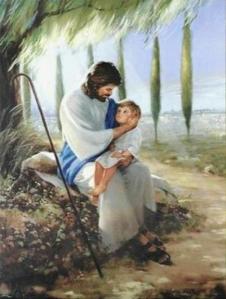
You are the child, and He is your father
Last night, as I prayed with Noel, you were heavy on my mind. I said, “Lord, O Lord, please let me be a pastor who preaches and leads and loves in a way that makes the impossibilities of life possible for your people by a miracle of sustaining grace. Help me to know the weight and pain of this life and not to be breezy when the mountains have fallen into the sea. Help me to have the aroma of Christ’s sufferings about me. Prevent shallowness and callousness to pain. O Lord make me and my people a burden bearing people.”
O John and Diane, I am so heavy with your child’s sightlessness!
God is visiting Bethlehem with such pain these days in the birth of broken children. Randy and Ann Erickson with their baby’s broken heart; Jan and Rob Barrett with their baby’s liver outside the body; and your precious little one! Is the Lord saying, “I have a gift for your community.” This is not one or two or three couples’ burden. This is a gift and call to the whole church. This word concerning the brokenness of this fallen age of futility. This is an invitation for you all to believe that “here we have no lasting city” (Hebrews 13:14).
This is an invitation for you to “count every gain as loss for the sake of Christ” (Philippians 3:7). This is a shocking test to see if you will “lose heart” when in fact God’s purpose is to show that his grace is sufficient to renew our inner person every day to deal with the “slight momentary affliction which is preparing for us an eternal weight of glory beyond all comparison, because we look not to the things that are seen but to the things that are unseen; for the things that are seen are transient, but the things that are unseen are eternal” (2 Corinthians 4:17-18).
O Lord, open our eyes to your love in this pain.
Open our eyes. “Then Elisha prayed, and said, ‘O Lord, I pray thee, open his eyes that he may see.’ So the Lord opened the eyes of the young man, and he saw; and behold, the mountain was full of horses and chariots of fire round about Elisha”(2 Kings 6:17). John and Diane, the mountains surrounding your lives are filled with the horses and chariots of God.
Only to the eyes of unbelief does the devil have the upper hand here. God is at work in ways and for years and generations and millions of people that we cannot now imagine.
This is ours to believe and to bear, no matter the cost. This is ours for this short life. It seems to me that this life is a proving ground for the kingdom to come. Some are asked to devote forty or fifty years to caring for a handicapped child instead of breezing through life without pain. Others are asked to be blind all their lives… But only in this life – ONLY in this life some are . I want to be the kind person who makes that “ONLY” what it really is – very short. Prelude to the infinity of joy, joy, joy.
But not yet. Not entirely.
How will we ever cope with the burdens of this life if we believe this is all there is, or even the main act in this drama of reality? O Lord, give us your view of things. May God fill you with anticipated joy. “I consider that the sufferings of this present time are not worth comparing with the glory that is to be revealed to us.”






 Broken Believers