Rembrandt’s Prodigal Son

Rembrandt-The_return_of_the_prodigal_son
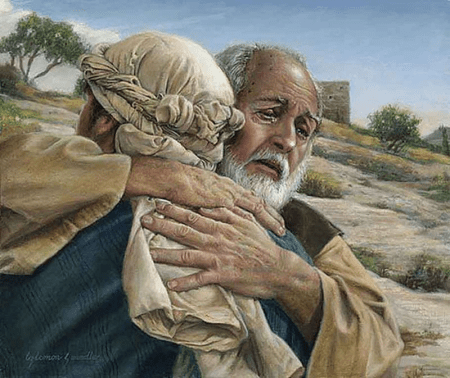
Rembrandt, “The Return of the Prodigal Son,” c. 1661

17 “But when he came to himself, he said, ‘How many of my father’s hired servants have more than enough bread, but I perish here with hunger! 18 I will arise and go to my father, and I will say to him, “Father, I have sinned against heaven and before you. 19 I am no longer worthy to be called your son. Treat me as one of your hired servants.”’ 20 And he arose and came to his father. But while he was still a long way off, his father saw him and felt compassion, and ran and embraced him and kissed him. 21 And the son said to him, ‘Father, I have sinned against heaven and before you. I am no longer worthy to be called your son.’ 22 But the father said to his servants, ‘Bring quickly the best robe, and put it on him, and put a ring on his hand, and shoes on his feet. 23 And bring the fattened calf and kill it, and let us eat and celebrate. 24 For this my son was dead, and is alive again; he was lost, and is found.’ And they began to celebrate.

Luke 15:17-24, ESV

Two hundred and eighty-nine words– these describe the life of every man, woman, and child who has ever lived. These 289 words reveal to us a God who loves far too much, way too easy. Perhaps we sort of expect that he will ‘appropriately’ punish his son– at least put him on probation at least. It only makes sense. But we find that is legalism talking.

“Every saint has a past, and every sinner has a future.” 

Many of us have lived as prodigals, and we have spent our inheritance like ‘drunken sailors.’ We really have nothing at all to show for it. The prodigal, completely destitute, takes the only work he can find. (Imagine a good Jewish boy feeding hogs.)

He is so far gone that he starts inspecting the filthy slop buckets for something to eat.

Many of us will understand his despair. Often there comes to us a crystalline moment of simple awareness. The prodigal, sin-crusted and impoverished, still has a lingering memory of the Father’s house.

The servants there had far more than him right now. Sometimes I wonder if in our captivity, we instinctively want to go home, if only in our minds, to be a servant there.

The Father has dreamed of this precise moment.

The parable says, “He saw him–felt compassion–ran out to him–embraced him–and kissed him.” The Father is a whirlwind of agape love. I’ve read the Parable of the Prodigal Son a hundred times or more. It never loses its punch. I simply want to bring some observations: 

  • We see that his father receives him with a tender gesture. His hands seem to suggest mothering and fathering at once; the left appears larger and more masculine, set on the son’s shoulder, while the right is softer and more receptive in gesture.
  • The son’s head is downy, almost like a newborn’s. We must enter the kingdom like little children. 
  • The Prodigal Son seems to be protected by his father. He snuggles near the Father’s breast. It’s love that holds him there.
  • Consider his sandals. It has taken a long time for him to come home. 
  • Standing at the right is the prodigal son’s older brother, who crosses his hands in stoic judgment; we read in the parable that he objects to the father’s compassion for his brother.
  • We see his mother in the background in the painting, and a seated steward or counselor. One stands in profound joy, the other in sits in stunned perplexity.

But Rembrandt had painted the Prodigal once before, when he was considerably younger. And it is a very good painting. The prodigal is happy and gay; there is absolutely no indication of the consequences of sin.

The Prodigal Son in the Brothel, 1635

He’s a charming young man at the height of his popularity, and we see him at a happy party. He is spending the inheritance of his father.

But Rembrandt chooses at the very end of his life to re-paint it to reflect reality.

This is one of the last paintings he will do, and it is the Prodigal Son–destitute and repenting. I can only imagine; the years have taken a toll and he doesn’t really feel his first painting is enough. He wants to paint what is true.

He now is painting our spiritual condition.

We are given a work that some critics call as the greatest painting ever completed. The painting is now in St. Petersburg, Russia. It is seldom seen by visitors. It is a clear echo of the grace of God for fallen men and women. Like the father in the painting, He’s ready to forgive every sin saturated son and daughter.


The Father’s Prodigal

bry-signat (1)


The Father is Running!

“So he returned home to his father. And while he was still a long way off, his father saw him coming. Filled with love and compassion, he ran to his son, embraced him, and kissed him.”

Luke 15:20, NLT

There comes a time when the prodigal stands up–looks around, and then decides he can’t live this way anymore, it’s now time to return home.  But he is no longer a ‘rich man’s son’, the pig-pen completely crushed that idea.  He returns home, thinking that at least he can be a slave.

The devastated prodigal now understands.

And it’s that which gives him the propulsion to leave the pigs behind, and begin to somehow be received by his father. The trip is a long one, lots of walking, and yes, it’s hard–he’s far from where he’s supposed to be. He is tired, ragged and worn.

But please dear one, you must understand this about Jesus’ parable–the story isn’t so much about the prodigal son, rather I think that the focus should really be on the father. Jesus is teaching us that the love of God is a searching/seeking kind of love, and it cannot be shut down, or go away over time. Not ever.

You see, it is a 24/7/365 day kind of love.

Think of it like high intensity radar that sweeps over extreme distances, it is always looking, seeking, and it won’t be denied.  The Father is seeking for His sons and daughters.  He intends to find them. If we refuse we will continue to feed pigs, over and over, and we will starve.

The running love of the Father is strenuous and reaching

The Father never sits on His backside, calmly watching from His throne. He reaches out and runs to us. God doesn’t sit. He is far from passive, rather He intensely yearns for His son. And God is fully into reclaiming His missing sons and daughters, just like in Jesus’ story.

He continues to search, even in when things get really bad.

Sin disfigures
Sin disfigures, a meth addict’s mug shots over time

The Father recognizes His prodigal son.  It’s funny, but gross sin often has a way that disfigures a person’s countenance. Look at the wino or meth addict on the street.

The boy who abruptly left home is not the son who returns.  There has been damage done.  His face has changed.  The Father understands this, and yes, it has been terribly hard and brutal. But that hardly matters.

I believe that this parable is the greatest of them all. 

Jesus is explaining the deep love the Father has for prodigals like us. This story is so revealing, in it we see that the Father who is running. We must know this about Him. We must internalize it and understand the compassion He has. If we stall in our discipleship it’s because we don’t grip the awesome depth of His love.

There seems to be very few people who understand a running God.

The prodigal son is a timeless parable that transcends generations, holds within it a profound message of forgiveness, redemption, and unending love. As we delve deeper into the intricate layers of this tale, we discover a powerful metaphor that illuminates the human experience and the unwavering compassion of the Father.

As the prodigal hits bottom he realizes the futility of his choices and yearns to return to the forgiving embrace of his father. Overwhelmed by guilt and shame, he makes the long journey back to the home he once took for granted. Little does he know it, behind the scenes, his father has been watching, waiting, and hoping for his return.

And then, in a moment that encapsulates the beauty of unconditional love, the father catches sight of his boy from afar. Without a second thought, the father runs towards him with outstretched arms, his love insisting on forgiveness.

We see a love that surpasses human understanding.

The parable teaches us about the power of redemption and forgiveness, reminding us that no sin is too great to be forgiven, and no distance is too far for reconciliation. It emphasizes the importance of humbly seeking forgiveness and shows that love is always within reach.

Jesus teaches us a different kind of love. It’s not based on achievements or what society says. This love is given to everyone, regardless of their flaws, but in order to have it, they must leave the pigs behind. Sometimes that isn’t always easy.

This profound depth of His love often leaves us feeling totally doubtful or skeptical.

Our logical minds struggle to grasp how such boundless love can exist, especially when we witness the failings and flaws of human love. Yet, it is precisely because love transcends logic that it is so powerful. It operates on a different plane, bypassing our human limitations and revealing a deeper truth about the nature of God’s infinite compassion.

So, let us tell others about this love that Jesus spoke of.

Let’s begin to see that this compassion will transform lives, heal wounds, and bridge divides. For when we approach Jesus’ parable with humility and faith, we may just catch a glimpse of its power and appreciate its profound beauty in a new way.

If the Church can just keep up with our running God, we will finally understand who He really is. And if we only accept the love of the Father towards prodigals—no matter what the sin—it’s then we will finally understand the white-hot love of the Kingdom of Jesus.

And the Church will finally be doing His will in the world.

Finally.

1brobry-sig4

My Two Sons

Pencil Portraits by Billy Nicol Creative

I have two sons and they are very different from each other. Connor is the oldest and he is an engineer who recently graduated from college with good leadership skills. He was born into our family with three older sisters.

My other son is Morris and he was born into abject poverty in Liberia, Africa. He came to our house when he was six. He has outstanding coordination, Is an excellent athlete, and is very musically inclined.

Connor and Morris have very different strengths as well as different weaknesses. One of my jobs as a dad is to allow them to be unique and to adjust my expectations accordingly. Ideally I could maximize their strengths while teaching them to mitigate their weaknesses.

I believe God in this respect is similar to a good dad. He doesn’t expect the same from everyone. He actively works with our physical, mental, emotional and spiritual aptitudes and abilities. That is one reason not to compare oneself to others as He has specific hopes and desires for each of us.

Likewise reading the bible like every verse currently applies to everyone is foolish. No one could possibly meet that standard. Scripture is best personally handled by asking Him what He wants you to see-to focus on-for yourself.

Jesus knows what He created. He knows your frame as David said. Rest in that knowledge and ask Him to speak individually to you about your walk with Him. He is among many other things very personal.

Your brother in Jesus,

Les

commentsbb@yahoo.com

Gifts are Nice, But There is Something Better

blue-dress1

This is my first attempt at writing a story. I’m not sure it belongs here, and I apologize for any deficiencies. Please be merciful.

A father stood by his young daughter’s bed. She was clearly tired from a busy day, but because her Dad was with her– that at the moment mattered most. “Dad, tell me a story… please?”

“I’m sorry dear heart, I can’t” he said sadly. “I must travel to Chicago, and then to St. Louis. I’m afraid I’ll be gone for three days. The girl responded, “But Daddy, you’re my best friend. You can’t leave.”

“Honey, if you are good and brave, I will bring you home a special present.” She looked up at him. “A ring?” “Yes, darling. A beautiful ring. Now go to sleep and have sweet dreams, good night. I love you so much.”

When the father returns he finds her at the door, eagerly waiting him. She runs and hugs him, wrapping her arms around his neck. “Oh papa, you are really home!” Setting down his suitcase, the Father reaches into his breast pocket. “Here you go, dear one. One special ring!”  It was silver with a small garnet stone, and it was so beautiful. And it sparkled.

Sometime later the father had to make another trip, this time to Akron. “Oh father, please don’t go again. Tell me another story.” (For the father was very good at telling such interesting tales of rabbits and ponies and storms and such.) “Please, stay!” the girl begged.

“Honey, if you’re good and brave, I will bring you home a special present.” The child  grew quiet for a few seconds. “Papa… maybe a dress? A blue one, with lace and puffy sleeves?” Yes love-heart,” he said, “with puffy sleeves. Now you need to go to sleep, dear.”

The trip to Akron was terribly uneventful, but he did stop by a J.C. Penny to buy a little blue dress. Arriving home he found his daughter waiting for him. Setting down his bags, he received so many kisses he wondered if he wasn’t the luckiest man alive.

“And here, young lady, is the dress I promised.” Out of the box, and with lots of ‘ooohs and aahs.’ She lifted it out and modeled it under her chin. It was blue and had puffy sleeves. It was wonderful. (She would wear that dress until it was worn out.)

One day the daughter grew quiet and still. “Father, I don’t want the ring. I don’t want the dress. I don’t want them anymore. I really want you!”

The father smiled, with tears in his eyes, “Dear heart, I love you so much.”

flourish2

The Father awaits you to come to this point, when you stop seeking His blessings and start to seek His face.

recite-4295-45802551-tvf8xa (1)