“Depression Deceptions,” by James Winsor

“Pilgrim’s Progress” by Bunyan

Bryan’s Note: On many occasions I encounter a blog that communicates so well that I think about doing a re-post.  Today is one of those days. So, here is Pastor Winsor’s exceptional article on depression.  I hope that his perspective will bless you and give you a deeper understanding of this mental illness.


Depression Deceptions by Rev. James Winsor
Lots of people these days suffer from depression. Many of them are Christians. If you suffer from depression, I hope the following information helps you. If you don’t suffer from depression, then maybe this will assist you in understanding and helping those who do. Here is a list of three Depression Deceptions to avoid.


Deception #1: If you’re depressed, you’re not a strong Christian. 

On August 2, 1527, Martin Luther wrote these words in a letter to a close friend: “l have been thrown more than a whole week into death and tossed back and forth in hell.. .I have lost Christ totally and have been shaken by the floods and storms of desperation and of blasphemy against God.”Even strong, mature Christians like Martin Luther can suffer from depression. Depression is not a sign of unbelief or weak faith. It’s a sign of spiritual battle, and battles are for healthy soldiers.

This is a sin-sick world. You’d be crazy not to be depressed sometimes!

Deception #2: No one would understand. 

Holy Scripture tells Christians to “bear one another’s burdens and so fulfill the law of Christ” (Galatians 6:2). We’re told to “mourn with those who mourn” (Romans 12:15). God doesn’t want you to carry your depression alone. God makes sure there are Christians around who understand.

You don’t have to be alone in your depression. Not all Christians will understand it, but some will. You just have to take a few risks until you find the ones who have experienced depression themselves and will understand what you’re going through. Your fellowship with those Christians will be tight. You may even end up being glad the depression brought the two of you together.

Deception #3: Depression is a Useless Detour in the Christian Life.

God has a purpose for the depression that falls on His children. In an Old Testament passage we’re told that “an evil spirit from the Lord tormented King Saul” (1 Samuel 16:14). God had anointed David to be Saul’s replacement as king. God wanted to save Saul’s eternal soul, but He also wanted to replace him as king. So God sent David as a music therapist for Saul. “Whenever the spirit from God came upon Saul, David would take his harp and play. Then relief would come to Saul; he would feel better, and the evil spirit would leave him” (1 Samuel 16:23).

God gave Saul a problem and sent David as the solution. Saul might have done the obvious thing – thank God for David and support him! But instead Saul tried to kill David because he was jealous of him. Saul missed the opportunity his depression offered him. He rejected both his depression and David as gifts from God.

St. Paul, on the other hand, had a similar experience of evil sent from God for a good purpose. He responded the right way and received the suffering as a gift from God. Paul wrote, “There was given me a thorn in my flesh, a messenger of Satan, to torment me. Three times I pleaded with the Lord to take it away from me. But he said to me, ‘My grace is sufficient for you, for my power is made perfect in weakness.’ Therefore, I will boast all the more gladly about my weaknesses, so that Christ’s power may rest on me.. .When I am weak, then I am strong.” (2 Corinthians 12:7-10).

God presented Paul with a problem. Then He presented him with the solution, grace in Christ. Paul learned to be thankful for his weaknesses because his weaknesses made him need Christ.

Depression does that to and for you. It leaves you with nothing to hang onto, but Jesus. When you’re depressed, you can’t find anything inside to place hope in. All that exists is darkness and emptiness. You come to find your hope in something outside of you: Christ and His cross and pardon.

That’s not a detour from the Christian life. That is the Christian life, God has you right where He wants you.

I was really depressed one day. I told a pastor friend of mine, “Sometimes I don’t know whether I’m saved. All I know is that I have a Savior.” God had me right where He wanted me. I could actually rejoice in my weakness. Suddenly all I had was Christ. And, in a way, you don’t have Christ until Christ is all you have.

“Carry each other’s burdens, and in this way you will fulfill the law of Christ.” 

Galatians 6:2

“Rejoice with those who rejoice; mourn with those who mourn.” 

Romans 12:15

NOTE: If you can’t seem to shake your feelings of sadness and depression after a few weeks, seek out help right away. Talk to your parents, a counselor, or your doctor to help you deal with these overwhelming emotions.


The Rev. James Winsor is pastor at Risen Christ Lutheran Church in Arvada, Colorado.


cropped-christiangraffiti1 (2)


Taken from the Spring 2002 edition of Higher Things magazine. You can write Higher Things at P.O. Box 58011, Pleasant Prairie, WI 53158-8011.

 www.issuesetc.org

Related articles

There is a Crack in Everything

“Ring the bells that still can ring/Forget your perfect offering/There is a crack in everything/That’s how the light gets in.”

Leonard Cohen,  Anthem

A crack in everything. As someone who has experienced brokenness in my life,  I appreciate the wisdom of these simple words. You see, I am intensely aware of being different then others.

I had a night job working my way through school frying donuts.  I remember clearly an incident were I overheard my boss telling someone that, “Bryan is one of the most eccentric people I have ever met.” Now I honestly was not trying to be odd, or eccentric.

To put this in perspective, I just happened to be taking N.T. Greek at the time and knew that the word for eccentric was a contraction, (of ek, meaning “off, or off to one side, and “centros”, meaning, “center”).  He was saying that I was “off centered”. That really troubled me because I always felt like I was intensely stable, and very much a well-balanced person. (But I was just 22.  I guess that fact alone explains much.)

Cohen’s poem tells us certain things. First, he describes bells that can’t be used, they don’t work anymore. Second, he tells us of our need to get real and to understand that “a perfect offering” is beyond our capability. Maybe 30 years ago, ‘naive idealism’ might have carried the day for us. But now I’m in my mid-50s  and I have tried to figure out a thing or two.   By then we start to see the cracks in everything, nothing has gone by untouched. We live in a fallen and broken world.

But the poet delivers a paradoxical truth, he states, “that’s how the light gets in.”

To learn this deeply, is to turbocharge your recovery. You’re a broken person. But that is actually a good thing. It summons up a discernment of how we grow spiritually.

I find it quite astonishing that the broken, weak, and the burned-out are closer to the Kingdom then the strong, the sure, and the gifted. This is a rich and an incredible truth, we are to see our brokenness and ruination in a whole different perspective.  We must see that that is how the light gets in.

“Blessed are the poor in Spirit, for theirs is the Kingdom of God.”

Matthew 5:3

“God uses broken things. It takes broken soil to produce a crop, broken clouds to give rain, broken grain to give bread, broken bread to give strength. It is the broken alabaster box that gives forth perfume. It is Peter, weeping bitterly, who returns to greater power than ever.”

Vance Havner

bry-signat-1

cropped-christiangraffiti1 (2)


Tangled Up in Sin (and Death)

vines-statue18 “Where is another God like you, who pardons the guilt of the remnant, overlooking the sins of his special people? You will not stay angry with your people forever, because you delight in showing unfailing love.

19 Once again you will have compassion on us. You will trample our sins under your feet and throw them into the depths of the ocean!”

Micah 7:18-18, NLT

These verses speak of the sin and guilt of God’s people. But even more importantly we hear of the extravagance of God to forgive so readily. Micah speaks directly to us who need to understand exactly what has been done for us. He knows what God is really like, and encourages not to give up hope.

I find that people as a whole understand sin. As they survey their lives, they are conscious of many flaws and shortcomings. Although we resist the label– ‘sinners’– we all admit a certain failure. It is this that Micah is speaking of. The Bible tells us “that all have sinned.” From the lost wino to the president of the United States, we are all cut from the same cloth. All means everyone. And we each have the same problem.

We are all in need of someone who will save us from our sin. These verses speak of the greatness of God to intervene. Without His intervention we are all buried in our sin. In a colorful way (so typical of Micah), we visualize God trampling down our iniquities, and forgiving us of so much sin. This is no small task. Generally, people are grateful for the intervention.

Like intertwined and tangled vines cover a marble statue, completely enmeshing it, we plead for release. There are many attempts at extricating ourselves. (Some rather heroic efforts). But nothing ever really works.

The wonder is that God has already done this. He has cut us free and trampled our sins underfoot. He has gathered up all our iniquity and dumped it in the Marianas Trench. We are now free to go. Our sin is forgiven. What a wonderful God!

Upon release we are free to help Him free the others. Isn’t this is what ‘evangelism’ is all about? What a noble task it is to assist the sons of Adam and the daughters of Eve.   1brobry-sig

Wondering Where the Lions Are?

http://lyndafinchart.com/lyndafinch/Prophetic/productdescriptions/good-lion.htm
Lynda Finch Art

“Twelve lions stood on the six steps, one at either end of each step. Nothing like it had ever been made for any other kingdom.”

1 Kings 10:20

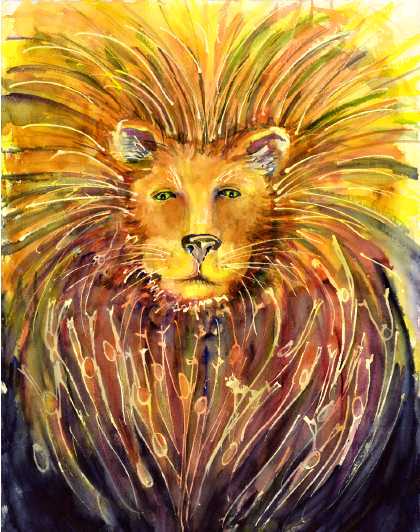
These statues had to be remarkable.  They seemed to stand guard, everyone who entered had to pass by them.  Symmetrically and aesthetically, they would’ve been placed six on the right and six on the left.  Each lion was placed at the end of the step.  Over the centuries, lions are a wonderful symbol of sovereignty , and in them, like nothing else, we can hold concepts of strength, dignity and royalty.

Lions are emblematic of ‘rootedness’ and stability.  Those who ‘wear the lion’ are intentionally connecting to this ‘strength’ and are stating they admire and respect all that the lion represents.  King Solomon intentionally chose the lion to guide the kingdom and give direction.

Lions cannot be domesticated.  They serve no one.  They cannot be made tame or docile.  Being carnivorous their appetites are something to be aware of.  (Lions have a tendency to be a tad irrational when hungry.)  But in spite of this they are amazing animals.  Fierce and intense, when they need to be, they watch over each other.  They do not mingle with other species of animals. They are set apart.

For the Christian believer, there is a definite ‘lion connection’.  We know Jesus as ‘the Lion of the tribe of Judah’, (Rev. 5:5).  His majesty and power have been intentionally referred to by believers throughout the centuries.  Jesus exhibits all the good attributes about lions, and none of the bad.

I wonder where the lions are?  Where are those who would stand against the evil we see today?  John, the Baptist stood in the light, and he would not take a step back.  We see him boldly confronting the wickedness of his day, and in it all, he would not bend; and yet it seems that’s what others thought he should do.

The lions, where are they?  There is a boldness that is missing in our churches.  It seems as if the lions on the front steps have been taken from us.  We haven’t even noticed, but they are not there anymore.  Even if the lions were returned to us, there would be a whole scale rejection of such fanaticism.  Lions are simply not ‘in style’ for the modern American believer. Lions defy so much of the protocol and etiquette of this present moment. They are simply not ‘politically correct.”

But what will we do without the lions?  Their absence may seem somewhat minor.  We don’t need them to give us authority or moral courage, after all we really should do this on our own. But we must receive a boldness and decisiveness from the Holy Spirit.  He has the ability that we need to follow Him.  We need men and women to live their lives as ‘spiritual’ lions.

*

ybic, Bryan