Growth in the Troughs of Life

This post has been floating around in my head for almost two weeks now, and I had fully intended to post it here at Broken Believers last weekend, but just didn’t get it done. In retrospect, learning of the great trough our dear brother Bryan is going through, I realize that either I should have made the time or the timing of posting it today is part of God’s design. All I know for sure is that it needs to be posted.

I recently purchased a new book titled The Soul of C.S. Lewis that consists of one-page reflections on various quotes from many of Lewis’ best-loved writings followed by a Bible verse. The book has 10 different contributing authors, and each essay is not attributed to an individual author, but they are all wonderful. Today I want to share a little about one of those essays, along with my own thoughts on the topic at hand.

The Lewis quote that begins the essay is from The Screwtape Letters, one of my favorites of Lewis’ fiction. Although fictional, there is a great deal of truth about the struggles and potential downfalls of the believer in Christ to be found in this short collection of letters between Screwtape, a high-level demon, and Wormwood, his nephew who is a low-level tempter in the minions of Satan. The quote at hand is:

“It is during such trough periods, much more than during peak periods, that it is growing into the sort of creature He wants it to be.” Screwtape, chap. 8, p. 40.

The trough periods Screwtape refers to are the low times in life that for some are manifested as periods of deep depression. Many a strong Christian has experienced such troughs over and over throughout their lives. I have experienced them to differing degrees myself, and our dear Bryan is experiencing just such a trough now. They are certainly no fun, and we often wish we could avoid them altogether, but experience tells us that is not possible. Perhaps it is not even truly preferable in the grand scheme of things as God sees it.

In the essay based on this quote, the author writes:

“Although the emotional peaks are bright and lovely and certainly more enjoyable, that doesn’t mean that the trough is the wrong place for us. The truth is that God is often most at work in the troughs—the hard places where we feel most desolate and alone. Sometimes when we’re trying to clamber back up to the peak, God may be calling us to stay awhile in the trough.”

“At these times we often feel full of confusion, fear, and sadness because we cannot see God’s hand at work, molding us by the very things we wish to escape. It is often only afterward, when he has moved us to a different place, that we can look back and see how he was working in the midst of the difficult spots.” The Soul of C.S. Lewis, pg. 115.

As I read this essay, I was reminded of Psalm 23. This well-known and beloved Psalm begins and ends in the peaks – “The Lord is my Shepherd, I shall not want” and “I will dwell in the house of the LORD forever.” But in the middle is a definite trough – “the valley of the shadow of death.” I’m pretty sure there is no trough deeper or darker than this valley. But – and this is the important part – we don’t travel that valley alone. God is with us in the valley of the shadow of death, He is with us in the troughs of life.

The valleys of deep depression are not signs that we have been forsaken by God or that God has given up on us. He is walking with us through that valley, using every step of the way to help us grow in faith and grace, so that we will be able to dwell in the house of the Lord forever. So let us not try to clamber out of the troughs we encounter ahead of God and by our own power, but let us instead walk close by our Lord, following in His footsteps to see where He will lead. He is our Light in the darkness of the deep valley. May we stop to see all that He is illuminating there.

Jesus said, “I have come into the world as a light, so that no one who believes in me should stay in darkness.” John 12:46 (NIV).

Looking at the Flip Side of Love


The other day Pastor Bryan posted an article titled “Making Some Sense of a Deep and Kind Love: 1 Corinthians 13.” It reminded me of a poem I recently wrote on my own blog, Linda Kruschke’s Blog. So I decided to offer it up here for your consideration.

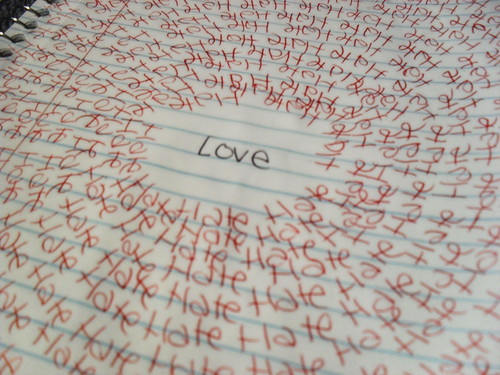
This poem was born as I was pondering 1 Corinthians 13, and it occurred to me that I might gain a better understanding of what love really is if I looked at it from the opposite side. Taking each description of love in this wonderful passage of scripture, I turned it on its head and saw what hate is. Afterall, hate is the opposite of love.

So here is my poem illustrating what the opposite of 1 Corinthians 13 looks like. (I don’t want to spoil anything, but the final line is my favorite.)

Hate Is . . .

Hate is impatient,
toe tapping, eye-rolling,
in a hurry for instant gratification

Hate is mean,
treating others unkindly,
bullying, and insulting

Hate is envious,
not happy for others’ prosperity,
wanting what others have,
and for them not to have it

Hate is boastful,
puffed up, pointing to self-accomplishments,
not recognizing contributions of others

Hate is not humble,
but is arrogant, filled with hubris
proudly thinking oneself better than all,
pretentious and vain, always vain

Hate is rude,
abusive and insulting, vulgar,
disrespectful, and never caring for others

Hate is self-seeking,
it’s-all-about-me attitude,
selfish and egotistical, self-important

Hate is easily angered,
irritated by the slightest mistake,
hot-headed, unwilling to forgive

Hate keeps a record of wrongs,
every little sin catalogued and indexed,
ready as part of its arsenal of hostility

Hate delights in evil,
revels in rebelling against authority,
is pleased to go its own way

Hate despises truth,
closes its ears to teaching,
refuses instruction and correction

Hate attacks,
harms loved ones and strangers alike,
injures all in its way without care

Hate distrusts,
lacks faith in God or anything,
doubts there is anything good

Hate despairs,
has no hope for a future,
lives in misery and sorrow

Hate gives up,
at the smallest obstacle it gives in,
is defeated by the tiniest tribulation

Hate never wins

Always remember that last line. Hate never wins. Satan never wins. And love never fails, ever! God’s love prevail for all of us on the cross.
Focus on a Known God

Note: I recently posted this on my blog, Linda Kruschke’s Blog, and right away I knew I needed to post it here at Broken Believers, too. I hope it will encourage many here.

Some things in life are unknown. Right now I’m facing the unknown of health concerns. After multiple tests, doctors still don’t know what is causing recent symptoms. I do have a list of what it is not. Whenever a test reveals that it is not something else I’m told it is good news. And I know that for the most part it is. But the difficult news remains that we don’t know what it is.

I thought of this post this morning, but decided not to write it because, frankly, I get tired of complaining about my health. I know there are a lot of people worse off than me, and I’m sure it gets old for others to hear about my various maladies.

Then I went to my list of blog subscriptions to see what others had posted for today. I clicked on a post by one of my favorite bloggers, Karla over at Out of Eden Ministries. The post was called “at the beginning going low.” She starts with a discussion of how Rahab the prostitute appears in the genealogy of Jesus in Matthew 1:5, and goes on to talk about how God makes the insignificant into a significant part of His plan. Karla writes:

Phone calls and prayers and prostitutes and a scarlet cord and you, yes you. Your life, your love, your pain, your prayer, and your hunger for more. All significant in the plans and the hands of God.”

I immediately knew I had to write this post after all, because although it starts with my insignificant struggle with pain and its unknown cause, it doesn’t end there. It ends with a focus on the known. What I thought of to write for today was how, even though I don’t know what is wrong with me, God does. And even more importantly, I know the truth of what God has revealed in His Holy Word. Here are some truths that I cling to, that I choose to focus on, as I face my insignificant struggles.

And we know that in all things God works for the good of those who love him, who have been called according to his purpose. Romans 8:28 (NIV).

For our light and momentary troubles are achieving for us an eternal glory that far outweighs them all. 2 Corinthians 4:17 (NIV).

And the God of all grace, who called you to his eternal glory in Christ, after you have suffered a little while, will himself restore you and make you strong, firm and steadfast. 1 Peter 5:10 (NIV).

“For I know the plans I have for you,” declares the LORD, “plans to prosper you and not to harm you, plans to give you hope and a future.” Jeremiah 29:11 (NIV).

My own struggles are light and momentary in the grand scheme of the universe and God’s plan. Though I will suffer a little while, Jesus will restore me and make me strong. He will use my sufferings for good in the big picture of His purpose. He has plans to prosper me spiritually, and He will faithfully fulfill this promise.

(You might be wondering why certain words are bolded in the above verses. These are the words I remember and that I used to find these verses on Biblegateway.com, since I seldom remember the actual chapter and verse of the scripture that I have stored up in my heart.)

Karla’s post made me realize that I needed to listen to the prompt in my spirit to post about my struggles and the known promises of God that I choose to focus on, because there just might be someone out there who is struggling too and needs to know that God is with them. If that happens to be you, then hold onto the promises of God and He will see you through.

What’s Your Pain Number?

If you have fibromyalgia, suffer from migraines, or have some other chronic pain illness, I think you can develop a skewed view of pain. Then when you go to the doctor because of some new or acute pain, and they ask “What’s your pain level on a scale of 1 to 10?”, I wonder if the answer is the same as it would be from someone who is otherwise healthy. I think that it may not be. I think when you deal with chronic pain what level of pain you consider tolerable – because there is no choice but to tolerate it – is much different than the person who is accustomed to living with a zero pain level.

It used to frustrate me when doctors would ask what my pain level was because I had no frame of reference for what was a 3 and what was a 9, or anything in between. Finally, several years ago, a pain specialist gave me a pain chart that I found very helpful in that it provides a description of each number on the pain scale. (I had to chuckle that they include “0 – No Pain” on the chart because I have no idea what that is like and wondered what the point of including this on the pain scale, except maybe to torment those of us who can never honestly say we are at 0.)

Anyway, I thought I would share this pain scale here, for those of you who have never had a doctor who was kind enough to give you a somewhat objective frame of reference. (I say somewhat objective because, as I said above, I think chronic pain can skew your view of what is tolerable pain.)

  1. Minimal = Pain is hardly noticeable.
  2. Mild = Feel a low level of pain; aware of pain only when paying attention to it.
  3. Uncomfortable = Pain is troubling but can be ignored most of the time.
  4. Moderate = Constantly aware of the pain but can continue normal activities.
  5. Distracting = Pain is barely tolerable; some activities limited by the pain.
  6. Distressing = Pain preoccupies thinking; must give up many activities due to pain.
  7. Unmanageable = Constant pain that interferes with almost all activities; often must take time off work; nothing seems to help.
  8. Intense = Severe pain makes it hard to concentrate on anything but the pain; conversations difficult.
  9. Severe = Can concentrate on nothing but the pain; can do almost nothing; can barely talk.
  10. Immobilizing = Pain is excruciating; unable to move except to seek immediate help for pain in emergency room, etc.; bedridden.

I recently experienced a pain in my side and abdomen that was different than and in a different place than any pain I have ever felt before. After talking to an advice nurse on the phone, I went to urgent care because she said I needed to be seen right away. She was concerned that it might be appendicitis or gall stones.

Once at urgent care, the doctor asked me the million dollar question, “What’s your level of pain on a scale of 1 to 10, with 10 being the worst pain you’ve ever felt?” I really wish I’d had my handy pain scale with me. If I compared the pain I was in that day to the worst pain I’ve ever experienced (which happens to be a 10 on the above scale), it really wasn’t that bad. I think I told him it was a 3 or 4. But based on the above scale it was more like 6 or 7.

It turned out I don’t have appendicitis, though they still haven’t figured out what is wrong. But as I thought about my experience with this urgent care doctor, a guy who didn’t know me at all, I wonder how seriously he took my complaint of pain since it was only at a level of 3 or 4. I wonder if someone else coming into urgent care whose “worst pain ever” was only a 5 on this scale would have answered his query much differently.

Reducing pain to a number doesn’t seem that helpful to me. Does a subjective number that is skewed by the patient’s prior pain experience really help a doctor with a diagnosis? I don’t know that it does. So I think I’m going to print off this pain scale on a small piece of paper that I can easily carry in my purse so that the next time I’m asked that question, I can pull it out and have an objective description of my pain for the doctor.