My Secret Temptations

Adam and Eve in the Garden by Michelangelo
Adam and Eve in the Garden, by Michelangelo

First and plainly, God has never tempted me to do anything evil. All that has come has been a test– to see if I would respond to sin. Whatever has come has me accepting the dark things over the light. God has no intention of seeing me fail in this. By resisting sin, I become strong. It is a gym of the Spirit.

I sin, because I want to. I will not excuse myself in this. I can’t blame God.

There are certain issues that I need to understand.

One, I must know the difference between needs and desires. We have a real need to know all that God has for us. But what I need and what I desire are separate issues. I dare not confuse the two.

Second, I’m to fix my eyes on Jesus. His own trials are meant to give me strength and purpose. He was tempted, but never sinned. His deepest passion is for me to understand this dynamic, We are not supposed to become casualties in this war against sin,.

Third,  admit your weakness over a certain sin. God blesses those who can do so, Power is give to all who admit their weakness. He is waiting for us to admit to all our flaws.

Fourth, there must be a willingness to resist sinning. Many breakdowns will come to thus point. We must want to hate the sin, but many will breakdown at this point. You must resist doing this.

Fifth, we must decide to flee certain things. Run from anything that stimulates youthful lusts. Instead, pursue righteous living, faithfulness, love, and peace. Enjoy the companionship of those who call on the Lord with pure hearts.” That is up to do whatever you decide.

Sixth, you must ally yourself to those who are focused on this process. Face it, “lukewarm” Christians will bring you down. But real believers will lead you to an authentic intimacy. Become a friend to all who stand against sin.

Seventh, meditate on what awaits you in this. The Word has certain promises for all who seek Him. Find them, and take them up as your own. Believe into them. Only this can truly protect you from sin. It’s like wearing sunscreen on a hot day, these promises help.

Eighth. Rejoice in the realization all this is temporary and victory is guaranteed. These all are only for a brief time. Someday we will be golden and stand clean before our Lord Jesus. Things will be understood, and we will shine like the stars in heaven.

aabryscript

Wounded and Healed, [Self Awareness]

I have a dear friend, Pastor Jim F. I have known him for over 20 years.  He has a real gift for understanding relationships. It is a knack that he has. Recently he made this observation, it is worth considering.

“The unhealed wounded, wound. The healed wounded, heal.” 

 You might have to read it slow.   But it seems that regardless, pain is the atmosphere we live in.  We can adjust, a certain degree at least.  But this planet remains a dangerous place.  Yet, healing does happen.  And we can than avoid  afflicting our pain on others.  It is possible.

There is little complexity in being wounded.  It is a word, a comment an inconsiderate act.  It happens quick, and its usually is not very sophisticated at all.  Children riding the school bus pierce the hearts of their classmates with frequency.  Husbands, crush their wives, and wives harm their children’s hearts.  We are seldom unscathed by the poison of each other.  We have mastered the art of hurting, and then call it social intelligence.

As Broken Believers we don’t have a monopoly on wholeness.  It may have given us an awareness, and may even have some remorse.  But it’s like we have the flu, we are intensely contagious.  Everyone who draws close, or crosses my path is infected.  I can be the “Typhoid Mary” of the Spirit.  At times, I seem to sicken everyone I meet.

I must be healed. My own wounds from over the years have accumulated.  They have been exacerbated–  made worse over time.  They say that time heals all wounds.  That seems logical, and encouraging even, but it simply isn’t real.  Maybe in an unfocused way, but much of the major woundings become much more painful.  I hurt worse now than ever.

I have has an ulcer on my tongue that won’t heal.  I have had it for the last 18 months.  It is painful, it wakes me up at night.  The sore rubs against my teeth and I start feeling like amputating my tongue to get some relief.  I am always aware of it, or so it seems.  My unhealed ulcerated tongue lowers me into reality.  On my heart there is another kind of ulcer.  Unkind words that have been spoken, hurtful things that have been done.

I guess I think it is both fitting and funny, for a preacher like me to be afflicted in this way.  I am being made aware that I speak words that sometimes harm and hurt.  Much of the things I say are simply normal, and maybe a bit boring.  But I can also speak venomous things.  And it is made worse because I carry the title of “pastor.”

We must be healed, we must be made whole.  We simply cannot continue to roll through people’s lives like we have for so long.  We must want to be healed, our hearts must be fixed, we are broken people.  If we are to bring healing, our own personal wholeness must first go to “the Great Physician.”  We cannot find strength in any other way.

ybic, Bryan

 

cropped-christiangraffiti1 (3)

7

(Lord, have mercy on us)

Coming Apart at the Seams, [S.A.D.]

sad-guy-alone
Seasonal Affective Disorder is real

If you notice periods of depression that seem to accompany seasonal changes during the year, you may suffer from seasonal affective disorder (SAD). This condition is characterized by recurrent episodes of depression – usually in late fall and winter – alternating with periods of normal or high mood the rest of the year.

Most people with SAD are women whose illness typically begins in their twenties, although men also report SAD of similar severity and have increasingly sought treatment. SAD can also occur in children and adolescents, in which case the syndrome is first suspected by parents and teachers. Many people with SAD report at least one close relative with a psychiatric condition, most frequently a severe depressive disorder (55 percent) or alcohol abuse (34 percent).

What are the patterns of SAD? Symptoms of “winter SAD” usually begin in October or November and subside in March or April. Some patients begin to slump as early as August, while others remain well until January. Regardless of the time of onset, most patients don’t feel fully back to normal until early May.

Their depressions are usually mild to moderate, but they can be severe. Very few patients with SAD have required hospitalization, and even fewer have been treated with electroconvulsive therapy.

The usual characteristics of recurrent winter depression include:

  • oversleeping,
  • daytime fatigue,
  • carbohydrate craving
  • and weight gain, although a patient does not necessarily show these symptoms.

Additionally, there are the usual features of depression, especially decreased sexual interest, lethargy, hopelessness, suicidal thoughts, lack of interest in normal activities, and social withdrawal.

Treating your SAD

Light therapy is now considered the first-line treatment intervention, and if properly dosed can produce relief within days. Antidepressants may also help, and if necessary can be used in conjunction with light. In about 1/10th of cases, annual relapse occurs in the summer rather than winter, possibly in response to high heat and humidity. During that period, the depression is more likely to be characterized by insomnia, decreased appetite, weight loss, and agitation or anxiety.

Interestingly, patients with such “reverse SAD” often find relief with summer trips to cooler climates in the north. Generally, normal air conditioning is not sufficient to relieve this depression, and an antidepressant may be needed. In still fewer cases, a patient may experience both winter and summer depressions, while feeling fine each fall and spring, around the equinoxes. The most common characteristic of people with winter SAD is their reaction to changes in environmental light.

Latitudes effect attitudes

Patients living at different latitudes note that their winter depressions are longer and more profound the farther north they live. Patients with SAD also report that their depression worsens or reappears whenever the weather is overcast at any time of the year, or if their indoor lighting is decreased. SAD is often misdiagnosed as hypothyroidism, hypoglycemia, infectious mononucleosis, and other viral infections.

http://www.ncpamd.com/seasonal.htm

http://www.mayoclinic.com/health/seasonal-affective-disorder/DS00195

http://www.alaskanorthernlights.com/


cropped-christiangraffiti1.jpg

Of Adjectives and Disorders [Mental Illness]

4e327a2ad597c5b4d01de2a30649b04d

“Therefore each of you must put off falsehood and speak truthfully to your neighbor, for we are all members of one body.”

Ephesians 4:25, NIV

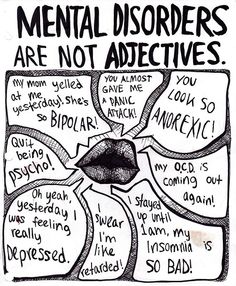
I catch myself using this strange new vocabulary quite a bit. There is a tendency to make adjectives where there should be nouns. There is an ‘in exactness’ in our thinking and speech.

Now we’re not the ‘policemen’ of other people’s grammar. We just should be aware of becoming too casual with mental disorders that can be quite debilitating to quite a few people. Do I ‘joke about’ having OCD when I try to do something precisely? (Sometimes.) Can I make light of being rather ‘retarded’ by some bone-head action I do? (More often than I’d like.)

I find I use terminology like this to explain ‘actions’ to give them a legitimacy as well as a medical reason to a situation. But when I do so, I can demean other people who actually are going through them for real. I also can label myself when I use these adjectives this way.

We really must be careful. We can use our language in such way that reveals our ignorance of the medical and psychological status of disorders. When we use words casually we start to ‘dilute’ them. They can describe a ‘reality’ of things that don’t really exist; we then end up speaking falsely and minimize the severity of a disorder.

“The true test of a man’s spirituality is not his ability to speak, as we are apt to think, but rather his ability to bridle his tongue.”

R. Kent Hughes

As a Christian believer, I also suffer from Bipolar disorder with delusions and anxiety. And yet, the Word tells me to always “speak the truth in love.” (Eph. 4:15). Listen to yourself, and let the Holy Spirit guard your words.

“Set a guard over my mouth, Lord;
    keep watch over the door of my lips.”

Psalm 141:3

bry-signat (1)

cropped-christiangraffiti1.jpg