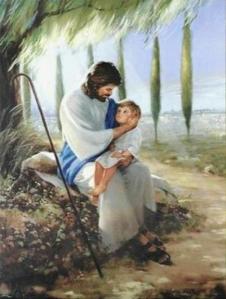
For a Child Born Without Eyes

A Pastor’s Letter to the Parents of a Child Born Blind

Dear John and Diane,

You are the child, and He is your father

Last night, as I prayed with Noel, you were heavy on my mind. I said, “Lord, O Lord, please let me be a pastor who preaches and leads and loves in a way that makes the impossibilities of life possible for your people by a miracle of sustaining grace. Help me to know the weight and pain of this life and not to be breezy when the mountains have fallen into the sea. Help me to have the aroma of Christ’s sufferings about me. Prevent shallowness and callousness to pain. O Lord make me and my people a burden bearing  people.”

O John and Diane, I am so heavy with your child’s sightlessness!

God is visiting Bethlehem with such pain these days in the birth of broken children. Randy and Ann Erickson with their baby’s broken heart; Jan and Rob Barrett with their baby’s liver outside the body; and your precious little one! Is the Lord saying, “I have a gift for your community.” This is not one or two or three couples’ burden. This is a gift and call to the whole church. This word concerning the brokenness of this fallen age of futility. This is an invitation for you all to believe that here we have no lasting city (Hebrews 13:14).

This is an invitation for you to count every gain as loss for the sake of Christ (Philippians 3:7). This is a shocking test to see if you will “lose heart” when in fact God’s purpose is to show that his grace is sufficient to renew our inner person every day to deal with the “slight momentary affliction which is preparing for us an eternal weight of glory beyond all comparison, because we look not to the things that are seen but to the things that are unseen; for the things that are seen are transient, but the things that are unseen are eternal (2 Corinthians 4:17-18).

O Lord, open our eyes to your love in this pain.

Open our eyes. Then Elisha prayed, and said, ‘O Lord, I pray thee, open his eyes that he may see.’ So the Lord opened the eyes of the young man, and he saw; and behold, the mountain was full of horses and chariots of fire round about Elisha” (2 Kings 6:17). John and Diane, the mountains surrounding your lives are filled with the horses and chariots of God.

Only to the eyes of unbelief does the devil have the upper hand here. God is at work in ways and for years and generations and millions of people that we cannot now imagine.

 This is ours to believe and to bear, no matter the cost. This is ours for this short life. It seems to me that this life is a proving ground for the kingdom to come. Some are asked to devote forty or fifty years to caring for a handicapped child instead of breezing through life without pain. Others are asked to be blind all their lives… But only in this life – ONLY in this life some are . I want to be the kind person who makes that “ONLY” what it really is – very short. Prelude to the infinity of joy, joy, joy.

But not yet. Not entirely.

How will we ever cope with the burdens of this life if we believe this is all there is, or even the main act in this drama of reality? O Lord, give us your view of things. May God fill you with anticipated joy. I consider that the sufferings of this present time are not worth comparing with the glory that is to be revealed to us.”

I love you,

Pastor John Piper


This is taken from the volunteer disability ministry blog for Bethlehem Baptist Church, Minneapolis, MN.

Mastered by Jesus

“A Christian is a person who has died with Christ, whose stiff neck has been broken, whose brazen forehead has been shattered, whose stony heart has been crushed, whose pride has been slain, and whose life is now mastered by Jesus Christ.”

–John Piper

No longer do I call you servants, for a servant does not know what his master is doing; but I have called you friends, for all things that I heard from My Father I have made known to you.”

John 15:15

I believe that the purpose of life is not to find our freedom. It’s really meant to find our Master.

Yes, the idea of being a slave to anyone is repugnant. We chafe at this, and yet man was never meant to be seperated from the Lordship of Jesus. We’re instructed repeatedly with the New Testament idea that “our life is not our own”  Over and over God proclaims Himself as the King.

That troubles us somewhat.

Not so much when life is fairly good, granted, but in those hard moments when a decision must be made between enjoying the titillating “lusts of the flesh,” or accepting the fruits of the Spirit. This is one of those “lordship moments.” They come, and go, and they show us exactly who we are.

If you’re really going to be authentic–a legitimate and real disciple, then you must determine who is going to be “boss.” This isn’t one of those casual decisions. You must securely fix it in your heart.

Your decision must become a settled issue.

The thief on the cross knew salvation, he was promised an eternity with God simply by faith. But I submit to you that he had put himself under the Lordship of Jesus, simply by recognizing the sign, “the King of the Jews.” I believe he saw and understood its imlications. Jesus was King!

This is a very hard word for some, but many of our personal issues hinge on this.

I know this first-hand. It can be a monumental struggle. You must admit to not only having Jesus as your Savior, but you also must put your life under His total Lordship.  You need to pick up your cross daily in order to follow.  You need to learn how to kneel.

I’ve chosen a crown to open up this post–it’s done on purpose.  I simply want you to to understand the supreme call He has on your life.

“The question in salvation is not whether Jesus is Lord, but whether we are submissive to His lordship.”

    John MacArthur

You must learn here and now how to kneel before the Sovereign King.


Christ and Cancer

NIH illustration
illustration by NIH

by John Piper

Before I entered college I hardly gave a thought to cancer and terminal illness. But ever since those college days death by disease has walked beside me all the way. Two of my college acquaintances died of leukemia and cancer of the lymph glands before they were 22. At seminary I watched Jim Morgan, my teacher of systematic theology, shrivel up and die in less than a year of intestinal cancer. He was 36. In my graduate program in Germany my own “doctor-father,” Professor Goppelt, died suddenly just before I was finished. He was 62—a massive coronary. Then I came to Bethel, the house of God! And I taught for six years and watched students, teachers, and administrators die of cancer: Sue Port, Paul Greely, Bob Bergerud, Ruth Ludeman, Graydon Held, Chet Lindsay, Mary Ellen Carlson—all Christians, all dead before their three score and ten were up. And now I’ve come to Bethlehem and Harvey Ring is gone. And you could multiply the list ten-fold.

What shall we say to these things? Something must be said because sickness and death are threats to faith in the love and power of God. And I regard it as my primary responsibility as a pastor to nourish and strengthen faith in the love and power of God. There is no weapon like the Word of God for warding off threats to faith. And so I want us to listen carefully today to the teaching of Scripture regarding Christ and cancer, the power and love of God over against the sickness of our bodies.

I regard this message today as a crucial pastoral message, because you need to know where your pastor stands on the issues of sickness, healing, and death. If you thought it was my conception that every sickness is a divine judgment on some particular sin, or that the failure to be healed after a few days of prayer was a clear sign of inauthentic faith, or that Satan is really the ruler in this world and God can only stand helplessly by while his enemy wreaks havoc with his children—if you thought any of those were my notions, you would relate to me very differently in sickness than you would if you knew what I really think. Therefore, I want to tell you what I really think and try to show you from Scripture that these thoughts are not just mine but also, I trust, God’s thoughts.

Six Affirmations Toward a Theology of Suffering

So I would like everyone who has a Bible to turn with me to Romans 8:18–28. There are six affirmations which sum up my theology of sickness, and at least the seed for each of these affirmations is here. Let’s read the text:

I consider that the sufferings of this present time are not worth comparing with the glory that is to be revealed to us. For the creation waits with eager longing for the revealing of the sons of God; for the creation was subjected to futility, not of its own will but by the will of him who subjected it in hope; because the creation itself will be set free from its bondage to decay and obtain the glorious liberty of the children of God. We know that the whole creation has been groaning in travail together until now; and not only the creation, but we ourselves, who have the first fruits of the Spirit, groan inwardly as we wait for adoption as sons, the redemption of our bodies. For in this hope we were saved. Now hope that is seen is not hope. For who hopes for what he sees? But if we hope for what we do not see, we wait for it with patience.

Likewise the Spirit helps us in our weakness; for we do not know how to pray as we ought, but the Spirit himself intercedes for us with sighs too deep for words. And he who searches the hearts of men knows what is the mind of the Spirit, because the Spirit intercedes for the saints according to the will of God.

We know that in everything God works for good with those who love him, who are called according to his purpose. (RSV)

1. All Creation Has Been Subjected to Futility

My first affirmation is this: the age in which we live, which extends from the fall of man into sin until the second coming of Christ, is an age in which the creation, including our bodies, has been “subjected to futility” and “enslaved to corruption.” Verse 20: “The creation was subjected to futility.” Verse 21: “The creation will be freed from slavery to corruption.” And the reason we know this includes our bodies is given in verse 23: not only the wider creation but “we ourselves (i.e., Christians) groan in ourselves awaiting sonship, the redemption of our bodies.” Our bodies are part of creation and participate in all the futility and corruption to which creation has been subjected.

Who is this in verse 20 that subjected creation to futility and enslaved it to corruption? It is God. The only other possible candidates to consider would be Satan or man himself. Perhaps Paul meant that Satan, in bringing man into sin, or man, in choosing to disobey God—perhaps one of them is referred to as the one who subjected creation to futility. But neither Satan nor man can be meant because of the words “in hope” at the end of verse 20. This little phrase, subjected “in hope,” gives the design or purpose of the one who subjected creation to futility. But it was neither man’s nor Satan’s intention to bring corruption upon the world in order that the hope of redemption might be kindled in men’s hearts and that someday the “freedom of the glory of the children of God” might shine more brightly. Only one person could subject the creation to futility with that design and purpose, namely, the just and loving creator.

Therefore, I conclude that this world stands under the judicial sentence of God upon a rebellious and sinful mankind—a sentence of universal futility and corruption. And no one is excluded, not even the precious children of God.

Probably the futility and corruption Paul speaks of refers to both spiritual and physical ruination. On the one hand man in his fallen state is enslaved to flawed perception, misconceived goals, foolish blunders, and spiritual numbness. On the other hand, there are floods, famines, volcanoes, earthquakes, tidal waves, plagues, snake bites, car accidents, plane crashes, asthma, allergies, and the common cold, and cancer, all rending and wracking the human body with pain and bringing men—all men—to the dust.

As long as we are in the body we are slaves to corruption. Paul said this same thing in another place. In 2 Corinthians 4:16 he said, “We do not lose heart, but though our outer man (i.e., the body) is decaying (i.e., being corrupted) yet our inner man is being renewed day by day.” The word Paul uses for decay or corrupt here is the same one used in Luke 12:33 where Jesus said, Make sure your treasure is in heaven “where thief does not come near and moth does not corrupt.” Just like a coat in a warm, dark closet will get moth eaten and ruined, so our bodies in this fallen world are going to be ruined one way or the other. For all creation has been subjected to futility and enslaved to corruption while this age lasts. That is my first affirmation.

2. An Age of Deliverance and Redemption Is Coming

My second affirmation is this: there is an age coming when all the children of God, who have endured to the end in faith, will be delivered from all futility and corruption, spiritually and physically. According to verse 21, the hope in which God subjected creation was that some day “The creation itself also will be set free from its slavery to corruption into the freedom of the glory of the children of God.” And verse 23 says that “We ourselves groan within ourselves waiting eagerly for our adoption as sons, the redemption of our bodies.” It has not happened yet. We wait. But it will happen. “Our citizenship is in heaven from which we await a Savior, the Lord, Jesus Christ, who will transform the body of our lowliness to be like the body of his glory” (Philippians 3:20, 21). “In a moment, in the twinkling of an eye, at the last trumpet, for the trumpet will sound and the dead will be raised incorruptible and we shall be changed” (1 Corinthians 15:52). “He will wipe away every tear from our eyes, and there shall be no longer any death; and there shall be no longer any mourning or crying or pain; the first things have passed away” (Revelation 21:4).

There is coming a day when every crutch will be carved up, and every wheelchair melted down into medallions of redemption. And Merlin and Reuben and Jim and Hazel and Ruth and all the others among us will do cartwheels through the Kingdom of Heaven. But not yet. Not yet. We groan, waiting for the redemption of our bodies. But the day is coming and that is my second affirmation.

3. Christ Purchased, Demonstrated, and Gave a Foretaste of It

Third, Jesus Christ came and died to purchase our redemption, to demonstrate the character of that redemption as both spiritual and physical, and to give us a foretaste of it. He purchased our redemption, demonstrated its character, and gave us a foretaste of it. Please listen carefully, for this is a truth badly distorted by many healers of our day.

The prophet Isaiah foretold the work of Christ like this in 53:5–6 (a text which Peter applied to Christians in 1 Peter 2:24):

But he was wounded for our transgressions, he was bruised for our iniquities; upon him was the chastisement that made us whole, and with his stripes we are healed. All we like sheep have gone astray; we have turned every one to his own way; and the Lord has laid on him the iniquity of us all. (RSV)

The blessing of forgiveness and the blessing of physical healing were purchased by Christ when he died for us on the cross. And all those who give their lives to him shall have both of these benefits. But when? That is the question of today. When will we be healed? When will our bodies no longer be enslaved to corruption?

Continue reading “Christ and Cancer”

Antidepressants for Believers?

What do you think of Christians taking antidepressants?

By Pastor John Piper, given on March 30, 2010

The following is an edited transcript of the audio.

What do you think of Christians taking antidepressants? I have been on them and have been accused of not relying on God.

That relates to an earlier question about how any physical or personal means that you use can signify that you’re not relying on God. So eating might be a failure to rely on God, because he might just fill your stomach by miracle, and you don’t have to eat. Or not sleeping would be a way of relying more on God, since you don’t have to have your psyche made stable by sleep at night. And so on.

God has ordained physical means. Aside from the ones that seem more natural, like food, there’s medicine: aspirin, Nyquil, etc. This water is helping my throat right now. [Sips it.] Was that sip a failure to rely on God?

Could be. “Just throw this away and rely on God! He will keep your throat moist. You don’t need to be drinking. You’re an idolater, Piper. You’re idolizing this because you’re depending on it.”

Well, the reason that’s not the case is because God has ordained for me to thank him for that. He created it and he made this body to need a lot of fluid. And it’s not a dishonor to him if I honor him through his gift.

Now the question is, “What medicines are like that or not like that?” Taking an aspirin?

My ophthalmologist told me about 4 years ago, “Take one baby aspirin a day and you will postpone cataracts or glaucoma or something.” He said, “I can see just the slightest little discoloration, and the way it works is that circulation helps.” So he told me to pop one of these little pills in my little vitamin thing. And I take it every day. And I just said, “Lord, whether I have eyes or not is totally dependent on you. But if you would like me to use this means, I would.”

My answer is that when you start working with peoples’ minds, you are in a very very tricky and difficult situation. But I think I want to say that, while nobody should hasten towards medication to alter their mental states—even as I say it I think of caffeine, right?—nevertheless, I know from reading history, like on William Cooper, and by dealing with many people over the years, that there are profoundly physical dimensions to our mental conditions.

Since that’s the case, physical means can be appropriate. For me it’s jogging. I produce stuff in my brain by jogging. But that might not work for somebody else, and they might be constantly unable to get on top of it emotionally. I just don’t want to rule out the possibility that there is a physical medication that just might, hopefully temporarily, enable them to get their equilibrium, process the truth, live out of the strength of the truth, honor God, and go off it.

When I preached on this one Easter Sunday a woman wrote me, thanking me that I took this approach. She said, “You just need to know that I live on these things, and I know what it was like 20 years ago and the horrors and the blackness of my life. And now I love Christ, I trust Christ, I love my husband, our marriage is preserved, and I’ll probably be on these till I’m dead.”

So I’m not in principle opposed. I just want to be very cautious in the way we use antidepressants.


© Desiring God

Permissions: You are permitted and encouraged to reproduce and distribute this material in any format provided that you do not alter the wording in any way and do not charge a fee beyond the cost of reproduction. For web posting, a link to this document on our website is preferred. Any exceptions to the above must be approved by Desiring God.

Please include the following statement on any distributed copy: By John Piper. © Desiring God. Website: desiringGod.org