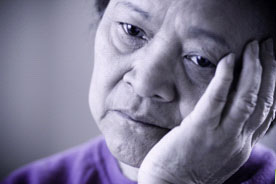
Focus on a Known God

Note: I recently posted this on my blog, Linda Kruschke’s Blog, and right away I knew I needed to post it here at Broken Believers, too. I hope it will encourage many here.

Some things in life are unknown. Right now I’m facing the unknown of health concerns. After multiple tests, doctors still don’t know what is causing recent symptoms. I do have a list of what it is not. Whenever a test reveals that it is not something else I’m told it is good news. And I know that for the most part it is. But the difficult news remains that we don’t know what it is.

I thought of this post this morning, but decided not to write it because, frankly, I get tired of complaining about my health. I know there are a lot of people worse off than me, and I’m sure it gets old for others to hear about my various maladies.

Then I went to my list of blog subscriptions to see what others had posted for today. I clicked on a post by one of my favorite bloggers, Karla over at Out of Eden Ministries. The post was called “at the beginning going low.” She starts with a discussion of how Rahab the prostitute appears in the genealogy of Jesus in Matthew 1:5, and goes on to talk about how God makes the insignificant into a significant part of His plan. Karla writes:

Phone calls and prayers and prostitutes and a scarlet cord and you, yes you. Your life, your love, your pain, your prayer, and your hunger for more. All significant in the plans and the hands of God.”

I immediately knew I had to write this post after all, because although it starts with my insignificant struggle with pain and its unknown cause, it doesn’t end there. It ends with a focus on the known. What I thought of to write for today was how, even though I don’t know what is wrong with me, God does. And even more importantly, I know the truth of what God has revealed in His Holy Word. Here are some truths that I cling to, that I choose to focus on, as I face my insignificant struggles.

And we know that in all things God works for the good of those who love him, who have been called according to his purpose. Romans 8:28 (NIV).

For our light and momentary troubles are achieving for us an eternal glory that far outweighs them all. 2 Corinthians 4:17 (NIV).

And the God of all grace, who called you to his eternal glory in Christ, after you have suffered a little while, will himself restore you and make you strong, firm and steadfast. 1 Peter 5:10 (NIV).

“For I know the plans I have for you,” declares the LORD, “plans to prosper you and not to harm you, plans to give you hope and a future.” Jeremiah 29:11 (NIV).

My own struggles are light and momentary in the grand scheme of the universe and God’s plan. Though I will suffer a little while, Jesus will restore me and make me strong. He will use my sufferings for good in the big picture of His purpose. He has plans to prosper me spiritually, and He will faithfully fulfill this promise.

(You might be wondering why certain words are bolded in the above verses. These are the words I remember and that I used to find these verses on Biblegateway.com, since I seldom remember the actual chapter and verse of the scripture that I have stored up in my heart.)

Karla’s post made me realize that I needed to listen to the prompt in my spirit to post about my struggles and the known promises of God that I choose to focus on, because there just might be someone out there who is struggling too and needs to know that God is with them. If that happens to be you, then hold onto the promises of God and He will see you through.

What’s Your Pain Number?

If you have fibromyalgia, suffer from migraines, or have some other chronic pain illness, I think you can develop a skewed view of pain. Then when you go to the doctor because of some new or acute pain, and they ask “What’s your pain level on a scale of 1 to 10?”, I wonder if the answer is the same as it would be from someone who is otherwise healthy. I think that it may not be. I think when you deal with chronic pain what level of pain you consider tolerable – because there is no choice but to tolerate it – is much different than the person who is accustomed to living with a zero pain level.

It used to frustrate me when doctors would ask what my pain level was because I had no frame of reference for what was a 3 and what was a 9, or anything in between. Finally, several years ago, a pain specialist gave me a pain chart that I found very helpful in that it provides a description of each number on the pain scale. (I had to chuckle that they include “0 – No Pain” on the chart because I have no idea what that is like and wondered what the point of including this on the pain scale, except maybe to torment those of us who can never honestly say we are at 0.)

Anyway, I thought I would share this pain scale here, for those of you who have never had a doctor who was kind enough to give you a somewhat objective frame of reference. (I say somewhat objective because, as I said above, I think chronic pain can skew your view of what is tolerable pain.)

  1. Minimal = Pain is hardly noticeable.
  2. Mild = Feel a low level of pain; aware of pain only when paying attention to it.
  3. Uncomfortable = Pain is troubling but can be ignored most of the time.
  4. Moderate = Constantly aware of the pain but can continue normal activities.
  5. Distracting = Pain is barely tolerable; some activities limited by the pain.
  6. Distressing = Pain preoccupies thinking; must give up many activities due to pain.
  7. Unmanageable = Constant pain that interferes with almost all activities; often must take time off work; nothing seems to help.
  8. Intense = Severe pain makes it hard to concentrate on anything but the pain; conversations difficult.
  9. Severe = Can concentrate on nothing but the pain; can do almost nothing; can barely talk.
  10. Immobilizing = Pain is excruciating; unable to move except to seek immediate help for pain in emergency room, etc.; bedridden.

I recently experienced a pain in my side and abdomen that was different than and in a different place than any pain I have ever felt before. After talking to an advice nurse on the phone, I went to urgent care because she said I needed to be seen right away. She was concerned that it might be appendicitis or gall stones.

Once at urgent care, the doctor asked me the million dollar question, “What’s your level of pain on a scale of 1 to 10, with 10 being the worst pain you’ve ever felt?” I really wish I’d had my handy pain scale with me. If I compared the pain I was in that day to the worst pain I’ve ever experienced (which happens to be a 10 on the above scale), it really wasn’t that bad. I think I told him it was a 3 or 4. But based on the above scale it was more like 6 or 7.

It turned out I don’t have appendicitis, though they still haven’t figured out what is wrong. But as I thought about my experience with this urgent care doctor, a guy who didn’t know me at all, I wonder how seriously he took my complaint of pain since it was only at a level of 3 or 4. I wonder if someone else coming into urgent care whose “worst pain ever” was only a 5 on this scale would have answered his query much differently.

Reducing pain to a number doesn’t seem that helpful to me. Does a subjective number that is skewed by the patient’s prior pain experience really help a doctor with a diagnosis? I don’t know that it does. So I think I’m going to print off this pain scale on a small piece of paper that I can easily carry in my purse so that the next time I’m asked that question, I can pull it out and have an objective description of my pain for the doctor.

Hope in the Darkness

Winter can be a particularly trying time for those who struggle with depression and bipolar disorder. The increased darkness outside can begin to reflect in our hearts and so increase the darkness within.

I know Pr. Bryan has posted here before about the challenge of winters in Alaska where the days are extremely short. But even in the Pacific Northwest, Seasonal Affective Disorder is a big problem. When you drive to work in very little light and drive home again in pitch dark, which is even darker when it is raining, it is hard to remember the long days of summer.

It is during this dark season that we must cling even more to the Light of Christ so that the darkness does not overcome us. We must cling to the faithfulness of our God who brings the sun every morning and the seasons in their turn, so that we know spring and summer will follow the darkness.

Thinking about this one dark night earlier this week, I wrote a poem, which I posted on my blog, Linda Kruschke’s Blog, as a Thankful Thursday post. I hope you like my ode to God’s promise of hope and light that stands firm even in the darkness, and that it reminds you of the hope we have in Jesus.

Hope in the Darkness

Sun sinks below the horizon
Darkness envelopes all life in my view
Each night the darkness comes sooner
Each morning the sun arises anew

This season, winter, brings darkness
It seems to engulf the light of my soul
Sometimes the darkness is deeper
And blacker than the blackest mine of coal

But winter does not last forever
Spring and summer bring sun ever near
Hope of a Light everlasting
Is all that my darkened soul needs to hear

In him was life, and that life was the light of all mankind. The light shines in the darkness, and the darkness has not overcome it.

John 1:4-5 (NIV).

My Favorite Name

This is a post that I first wrote on my own blog, Linda Kruschke’s Blog, in December of 2009. I somehow stumbled upon it the other day and thought it would be a good one to share here at Broken Believers. It is a good reminder that God is with us, and God wants us to be with Him. That is true for each and every person, no matter how broken or lost.

As Christmas is fast approaching, I’ve been thinking about the many names given to Jesus in the Bible. He is called the Son of God, the Son of Man, the Prince of Peace, King of Kings, Lord of Lords, Alpha & Omega, and many more. But my favorite name of Jesus is Immanuel.

The prophet Isaiah wrote:

“Therefore the Lord himself will give you a sign: The virgin will be with child and will give birth to a son, and will call him Immanuel.

Isaiah 7:14

This verse is quoted in Matthew 1:23 regarding Jesus, and in Matthew the writer defines the name Immanuel to mean “God with us.”

When I look at one of my many nativity scenes, that is what I see: God with us. For thousands of years God tried to get the message across to His people that He loved them and would always be there for them. He spoke through miracles, such as the parting of the Red Sea, and through prophets, such as Isaiah and Daniel. But in spite of all His attempts to get through to them, His people didn’t always get it.

So God decided to become one of us, to be with us, to experience life just as we do. I like the name Immanuel because it reminds me that God loves us enough to be willing to experience all the pain, trials, and heartache that we do, to fully understand how we experience relationships and love. God did this in hopes that we could and would better relate to Him. Because ultimately what He wants is for us to be with Him.

This Christmas, I hope you will feel the blessing of being with God and of God being with you. I hope you will experience the fullness of Immanuel.