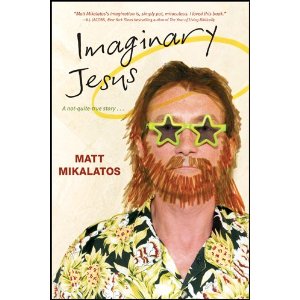
This was a book saturated with holy surprises. For sure, the title seemed eccentric and I couldn’t be certain that it be worth reading. After I read several pages I was able to use my own “spiritual” GPS and locate, and understand the “lay-of-the-land.” There was a sense of reading something very fresh, and striding to keep up with Mikalotos. I discovered that I couldn’t wait for the next page, which is a great indicator.
Imaginative and engaging. If this book transformed into a person, I would immediately invite him to my living room for coffee and a conversation. I would not hesitate. Plot and content wise–this is a narrative of a man’s journey to what is real. Especially in the spiritual realm of the truth, where it is best to possess what you confess.
The book unfolds with adventure after adventure. It has a plot that seems like sci-fi. It is both exotic and friendly, all at the same time. If I could think out loud my impressions of “Imaginary Jesus” in a single word it would be “winsome.” Mikalatos presses into our imaginations a journey that is both amusing as it is cutting. It is a fun read, that is explosive and sure, it puts together for us an understanding of our own hearts in this generation.
Outside Review: “Take the theological forcefulness of Bonhoeffer, combine it with the imaginative whimsy of C. S. Lewis and the wit of Charles Spurgeon, and you get Matt Mikalatos. Imaginary Jesus marks the debut of one of today’s most prominent young Christian writers. “(Gary Thomas, Author of Sacred Marriage and Pure Pleasure )
————————-
I purchased my book direct from Amazon.com for $10.19 USD.
Paperback: 240 pages
Publisher: BarnaBooks (March 18, 2010)
Language: English
ISBN-10:9781414335636
ISBN-13:978-1414335636
ASIN:1414335636
Product Dimensions: 8.2 x 5.6 x 0.5 inches
Average Customer Review: 4.3 out of 5 stars. (134 customer reviews)
Amazon Bestsellers Rank: #75,518 in Books (See Top 100 in Books)
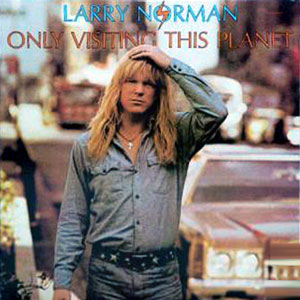
Larry David Norman (April 8, 1947 – February 24, 2008[1]) was an American Christian musician, singer, songwriter, record label owner, record producer, writer, playwright, actor, photographer, and humorist, who is credited as “a key figure in the development of contemporary Christian music“,[2] “the most significant artist in the creation of contemporary Christian music (CCM)”,[3] the “father of Christian rock music”,[4] the “Godfather of gospel rock”;[5] “Christianity’s first rock star”,[6] the “bad boy of Christian music”,[7] and “the poet laureate of the Jesus revolution”.[8] “By 1970, Norman had the most recognized name (and face) in the Jesus Movement and the Christian music scene”,[9] with Time magazine soon describing him as “probably the top solo artist in the field”.[10] While he had long been associated with the Jesus people,[11][12] and was even described as “the personification of the Jesus Movement of the late ’60s and early ’70s”,[13] Norman himself “did not particularly identify himself with the youth-oriented ‘Jesus movement’ of the time”.[14][15] He has been credited with having a significant influence on many artists, both secular and religious.[16] Norman has also been described as having a “propensity for spinning stories”,[17] and a “penchant for revisionist history”.[18]
Since Norman’s first professional release in 1967, more than 100 of his own albums have been released through such commercial record labels as Capitol, MGM, Verve, and his own independent labels: One Way Records, Solid Rock Records, Street Level Records, and Phydeaux Records. Norman’s first album, I Love You, recorded when he was one of the lead singers for the group People!, was released in 1968. The band’s cover version of The Zombies song of the same name reached number 14 on Billboard magazine‘s top twenty list in 1968 as a single.[19] Norman left People! in 1968 and subsequently performed as a solo artist, appearing both on mainstream and independent labels.[20] In 1969 Norman recorded Upon This Rock, “the first commercially released Jesus rock album”,[21] and in 1972 one of “the most influential Christian rock records of all time”, Only Visiting This Planet.[22] Norman’s recordings are noted for their Christian and social subject matter, having successfully “wed the rhythms of pop music with the spiritual and social outlook of Christianity to create a kind of flower-power gospel.”
–Copied from Wikipedia, the free encyclopedia
My note: Larry Norman seemed to struggle most of his life. He was a very talented and gifted songwriter. Some of his “issues” seem to be proceed from what some considered bipolar disorder, but that probably was never medically confirmed. He was known by many to be a rascal (the kind of person we minister to at BB.)
An excerpt from Christianity Today, announcing his death.
“Christian music legend Larry Norman died Sunday of heart failure, according to his brother Charles Norman. He was 60.
Norman, a blonde, long-haired rocker who is often called the father of Christian rock music, was a giant in the Christian music industry, said Chris Willman, senior music writer for Entertainment Weekly.
“His influence outweighed his sales so much that it’s comical,” Willman said. “He certainly had a heart for evangelism — almost to his detriment, I might say. He really could’ve been a star if he were singing about something other than Jesus.”
Norman’s 1972 Only Visiting This Planet album is regarded as one of the top contemporary Christian music albums of all time. His many hits were at the cutting edge, said Larry Eskridge, associate director of the Institute for the Study of American Evangelicals at Wheaton College.
“The song ‘Why Should the Devil Have All the Good Music?’ was one of his enduring trumpet blasts against the stodgy, old Christian establishment,” Eskridge said. “‘I Wish We’d All Been Ready’ fit with the end times, apocalyptic feel that was in the air at the time.”
“I Wish We’d All Been Ready” was also featured in the 1972 end times film, A Thief in the Night. In concerts, the singer gave his trademark “One Way” gesture, pointing an index finger toward heaven.
Eskridge said Norman was an icon during the Jesus People of the 1960s but distanced himself from the movement when it became a fad and eventually faded.”
There is a considerable interest in the last words of a person. Within them we believe we are hearing words of wisdom and understanding. Jesus is on his last legs, and he is just waiting until they come and collect him for crucifixion. He moves directly in this. He is never caught off guard. Jesus knows deep-down what is going to happen.
There is an urgency here. And Jesus starts to pray. He begins to intercede for his followers. They are like “babes in the woods.” Because of them, he stands as an intercessor for their safety and all that each might step into. He loves people, and shows it by his prayer life.
But Jesus reaches. He not only prays for his disciples, but he extends further. He starts praying for everyone who will follow him. He intercedes for you and for me. This is terribly important to him. And for us it is a bit astounding. Jesus prayed for me. He knew we would come to this place of faith.
When we consider Jesus’ prayer life, we find it to be two things–The first is to be efficient and strong. The second is to be reaching each believer, whatever generation and whatever culture. First world, or third world. He establishes by prayer his victory in the lives of everyone who follows him.
Jesus has the distinct and plain approach of “standing in the gap” for you and me. It isn’t a long prayer, but it carries a momentum and power that reaches us. The prayers of Jesus for us are short, but spiritually sweet. Perhaps, that is the reason you are standing at all!
We live in such grace. Wherever we look, we should be able to see it. The new-agers speak of everyone having an aura. Perhaps a small slice of this carries some truth. Each of us, as believers, carries a definite presence of something supernatural. We can’t explain it. But this is real, and authentic.
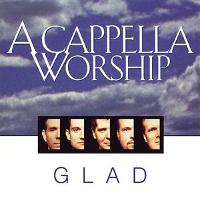
GLAD is one of the pioneers of Christian pop/rock and a cappella music, having formed as a progressive rock group in 1972 and discovered a large audience for their a cappella music in 1988.
Today, with over 1.5 million albums sold, they continue to perform concerts and release occasional recordings. As Contemporary Christian Music (CCM Magazine) described it, “GLAD’s elegant vocals helped set them apart from other pioneers of Contemporary Christian music. That vocal sound has since evolved into a complex, self-sustaining life form of its own…” The GLAD sound is known for its tight harmonies and intricate arrangements with classical and jazz overtones. Some of their hits over the years have included “Be Ye Glad,” “Maker of My Heart,” “God is My Rock,” “The Easter Song,” “You Put This Love in My Heart,” and “Color Outside the Lines.
In these days of confused situations.
In these nights of a restless remorse,
When the heart and the soul of the nation,
lay wounded and cold as a corpse.
From the grave of the innocent Adam,
comes a song bringing joy to the sad.
Oh your cry has been heard and the ransom,
has been paid up in full, Be Ye Glad.
(Chorus)
Oh, Be Ye Glad, Be Ye Glad,
Every debt that you ever had
Has been paid up in full by the grace of the Lord,
Be Ye Glad, Be Ye Glad, Be Ye Glad.
From the dungeon a rumor is stirring.
You have heard it again and again.
But this time the cell keys are turning,
and outside there are faces of friends.
And though your body lay weary from wasting,
and your eyes show the sorrow they’ve had.
Oh the love that your heart is now tasting
has opened the gate, Be Ye Glad.
(Chorus)
So be like lights on the rim of the water,
giving hope in a storm sea of night.
Be a refuge amidst the slaughter,
for these fugitives in their flight.
For you are timeless and part of a puzzle.
You are winsome and young as a lad.
And there is no disease or no struggle,
that can pull you from God, Be Ye Glad.

 This was a book saturated with holy surprises. For sure, the title seemed eccentric and I couldn’t be certain that it be worth reading. After I read several pages I was able to use my own “spiritual” GPS and locate, and understand the “lay-of-the-land.” There was a sense of reading something very fresh, and striding to keep up with Mikalotos. I discovered that I couldn’t wait for the next page, which is a great indicator.
 I purchased my book direct from Amazon.com for $10.19 USD.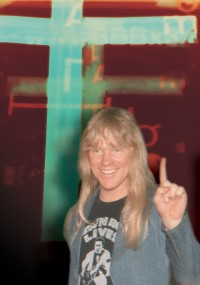


 Broken Believers