The Father is Running!

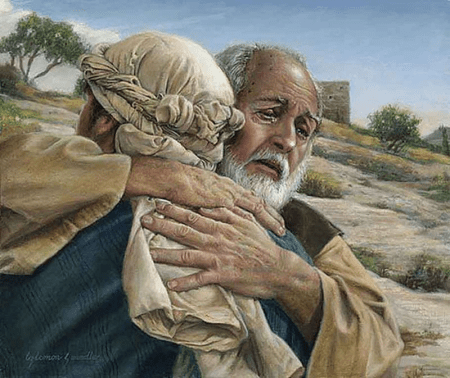
“So he returned home to his father. And while he was still a long way off, his father saw him coming. Filled with love and compassion, he ran to his son, embraced him, and kissed him.”

Luke 15:20, NLT

There comes a time when the prodigal stands up–looks around, and then decides he can’t live this way anymore, it’s now time to return home.  But he is no longer a ‘rich man’s son’, the pig-pen completely crushed that idea.  He returns home, thinking that at least he can be a slave.

The devastated prodigal now understands.

And it’s that which gives him the propulsion to leave the pigs behind, and begin to somehow be received by his father. The trip is a long one, lots of walking, and yes, it’s hard–he’s far from where he’s supposed to be. He is tired, ragged and worn.

But please dear one, you must understand this about Jesus’ parable–the story isn’t so much about the prodigal son, rather I think that the focus should really be on the father. Jesus is teaching us that the love of God is a searching/seeking kind of love, and it cannot be shut down, or go away over time. Not ever.

You see, it is a 24/7/365 day kind of love.

Think of it like high intensity radar that sweeps over extreme distances, it is always looking, seeking, and it won’t be denied.  The Father is seeking for His sons and daughters.  He intends to find them. If we refuse we will continue to feed pigs, over and over, and we will starve.

The running love of the Father is strenuous and reaching

The Father never sits on His backside, calmly watching from His throne. He reaches out and runs to us. God doesn’t sit. He is far from passive, rather He intensely yearns for His son. And God is fully into reclaiming His missing sons and daughters, just like in Jesus’ story.

He continues to search, even in when things get really bad.

Sin disfigures
Sin disfigures, a meth addict’s mug shots over time

The Father recognizes His prodigal son.  It’s funny, but gross sin often has a way that disfigures a person’s countenance. Look at the wino or meth addict on the street.

The boy who abruptly left home is not the son who returns.  There has been damage done.  His face has changed.  The Father understands this, and yes, it has been terribly hard and brutal. But that hardly matters.

I believe that this parable is the greatest of them all. 

Jesus is explaining the deep love the Father has for prodigals like us. This story is so revealing, in it we see that the Father who is running. We must know this about Him. We must internalize it and understand the compassion He has. If we stall in our discipleship it’s because we don’t grip the awesome depth of His love.

There seems to be very few people who understand a running God.

The prodigal son is a timeless parable that transcends generations, holds within it a profound message of forgiveness, redemption, and unending love. As we delve deeper into the intricate layers of this tale, we discover a powerful metaphor that illuminates the human experience and the unwavering compassion of the Father.

As the prodigal hits bottom he realizes the futility of his choices and yearns to return to the forgiving embrace of his father. Overwhelmed by guilt and shame, he makes the long journey back to the home he once took for granted. Little does he know it, behind the scenes, his father has been watching, waiting, and hoping for his return.

And then, in a moment that encapsulates the beauty of unconditional love, the father catches sight of his boy from afar. Without a second thought, the father runs towards him with outstretched arms, his love insisting on forgiveness.

We see a love that surpasses human understanding.

The parable teaches us about the power of redemption and forgiveness, reminding us that no sin is too great to be forgiven, and no distance is too far for reconciliation. It emphasizes the importance of humbly seeking forgiveness and shows that love is always within reach.

Jesus teaches us a different kind of love. It’s not based on achievements or what society says. This love is given to everyone, regardless of their flaws, but in order to have it, they must leave the pigs behind. Sometimes that isn’t always easy.

This profound depth of His love often leaves us feeling totally doubtful or skeptical.

Our logical minds struggle to grasp how such boundless love can exist, especially when we witness the failings and flaws of human love. Yet, it is precisely because love transcends logic that it is so powerful. It operates on a different plane, bypassing our human limitations and revealing a deeper truth about the nature of God’s infinite compassion.

So, let us tell others about this love that Jesus spoke of.

Let’s begin to see that this compassion will transform lives, heal wounds, and bridge divides. For when we approach Jesus’ parable with humility and faith, we may just catch a glimpse of its power and appreciate its profound beauty in a new way.

If the Church can just keep up with our running God, we will finally understand who He really is. And if we only accept the love of the Father towards prodigals—no matter what the sin—it’s then we will finally understand the white-hot love of the Kingdom of Jesus.

And the Church will finally be doing His will in the world.

Finally.
1brobry-sig4

Braiding and Waiting

wait_bench_ocean

“Yet those who wait for the Lord
Will gain new strength;
They will mount up with wings like eagles,
They will run and not get tired,
They will walk and not become weary.”

Isaiah 40:31, NASB

The particular word “wait” is a vital force that must be reckoned with. It’s not used passively in the Scriptures. It does not mean to be apathetic or lazy. Sometimes we wait in line at the grocery store, or maybe we’re waiting for a phone call. We regularly wait all the time, and usually, we don’t even realize it.

The Hebrew word for ‘wait’ is special. It’s qāvâ. It means, ‘to bind together by twisting.’

It will sometimes mean to work like a fisherman who repairs his nets to get them ready for tomorrow’s task.

(There are always holes to mend after a long night’s efforts.)

When I truly wait on God, I realize that I’m actually repairing myself for His heart and for His work.

  • Seeing His face
  • Hearing His voice
  • Keeping pace with Him, whether He moves or doesn’t

It’s a fascinating way of describing something, isn’t it? Sometimes, when we think of waiting only in the context of the English language, it can become a frustrating delay. This often causes us to miss out on the true meaning of ‘wait’. I strongly believe that the Holy Spirit wants us to understand the concept of being closely connected to God. Sadly, we are often held back by our own definitions, rather than embracing the definitions found in God’s Word.

“The LORD is good to those who WAIT for him,
to the soul who seeks him.”

Psalm 27:14

For those of us who are sick – in body or mind – being told to “wait on the Lord” can be difficult to understand and accept. It is common for us to feel frustrated with this advice and the person giving it, mainly because we don’t fully grasp the true meaning of ‘waiting.’ We get close to understanding it, but we never quite reach that understanding of that word.

“WAIT for the LORD;
be strong, and let your heart take courage;
WAIT for the LORD!”

Psalm 27:14

He becomes my strength; He is now the strong cord I am braided into. (Perhaps this is how He imparts strength and might to His people?) We need this, and the Lord is quite eager to lead us into this new kind of intimacy.

“The LORD is good to those who WAIT for him,
to the soul who seeks him.”

Lamentations 3:25

The promise in Isaiah 40:31 talks about getting new strength, like an eagle’s wings, a holy energy. This verse is important for us, especially today; we need this kind of strength right now. I just want to inspire you during your prayer time to become consciously and purposefully connected to the Lord.

It’s only then can we can put our nets back together again?

“Waiting for God is not laziness. Waiting for God is not going to sleep. Waiting for God is not the abandonment of effort. Waiting for God means, first, activity under command; second, readiness for any new command that may come; third, the ability to do nothing until the command is given.”

    G. Campbell Morgan

Hold Onto the Truth

We need the Bible. It’s our portal, our clear window, our direct line into knowing the King. These are our promises.

A dear and wise friend of mine once told me that I should never go by what I feel, but by what I know. Feelings can be fickle and reactionary, and oftentimes they do not reveal the truth about the situation they are a reaction to.

There are times when my feelings have been all of these things. I’m sometimes sad or angry or depressed or disillusioned. My feelings are often a reaction to what has been going on in my life, or to things that have been said to me as well as about me and others whom I care deeply about. I’ve had times of feeling hopeless and been in disbelief of the things that have transpired in my life. I had days when I feel completely lost and alone.

On those days I listen to my dear friend and turn to the things I know to help me get through how I am feeling, to get to the truth of the matter. Here is what I know:

  •  ”And we know that in all things God works for the good of those who love him, who have been called according to his purpose.” Romans 8:28. The important word in this verse for me is “all.” It is not just in some things, but in all things, that God works for the good of those who love Him. I may not see the good that will come from my present circumstances, but God does.
  • “‘For I know the plans I have for you,’ declares the LORD, ‘plans to prosper you and not to harm you, plans to give you hope and a future.’” Jeremiah 29:11. God has planned my days, now and for eternity, and His plan is one of hope.
  • “But those who hope in the LORD will renew their strength. They will soar on wings like eagles; they will run and not grow weary, they will walk and not be faint.” Isaiah 40:31. Even though my own strength may be insufficient to get me through difficult times, the strength of the Lord is always there for me to lean on.
  • “Cast all your anxiety on Him because He cares for you.”  Peter 5:7. God loves me and will take my burdens and anxiety if I will only let go.
  • “Now this is eternal life: that they may know you, the only true God, and Jesus Christ, whom you have sent.” John 17:3. Eternal life starts now by knowing Jesus, not just when this body dies.
  • “Give, and it will be given to you. A good measure, pressed down, shaken together and running over, will be poured into your lap. For with the measure you use, it will be measured to you.” Luke 6:38. This is one I have proven to myself. As I am a blessing to others I receive a blessing in return much greater than I gave.
  • “Do not grieve, for the joy of the LORD is your strength.” Nehemiah 8:10. There is a joy to be found when I trust in the Lord.
  • “From the fullness of his grace we have all received one blessing after another. For the law was given through Moses; grace and truth came through Jesus Christ.” John 1:16-17. Grace and truth go hand in hand, and they are the great blessing that we all have from Jesus.
  • “The thief comes only to steal and kill and destroy; I have come that they may have life, and have it to the full.” John 10:10. Jesus came that we might live an abundant life, the best life that God could possibly want for us, something much better than we can ever imagine. Satan is the thief who promises pleasure and great ideas but means us only harm.
  • “Surely goodness and love will follow me all the days of my life, and I will dwell in the house of the LORD forever.” Psalm 23:6. This is a promise and a truth that can get me through any day.

These are just some of the things I know. God’s Word is full of promises of hope, love, joy, and redemption. It is full of stories of how those who had faith in God, who trusted in His promises, were blessed beyond measure.

God is far, far greater than my feelings.

I may feel hopeless, but that does not negate the hope He offers. I may feel lost, but that does not change the fact that He has found me and will never leave me. For all these promises I am grateful.

Love,

Linda

Linda’s home site can be found here.

The Desiderata

Desiderata (Latin: “desired things”, plural of desideratum) is a 1927 prose poem by American writer Max Ehrmann (1872-1945).

It exhorts the reader to “be at peace with God, whatever you conceive Him to be”, and to “keep peace with your soul”. “With all its sham, drudgery, and broken dreams,” wrote Ehrmann, “it is still a beautiful world.”Wikipedia

Unquestionably, some of this prose-poem may be a bit pretentious, it revolves around concepts, at times which are not entirely sound, especially for the Christian believer.

We note these things and look for what we need. My old pastor liked to observe, “Swallow the meat, and spit out the bones.” That seems fitting, especially now. But no matter what we say, this particular work has very much wisdom for each of us. It is worthwhile I think.

This world that we’re immersed in needs hope and peace. Especially now.

  The Desiderata

Go placidly amid the noise and haste,
and remember what peace there may be in silence.
As far as possible without surrender
be on good terms with all persons.
Speak your truth quietly and clearly;
and listen to others,
even the dull and the ignorant;
they too have their story.
Avoid loud and aggressive persons,
they are vexatious to the spirit.
If you compare yourself with others,
you may become vain or bitter;
for always there will be greater and lesser persons than yourself.
Enjoy your achievements as well as your plans.
Keep interested in your own career, however humble;
it is a real possession in the changing fortunes of time.
Exercise caution in your business affairs;
for the world is full of trickery.
But let this not blind you to what virtue there is;
many persons strive for high ideals;
and everywhere life is full of heroism.
Be yourself.
Especially, do not feign affection.
Neither be cynical about love;
for in the face of all aridity and disenchantment
it is as perennial as the grass.
Take kindly the counsel of the years,
gracefully surrendering the things of youth.
Nurture strength of spirit to shield you in sudden misfortune.
But do not distress yourself with dark imaginings.
Many fears are born of fatigue and loneliness.
Beyond a wholesome discipline,
be gentle with yourself.
You are a child of the universe,
no less than the trees and the stars;
you have a right to be here.
And whether or not it is clear to you,
no doubt the universe is unfolding as it should.
Therefore be at peace with God,
whatever you conceive Him to be,
and whatever your labors and aspirations,
in the noisy confusion of life keep peace with your soul.
With all its sham, drudgery, and broken dreams,
it is still a beautiful world.
Be cheerful.
Strive to be happy.

Max Ehrmann, 1927