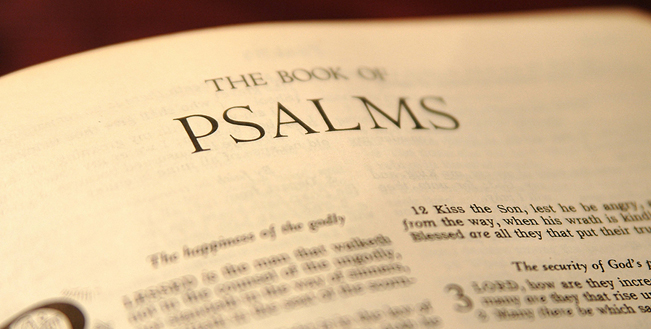
My Favorite Psalm

psalms_2

Probably the best known Psalm in the Bible is Psalm 23:The Lord is my shepherd, I shall not be in want . . .” And I do like this Psalm. I particularly like the part that says “Even though I walk through the valley of the shadow of death, you are with me.” I like this part because of the preposition “through,” which indicates the valley of the shadow of death is not a permanent dwelling place, but rather a place we travel through to get somewhere else. But this is not my favorite Psalm.

Psalm 22 is also another popular one, especially since Jesus quoted it on the cross when he said, “My God, my God, why have you forsaken me?” I like this Psalm because of it’s prophetic nature. Looked at closely you can find many of the things that would later happen to Jesus talked about by David in this Psalm even though David did not know that is what he was doing. But this is not my favorite Psalm either.

Psalm 27 is another favorite of many because it gives courage when it says, “ The Lord is my light and my salvation; whom shall I fear? The Lord is the stronghold of my life; of whom shall I be afraid?” In a sometimes terrifying and wearying world, this Psalm provides great comfort to those enduring trials. But this is not my favorite either.

If you ask most Christians (and even some non-Christians), they will have a favorite Psalm, and I am no different. My favorite is Psalm 116. This Psalm starts in verse 1 with: “I love the LORD, for he heard my voice; he heard my cry for mercy.” This is a Psalm of David when he was in great anguish and danger. The verses that speak to me the most are 3-4 and 8-9.

3 The cords of death entangled me,
       the anguish of the grave came upon me;
       I was overcome by trouble and sorrow.

 4 Then I called on the name of the LORD :
       “O LORD, save me!”

8For you, O LORD, have delivered my soul from death,
       my eyes from tears,
       my feet from stumbling,

 9 that I may walk before the LORD
       in the land of the living.

Reading this Psalm reminds me of my journey through major depression and how God was with me in it all. It reminds me why I trust in Him – because He has proven Himself faithful to me in the past and has heard my cries for mercy. I supposed Psalms 23, 22, or 27 could serve the same purpose, but the language of Psalm 116 more closely fits the trouble and sorrow I went through, especially the part about delivering my eyes from tears. If you have ever experienced major depression, or known someone who has, you know that tears are an almost constant companion, and yet there is no understanding of why they are there.

I still have times of melancholy, and I certainly cry from time to time. But now I can identify what is making me blue and my tears have a reason and purpose when they come. And my God is always there to hear my cries of mercy.

So this is my favorite Psalm. What’s yours?

ysic, Linda K.

flourish15


A ‘Slipping Down’ Life

“When the man saw that he did not prevail against Jacob, he touched his hip socket, and Jacob’s hip was put out of joint as he wrestled with him.”

Genesis 32:25

There is no question that we each want a wonderful life.  Young and strong and very idealistic, we brew dreams that we will become persons of wonder and deep significance.  After all, anything less would be a denial of what we believe.  In our youthful zeal we more or less insist on our own success.  We just know, deep down, that we are God’s special gift to the world.

All of a sudden we strike reality’s iceberg.  It is very bitter, and it hurts us.  Then things unfold around us that are difficult and quite challenging to process.  But as it ‘sifts out’ we realize that we find we are severely mismatched by what we must face.  It is at this point things will proceed from ‘difficult to ugly.’

We discover that our life is ‘a slipping down’ sort of kind.  Twenty years ago, we would never admit this.  But our vision and expectations have shrunken, and we’ve become less than we imagined than we would be. We have ‘slipped down.’ Living this kind of life, inserts a humility in us. We have aspired, but have not attained. We discover that we haven’t met our earlier expectations. We are woefully short.

But if we are honest with ourselves (and others) we find ourselves– subtracted.  We wrestle with our angel, and he pulverizes us. We discover that we now limp, but this is a necessary step for us to take.  Sometimes “Christlikeness” must be beaten into us by life itself.

There are those among us who profoundly struggle with pain and illness are expected to join with millions that have gone before us.  Loss and ugliness pay a visit to our lives.  There are those of us who fight with a mental illness, (sometimes winning, and often losing) have to sift through all that remains.  But this is all ‘injected humility.’ This experience does teach us, like nothing else can.

“Experience: that most brutal of teachers. But you learn, my God– Oh my, but you do learn.  C.S. Lewis

Personal brokenness requires that we pick-up the pieces.  And that in itself works something in us.  On our hands and knees we have an epiphany.  We are not what we thought we’d be.  But humility, the soil that grows our spirits, finally has begun to work in us.

A ‘slipping-down life’ brings us to the ‘bitter-sweet place’ where the Spirit can reach into us to do His work.  It is the ‘operating room’ where He works deep inside us.  None will truly know the Lord’s touch without this deep work. I strongly encourage you to submit your hearts to His precise work.  After all, you really don’t have a whole bunch of viable options. aabryscript

So You Want to Become Vulnerable?

freedom_by_ahmetorhan

“To love at all is to be vulnerable. Love anything and your heart will be wrung and possibly broken. If you want to make sure of keeping it intact you must give it to no one, not even an animal. Wrap it carefully round with hobbies and little luxuries; avoid all entanglements. Lock it up safe in the casket or coffin of your selfishness. But in that casket, safe, dark, motionless, airless, it will change. It will not be broken; it will become unbreakable, impenetrable, irredeemable. To love is to be vulnerable.”

 — C.S. Lewis, The Four Loves

Public speaking has never been a problem for me. All through high school, Bible college, as a street evangelist– nothing I’ve ever done really has ever been a concern.  But,  I have friends who rather submit themselves to hideous torture then to put themselves in that public position.  They are afraid of the spotlight, feel exposed and just a little too accessible in the lime light.

Becoming vulnerable in love is ‘above and beyond’ the fear of public speaking.  It is almost irrational in the way it takes charge.  We refuse to put out, with the fear of being that accessible.  We will not allow ourselves to become a victim.  But public speaking has nothing on loving someone deeply, because of the risk involved.

Men are the greatest perpetrators of this attitude.  We close ourselves off and keep our hearts protected and safe.  We cannot truly give our hearts away, because we cannot share that which is most intimate (we hate that word!).  I will refuse to become vulnerable to anyone, because of the risk I put myself in. To really “trust,” in deep way, is way too much exposure for us.

Our families cannot understand our emotional coldness.  They think that the problem is their fault.  They struggle to understand.  And we respond to their attempts to accommodate us with skepticism and fear.  We hold back and pathetically attempt to adjust to their efforts.  Selfishness ultimately wins the day.

Lewis reveals that our natural inclination is towards selfishness.  We try to hide and avoid the “nakedness” that love requires.  I am convinced that we will spare no effort to stay safe, becoming invulnerable to another’s inspection.  We wall up ourselves to the risks of love.  But learning to trust is one of life’s most difficult tasks.

Jesus Christ has come, to teach us how to love openly and freely.  He became vulnerable, laying aside his prerogative of being God.  He is teaching us to love like him. We will only truly heal when we risk it all, with our Father, and our brothers and sisters.

aabryscript

Are You a Half-Shekel Short?

The Jerusalem shekel
How much money a person has can make a big difference in many things in life. It can mean the difference between shopping for groceries as Whole Foods or WinCo, or not being able to shop at all but having to go to a food bank instead.

Money can mean the difference between driving a BMW, or a 30-year-old “beater car”, or not being able to have a car at all. Money can mean the difference between having designer clothes and a nice house or wearing hand-me-down clothes and living in a one-room shack, or not having but the clothes on your back and a cardboard box to keep you warm at night.

But there is one thing that’s available to all regardless of financial circumstances. The rich have no more claim to it than the poor. And that is the gift of salvation offered through the sacrifice of Jesus on the cross.

Once when I was reading through Luke, I came to the story of when Jesus, after His resurrection, appeared to some disciples on the road to Emmaus. Describing His conversation with them, Luke says, “And beginning with Moses and all the Prophets, he explained to them what was said in all the Scriptures concerning himself.” Luke 24:27.

When I read that, I realized that all of the Old Testament, and not just the New Testament, is about Jesus. He existed before the world began and His story is the story of God’s relationship with His people. At that time, I prayed and asked God to show me where Jesus was revealed in the Old Testament scriptures as I read them.

Another time, in answer to that prayer, God revealed an interesting passage to me in Exodus. Generally, the book of Exodus is considered the story of Moses leading the Israelites out of Egypt and their subsequent wanderings in the desert of Sinai. This is not a book where one normally would think to find reference to Jesus. But it is there nonethless.

Then the LORD said to Moses, ”When you take a census of the Israelites to count them, each one must pay the LORD a ransom for his life at the time he is counted. . . . Each one who crosses over to those already counted is to give a half shekel, according to the sanctuary shekel, which weighs twenty gerahs.

This half shekel is an offering to the LORD. All who cross over, those twenty years old or more, are to give an offering to the LORD. The rich are not to give more than a half shekel and the poor are not to give less when you make the offering to the LORD to atone for your lives.”

Exodus 30:11-15, NIV

<

p>When I read this, it became clear that the price to ransom every person’s life is the same. Whether we are rich or poor, the price to pay for all our sins and redeem us, to reconcile us with God, is the same. And that price was the life of Jesus Christ; He is the half shekel. The price has been paid. Satan seeks to hold us captive, but God paid the kidnapper’s ransom 2000 years ago on Calvary.

The rich are no better off because they could give more; the poor are not at a disadvantage because they cannot pay the price themselves. Standing before God on our judgment day, rich or poor stand in the same position. The only question is whether you and I will claim we have paid the price ourselves by our good deeds and works, or whether we will accept the offer of Jesus to take care of our debt and to pay our ransom price.

So are you feeling like you are a half-shekel short in life? Look to Jesus who is our half-shekel who ransomed us all for God.

ysic, Linda

Please check out Linda’s blog. It’s found at http://lindakruschke.wordpress.com/