Our (Eternal) Compulsion

eternal-view

Strangely compelling. This morning I found waiting for me a series of verses that link with each other. Together they are both irresistible and indispensable. Combined, they form and establish the eternal perspective for the believing Christian. And it is all very real.

Look for what links them. (All verses are from the New Living Translation.).

flourish1

“Because I am righteous, I will see you.
When I awake, I will see you face to face and be satisfied.”

Psalm 17:15

“Your eyes will see the king in all his splendor,
and you will see a land that stretches into the distance.”

Isaiah 33:17

 “Father, I want these whom you have given me to be with me where I am. Then they can see all the glory you gave me because you loved me even before the world began!”

John 17:24

“Now we see things imperfectly, like puzzling reflections in a mirror, but then we will see everything with perfect clarity. All that I know now is partial and incomplete, but then I will know everything completely, just as God now knows me completely.

1 Corinthians 13:12

“Dear friends, we are already God’s children, but he has not yet shown us what we will be like when Christ appears. But we do know that we will be like him, for we will see him as he really is.”

1 John 3:2

“And they will see his face, and his name will be written on their foreheads.”

Revelation 22:4

Living forever, and being changed irrevocably is the sole privilege of the believer. It’s what we long for– sort of a (good) divine madness that continues to drive us; a splinter in our hearts that we can’t expel. But even if we could, would we?

Eternal life has already started for us; I believe far more awaits.

Ecclesiastes 3:11

aabryscript

Two O’ Clock in the Morning Poetry, #5

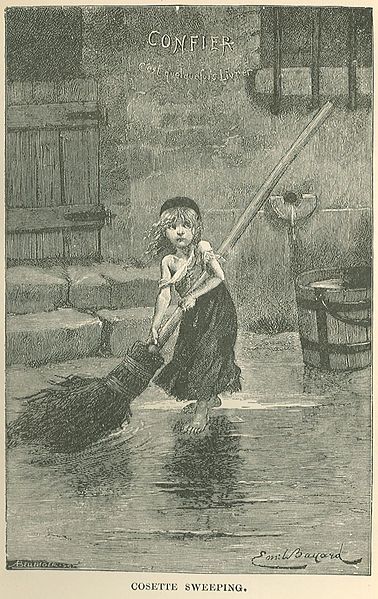
Cosette-sweeping-les-miserables-albert-bellenger-1886

~Victor Hugo – Les Miserables 

“Deep hearts, wise minds, take life as God has made it. It is a long trial; An unintelligible preparation for an unknown destiny. This destiny, the true one, begins for man at the first step in the interior of the tomb.”

“There he begins to discern the definite. The definite, think of this word! The living see the infinite; the definite reveals itself only to the dead. Meantime, love and suffer, hope and contemplate. “

“Woe, alas! to him who shall have loved forms, bodies, appearances only. Death will take all from him. Try to love souls, you shall find them again.”

yY

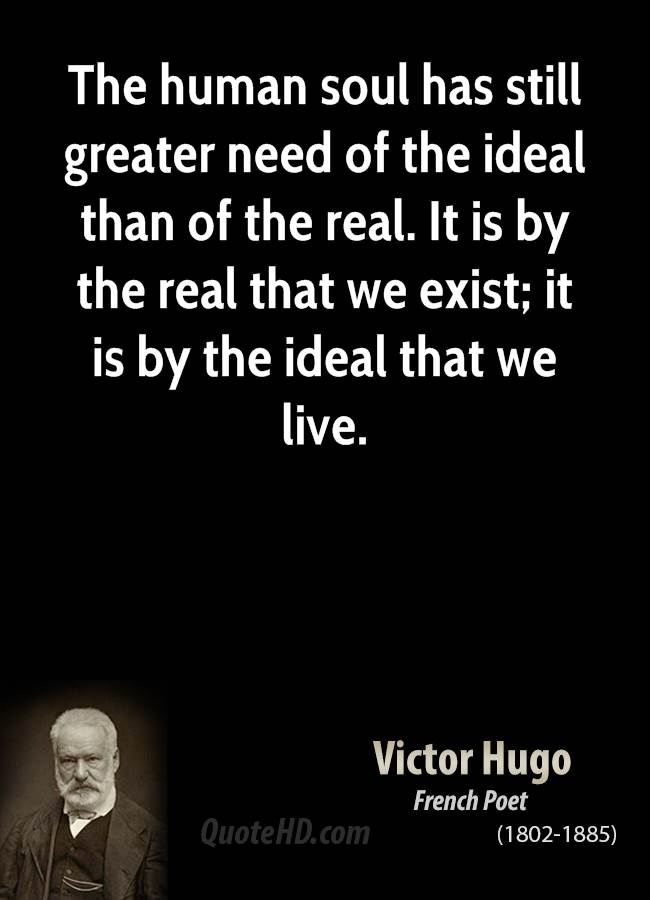
Victor Marie Hugo (French pronunciation: ​[viktɔʁ maʁi yɡo]; 26 February 1802 – 22 May 1885) was a French poet, novelist, and dramatist of the Romantic movement. He is considered one of the greatest and best known French writers. In France, Hugo’s literary fame comes first from his poetry but also rests upon his novels and his dramatic achieveme’
nts. Among many volumes of poetry, Les Contemplations and La Légende des siècles stand particularly high in critical esteem. Outside France, his best-known works are the novels Les Misérables, 1862, and Notre-Dame de Paris, 1831 (known in English as The Hunchback of Notre-Dame).
y

victor-hugo-author-the-human-soul-has-still-greater-need-of-the-ideal-than-of-the

Two O’ Clock in the Morning Poetry, #3

Collector_Trench

Middle Parts of Fortune, by Frederic Manning

“The air was alive with the rush and flutter of wings; it was ripped by screaming shells, hissing like tons of molten metal plunging suddenly into water, there was the blast and concussion of their explosion, men smashed, obliterated in sudden eruptions of earth, rent and strewn in bloody fragments, shells that were like hell-cats humped and spitting, little sounds, unpleasantly close, lie the plucking of tense strings, and something tangling his feet, tearing at his trousers and puttees as he stumbled over it, and then a face suddenly, an inconceivably distorted face, which raved and sobbed at him as he fell with it into a shell-hole.”

(Accounts of The Great War) 
R
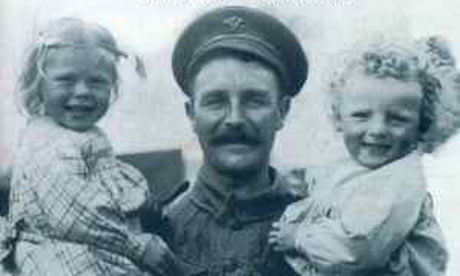
FredricmanningManning was an Australian aspiring intellectual, already in his mid-30s when he enlisted as a private soldier in 1915. His prewar existence in England was dogged by unfulfilled literary hopes and emotional confusions. He served for only a few months in France, and his military career ended in alcoholism and disgrace. But in 1929 he composed a novel, obviously autobiographical, about three soldiers’ experience of the trench nightmare, which is outstanding. Almost certainly the finest work of its kind to emerge from the war. (Penguin)
&

Manning continued to write. In 1917 he published a collection of poems under the title Ediola. This was a mixture of verse predominantly in his former style alongside war poems heavily influenced by the imagism of Pound, which deal introspectively with personal aims and ideals tempered in the crucible of battle. He contributed to anthologies, for example, The Monthly Chapbook which appeared in July 1919 edited by Harold Monro, containing twenty-three poems by writers including John Alford, Herbert ReadWalter De La MareOsbert SitwellSiegfried SassoonD. H. LawrenceEdith SitwellRobert NicholsRose Macaulay and W. H. Davies alongside Manning and Aldington. He wrote for periodicals, including The Criterion, which was produced by T. S. Eliot.

&&&

Poetry did not pay, and so in 1923 Manning took a commission from his publisher John Murray to write The Life of Sir William White, a biography of the man who, as Director of Naval Construction, led the build-up of the Royal Navy in the last years of the nineteenth century. Galton had died in 1921, which not only left Manning effectively homeless, but also lacking a forceful directing influence in his life. He lived for much of the time at the Bull Hotel in Bourne, apart from a short spell when he owned a farmhouse in Surrey. At this time he was friendly with T. E. Lawrence, then serving in the Royal Air Force at RAF Cranwell, some twenty miles (a motorcycle ride) from where Manning was living. In 1926 he contributed the introduction to an edition of Epicurus’s Morals: Collected and faithfully Englished by Walter Charleton, originally published in 1656, published in a limited edition by Peter Davies. — from Wikipedia and Penguin

&

Bonus–

wwi13
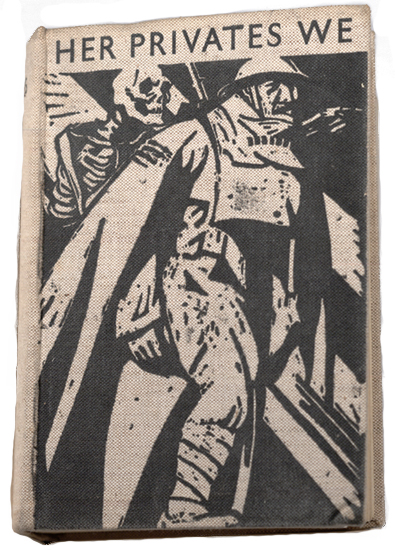
“Her Privates We” 1930, Cover art

Two O’ Clock in the Morning Poetry, #2

John-Donne-Quotes-1

“Death Be Not Proud, Holy Sonnets, no. 10 ” by John Donne

Death be not proud, though some have called thee
Mighty and dreadful, for thou art not so;
For those whom thou think’st thou dost overthrow

Die not, poor death, nor yet canst thou kill me.
From rest and sleep, which but thy pictures be,
Much pleasure, then from thee much more must flow,
And soonest our best men with thee do go,
Rest of their bones, and souls’ delivery.
Thou art slave to fate, chance, kings, and desperate men,
And dost with poison, war, and sickness dwell,
And poppy, or charms can make us sleep as well,
And better than thy stroke; why swell’st thou then?
One short sleep past, we wake eternally,
And death shall be no more; death, thou shalt die.

U

flourish-8
john-donneJohn Donne (/ˈdʌn/ dun) (between 24 January and 19 June 1572[1] – 31 March 1631) was an English poet, satirist, lawyer and a cleric in the Church of England. He is considered the pre-eminent representative of the metaphysical poets. His works are noted for their strong, sensual style and include sonnets, love poetry, religious poems, Latin translations, epigramselegies, songs, satires and sermons. His poetry is noted for its vibrancy of language and inventiveness of metaphor, especially compared to that of his contemporaries.
Donne’s style is characterised by abrupt openings and various paradoxes, ironies and dislocations. These features, along with his frequent dramatic or everyday speech rhythms, his tense syntax and his tough eloquence, were both a reaction against the smoothness of conventional Elizabethan poetry and an adaptation into English of European baroque and mannerist techniques. His early career was marked by poetry that bore immense knowledge of British society and he met that knowledge with sharp criticism.
–from Wikipedia
88
Bonus—
John+donne+famous+quotes+3