Come, Follow Me

“He said to another person, “Come, follow me.”

   The man agreed, but he said, “Lord, first let me return home and bury my father.”

 But Jesus told him, “Let the spiritually dead bury their own dead! Your duty is to go and preach about the Kingdom of God.”

Luke 9:59-60


Considering this whole passage must bring us to the place of seeing God’s Will as supreme.  He asks for a complete and comprehensive obedience.  We can never entertain a lesser commitment.  Following Jesus, as His disciple will radically alter our priorities and change our relationships.  Irrevocably.

There was a negotiation of sorts taking place.  This would-be disciple was trying to be reasonable.  His heart appears to be already in harness.  Being Jesus’ disciple was what he really wanted.  But, there was this slight problem, it really seemed logical and definitely prudent and sensible.

Yet Jesus doesn’t negotiate with him.  He does not accept the argument of reasonability and propriety.  The call to walk out discipleship requires a whole-hearted, full-bore dedication to Jesus Christ as Lord.  Everything must be adjusted.  And nothing is ever the same.

Have you dictated to Jesus what is reasonable?  Are you adjusting discipleship to your own terms of what is appropriate?  This particular passage in Luke 9 has implications to us today.  A rock was thrown into the pond, and the ripple is still being seen and felt.  Simply put, we are being called to authenticity.  We cannot reduce discipleship to fit our personal desires.

Will we adjust?  Will we sell out to the Kingdom’s supremacy?  To be a concert violinist requires intense effort and commitment.  A professional athlete takes his training to a level that is unbelievable to the average person.  Both have a dedication to their calling.  Can we just assume that something less is considered to be a disciple of the Lord Jesus Christ?

Please re-examine your thinking.  I certainly do not want to condemn or judge.  But I am afraid that we are using discipleship without considering what that really means, and we entertain a definition that somehow defaults to an acceptable level.  Are we really that willing to undergo an adjustment that is nothing less than radical transformation of our faith?

Photo: Chicago at Night

One of my favorite cities is Chicago, IL.  I like its bustle and its different neighborhoods.  I came across this photo on National Geographic and wanted to share it with you.

I think what it does is put you into a completely different viewpoint.  Seeing the city with a whole different set of eyes.  So much of walking out our spiritual lives is vision, seeing things from His perspective.

Photo: Night Sky

The heavens tell us about the Glory that God has.  We look up and see a universe that was created, and is now on display.  I remember on an isolated beach in Mexico.  One night, the entire Milky Way was revealed.  I laid on the sand transfixed by it all.  Suddenly, I got afraid and had the sensation of being very, very small.  That awareness has never left me.

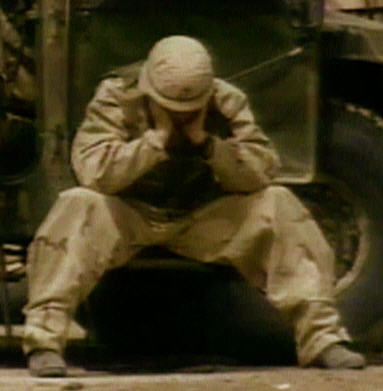
Combat’s Hidden Toll: 1 in 10 Soldiers Report Mental Health Problems

Soldiers Report PTSD Symptoms and Other Mental Health Problems
 
By KIM CAROLLO
ABCNews Medical Unit
June 9, 2010

Even though he’s retired from active military duty, CSM Samuel Rhodes still suffers from deep emotional wounds.

“I had to take this afternoon off from work today because of anxiety,” he said. “And sometimes, if I’m going through a really tough time, I think about suicide.”

He spent nearly 30 years in the Army and recently spent 30 straight months deployed in Iraq where he, like many soldiers, witnessed some of the horrors of war.

“In April 2005, it started to eat me up because I started losing one soldier after another,” Rhodes said. “We lost 37 soldiers that were in my unit.”

He was in charge of the brigade of 37 soldiers, and as time wore on, the loss of life wore him down.

“In April 2007, it came full circle. I considered suicide as an option. I felt guilty about losing those soldiers, even though I had no control over it,” he said.

“And I was sleepwalking. I had to tie myself to my cot to prevent it,” he added.

Later, during his 24th month in Iraq, he was found unconscious, and doctors diagnosed him with exhaustion. At that time, the combat stress doctor told him he was also suffering from post-traumatic stress disorder.

“He started explaining it to me, and I realized he was right,” Rhodes said.

And according to a new study conducted by researchers at Walter Reed Army Institute of Research, Rhodes’ mental health problems are common among soldiers returning from Iraq.

Between 2004 and 2007, researchers gave out anonymous surveys to four active duty brigade combat teams and two National Guard combat team three months and 12 months after deployment. The surveys screened soldiers for PTSD, depression, alcohol misuse and aggressive behavior and asked them to report whether these problems impacted their ability to get along with others, take care of things at home or perform their job duties.”A high number of those that had symptoms of PTSD and depression also reported some aspect of impairment,” said Jeffrey L. Thomas, one of the study’s co-authors. “The range was about 9 to 14 percent.” Depression rates ranged from 5 percent to 8.5 percent.

But by using a less stringent definition of PTSD, they found between 20 and 30 percent of soldiers showed symptoms of PTSD, while they found between 11.5 to 16 percent of them were depressed.

Full article, please go to:  http://abcnews.go.com/Health/MindMoodNews/10-soldiers-fought-iraq-mentally-ill/story?id=10850315&page=2