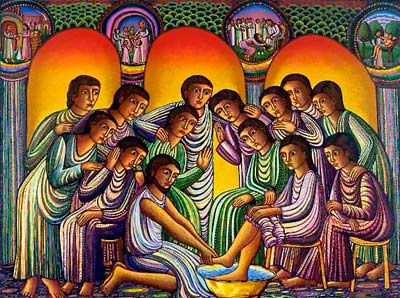
Go Lower Yet

footwashing

“Now that I, your Lord and Teacher, have washed your feet, you also should wash one another’s feet.”

John 13:14

Some Christians reading this part of scripture, have concluded that foot washing should be part of the Churches customary routine.  Their case is compelling, and they may be right in their interpretation.  There is as much support for this as with other things, and Lord knows we could use the humility by getting on your knees with a basin and towel before a brother. 

It probably would relieve issues between saints. It may even heal Church splits. (Oh my!)

Jesus pronounced that His act of service was to be imitated by everyone who would follow.  He further would assert that His example would be emulated by every believer that followed after Him.  Our service to our brother, or sister is to help them become clean Christians. 

We have this ministry of the basin and towel to remove the dirt and filth that comes from walking in this world.  Of course, we cannot remove sins.  But we can serve as Jesus would and intervene with His power.

Cleansing people that we meet will be a challenge. 

It will call us to strip our lives down to a minimum, and to get lower.  We need to get so low that we’re on the floor.  This requires much grace and discipline.  We must weed out every pretense and pride–especially the kind that says, “Look at me serving; am I not wonderful?  I am a true disciple now.”  We are to shake off thoughts like that. 

We are to love others, and perhaps be honestly brutal on ourselves. (Not in a morbid way, just less of ‘yourself.’)

While in my first year of Bible college, I developed a bitter dislike for a classmate.  He had been a lead guitarist; he was handsome and popular, and he oozed pride from every pore (at least I could see it).  I actually took it on myself to be God’s hand in humbling him.  I became antagonistic and scorned him every chance I could.

Within days, my prayer life shut down and the heavens became brass.  One day I was praying and the Holy Spirit graciously zapped me.  I became aware of my sin toward my brother, and I repented. There was a real definite leading, to find a basin and a towel, and then to wash his feet.

God reconciled us, as I knelt at his feet in that dorm room.  From that point on we became very good friends.

We must go lower still.   Water always finds the lowest point, were it pools and gathers into the place of healing others. Perhaps the Holy Spirit will not lead us ‘deeper’ until we start practicing true humility.

When we lower ourselves even deeper we find His presence waiting for us.  But we must cleanse our own hands first, and His blood must work its ministry on me. It’s then I can proceed to clean the filth off of their feet.  If I am not clean myself I will only perpetuate the dirt on to my brother with my dirty hands.

We must scrub our way into the heart of our sister or brother with a basin, some soap and a towel. 

The challenge for us will be a super-challenge.  Christlikeness will always demand this humble grace.  When we think about being like Jesus we must make sure we are following the Jesus in the Bible.  The Jesus who washed dirty feet as a slave.

But let’s not have any foolish nonsense of a discipleship that doesn’t kneel before our brothers in humility.


 

Testimony of the Scars

At the crucifixion, Jesus suffered incredible pain.

He was beaten, flogged, spat upon, and had a crown of thorns jammed into his brow. Then He was nailed to the cross through His feet and hands and then pierced in the side with a spear causing blood and water to flow from His body. He was covered in welts, bruises, and blood so that He was almost unrecognizable.

After His resurrection, He appeared to His disciples in the upper room.

The welts, bruises, and blood were gone. His body showed very little of the pain and suffering He had endured. He did not have scars on His face or across His back. He was once again beautiful. His resurrected body testified to the resurrection we will all one day know with new, healed bodies that are once again beautiful, even in our own eyes.

The exceptions to this miraculous healing of His body were the nail scars on His hands and feet, and the scar from where He was pierced with the spear.

“Then he said to Thomas, ‘Put your finger here; see my hands. Reach out your hand and put it into my side. Stop doubting and believe.’”

John 20:27 (NIV).

These scars testified to His death and suffering on the cross. They testified to the love and mercy we find there. They testify even now to the greatest gift God has ever offered mankind: the knowledge that He was one of us, faced death as we do, and came out on the other side victorious as we one day will be if we trust in Him.

We all experience suffering and injury.

We all bear scars, some physical, and others emotional or spiritual. We tend to hide our scars from the world, thinking we are the only ones who bear them. But that’s not exactly true.

Our own scars long to testify to the love and mercy of a God who saw us through our trials and helped us come out victorious on the other side. They long to testify that we were not defeated because God was on our side.

What if, instead of hiding our scars from the world, we shared them for all to see just as Jesus bid Thomas touch the scars on His palms and His side? What if we let our scars testify to the love and mercy of our God? What if we helped share the greatest gift God has ever given mankind, a gift that our scars testify to?

What victory do your scars testify to? Please dear one, share it with others. People are waiting to hear from you.

Take a look at my own website. You’ll be blessed I think–anotherfearlessyear.net.

How to Die Well

“Even though I walk through the valley of the shadow of death,
   I will fear no evil,
for you are with me;
   your rod and your staff,
 they comfort me.”

Psalm 23:4, ESV

“Precious in the sight of the Lord is the death of his saints.”

Psalm 116:15, ESV


“Death is like my car. It takes me where I want to go.” 

Pastor John Piper

Our generation simply doesn’t know how to die well.  There are so many conflicting messages and attitudes which have steered us away from the reality of dying.  Much of it is the natural development of unbelief.  Our pop culture develops this and gives it momentum.  We are trying to convince ourselves that “death is impossible, my life will not end.’  But we’re escaping into a delusion.  We are running from what is real.

There is a Latin phrase,  Ars moriendi  (“The Art of Dying”) which the Church practiced in past generations.  In past time, Christians would be buried as close as possible to the Church building.  Many would be interred within the very walls of the Church.  The understanding was that the dead were part of the congregation.  That there was only a thin veil that stood between the living and the dead.  The dead didn’t just vanish.  They are with us.

My generation is confused.  We have forced death to wear a mask.  We insist on a significant camouflage to hide the reality of sickness and death.  No one really ever talks about it, and so no instructions are given on how to die well. So we don’t, we die poorly–in ICUs and LTCs, completely sedated, separated and unable to process it or help our families process it.  There can be no solid connection between the living and the dying. And to be very honest, this is not working.

For many, the fear of dying is intense and paralyzing.  Death brings us a terror that twists us; we don’t know how to respond to it.  Additionally there seems that there is no one available to direct us.  Death is a spooky taboo that no one really explains.  The implication is that we are simply to avoid death, ‘it may not come for you’.  But that is not what is real.

“Death avoidance” pretends to lift us above the issue, where we can imagine that we will stay separated somehow from its obscenity and ugliness.  Funerals are nothing more then an aberration.  We have become ‘teflonized’, these things just slide on and off.  We just refuse to calculate, or accept what is happening.  We have ‘molded’ our fear into a more desirable shape.  We simply cannot function in the steady gaze of what is real.  We just shut down and refuse to function. We simply pretend.

Its time for the Church to step up and guide us to our next step.  Our pastors and elders have got to prepare us to die well.  It is a part of being a disciple.  It is discipleship, and dying is inclusive.  We need somebody to prepare us for the inevitable and the certainty that is approaching us.  I need someone that will help me face my own death.

You know what?  No one escapes.  And the reality of that drives some of us mad, or addicted, or psychotic.  The idea of filling a casket up for forever is incomprehensible.  We cannot live with this sick idea of dying.  It disturbs us on the deepest level possible.  It is completely evil.

Psalm 23 has been pure comfort and healing for generations.  And it is an excellent starting point for us.  Verse 4 develops the idea of traversing death.  The writer has incredible insight of passing through death.  This verse alone is worth “billions of dollars in gold”.  Psalm 23 has made me a very wealthy man.  His Word has become my rich treasure.


Loving Others (Just Like Jesus Loves Us)


““A new command I give you: Love one another. As I have loved you, so you must love one another. By this everyone will know that you are my disciples, if you love one another.””

– John 13:34-35

What is “love” like?  How do we consistently understand love when we fall short of it all the time?

We understand love by coming to know Jesus.  He not only explains it, but He also exhibits it–He puts it out in the public eye for all to see.  His explanation of what love is will mean a cruel death in order to save us.  When Jesus dies, I am saved.  My salvation has absolutely nothing to do with me– and everything to do with Him, and all that He has done.

Jesus helps us to see others.  He makes a definitive statement, that we are to love others.  We are to use what He has done for me, as an example.  What Jesus did is the pattern, the prototype.  We are to be the photostat or mimeograph.  As believers we are to be captured and drawn into this approach.

We are to find someone, and then, in some sense, ‘die’ for them. That is the way God’s love is.

That very strong word, must in verse 34 cannot escape our attention.  It implies a deep and a very definite commitment to doing that is beyond us.  We ‘must’ connect and receive all that moves through our life.  We love the unlovely, and this is irrational. God says that people are worth crucifixion. We’re the criminals, and the judge has sentenced us. And then He Himself has decided to pay our penalty. This is ‘agape’ love.

We must love accurately. We should love the way He loves us.  We cannot do anything less. 

But the love of Jesus is tracking each wanderer.  He is working to connect with every person on this planet.  No one escapes His view, or His love.  Everyone who belongs to Him, is required to know this.  Our Lord is definitely not going to move if there are still “seekers” still out there.  He leaves no one behind.

Loving others will require a significant broadening of the way we see things.  We purposefully lift up Jesus because He lifted us.  We exalt Him because we have discovered we are so pitiful.  We must be convinced, that His way, is the way of the cross.

We must love more accurately —the same way He loves us.  We cannot do anything less.  For many of us, love is just a concept–a way of feeling ‘warm and fuzzy’ inside.  But it is far more than feeling nice thoughts. It is all about “the extra mile” and we honestly can’t make that trip if we haven’t been willing to die ourselves.