The Joyful Necessity of Dying Daily

Eye+Fetch+Photography+Stormy+Wheat+Fields+by+Diane+Loft (1)
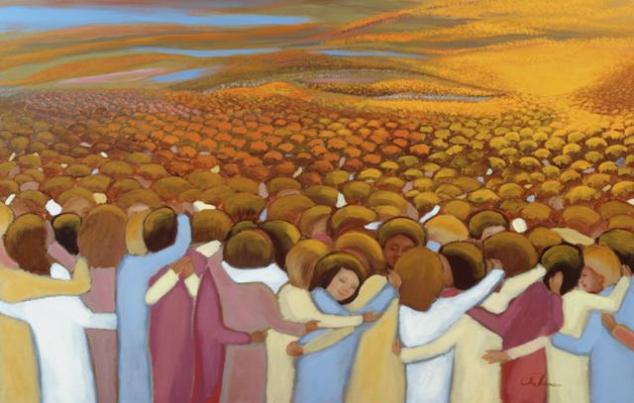
Photo by Diane Loft

“We know that our old sinful selves were crucified with Christ so that sin might lose its power in our lives. We are no longer slaves to sin.”

Romans 6:6, NLT

“There are two things which the Church needs: more death and more life— more death in order to live; more life in order to die.”

C.A. Fox

The need of this moment is critical. Many believers have never came to this point of ‘knowing.’ Maturity comes when one realizes that crucifixion has dealt with the old man. We died when He died, we were there when He died, we were part of that event. Romans 6 is all about a believers ‘co-crucifixion’ with Jesus Christ. Calvary was far more than a religious event— it was where our sin was terminated. It was more than just a penalty carried— it was where our old nature put to death.

“My old self has been crucified with Christ. It is no longer I who live, but Christ lives in me. So I live in this earthly body by trusting in the Son of God, who loved me and gave himself for me.”

Galatians 2:20

Sin has no power to sway a dead man. A man who is dead doesn’t respond to a girl in a leopard skin bikini. (It doesn’t matter if she is insanely gorgeous). He no longer can be tempted to sin. Why?  Because he is dead. This is not an issue of semantics, it is not poetic interpretation of a metaphor. It rings true in heaven and it is quite real here on earth.

Sin should no longer remain in power of a believer’s life. We believe that our sins have been dealt with on the cross, that Jesus took our sins from us, bearing them as a ‘sacrificial lamb.’ But the same is true to say, “My sinful nature was also crucified with him.”

“I tell you the truth, unless a kernel of wheat is planted in the soil and dies, it remains alone. But its death will produce many new kernels—a plentiful harvest of new lives.”

John 12:24

The principle is from farming. A kernel of wheat will bring an abundance. But it must be buried first. The dead seed miraculously sprouts. At the moment of death it suddenly receives a new life. The dead seed grows into a bountiful harvest. This is the New Testament principle of dying to self. A few things:

  • we are not sinless— we must deal daily with the sinful part of us,
  • this must be taken by faith, much like anything else from God, Heb. 11
  • discipline aids our quest for holiness, 1 Tim. 4:8
  • it accentuates the role of water baptism, it’s a daily reckoning, Rom. 6:4,
  • temptations can be really strong, but He enables us, 1 Cor. 10:13
  • this is a God honoring way to live.

Crucifixion should always be taken by faith in God’s Word and it will lead to resurrection. Crucifixion weakness is necessary for resurrection power. Jesus shares his life with us— his power is given to his people. He shares all that He is so we might become like him.

“Do not let sin control the way you live; do not give in to sinful desires. 13 Do not let any part of your body become an instrument of evil to serve sin. Instead, give yourselves completely to God, for you were dead, but now you have new life. So use your whole body as an instrument to do what is right for the glory of God.”

Romans 6:12-13

We’ve been given a gracious teacher in the person of the Holy Spirit. He will never condemn our feeble efforts to be holy. Be encouraged: God delights to make the weakest of us strong. He has done all He can to work holiness into our hearts.

bry-signat-1-1


cropped-christiangraffiti1.jpg


Drink Offerings, [Service]

poured-out-life

“Even if I am to be poured out as a drink offering upon the sacrificial offering of your faith, I am glad and rejoice with you all.”

Philippians 2:17

“For I am already being poured out as a drink offering, and the time of my departure has come. I have fought the good fight, I have finished the race, I have kept the faith.”

2 Timothy 4:6-7

Paul is the ultimate and conclusive example of self sacrifice for the Church. He is an example to us of loving until it hurts. The children of men are a needy lot and the burden of the apostle. He cares intensely (and it shows) as Paul describes his mission to the churches. He wants to help those who cannot help themselves. Paul understood that he was being poured like “a drink offering” to the Lord for the saints.

The Lord Jesus was the pattern Paul focused on. In Jesus we see a man dying on a terrible cross to bring a very real salvation to those without any hope at all. You and I stand “accepted in the beloved” because of that sacrifice.

“We want to avoid suffering, death, sin, ashes. But we live in a world crushed and broken and torn, a world God Himself visited to redeem. We receive his poured-out life, and being allowed the high privilege of suffering with Him, may we then pour ourselves out for others.”  

–Elisabeth Elliot

“Truly, truly, I say to you, unless a grain of wheat falls into the earth and dies, it remains alone; but if it dies, it bears much fruit.”

John 12:24

I honestly believe that fruitfulness hinges on the decision to “die”, and perhaps that is precisely why we are barren. Jesus must give himself up in order to save us. Are things so different now? Over the many centuries, the chosen Church practiced a “dying to self” as the primary way of growth.

Being poured out for others usually isn’t too dramatic; it offers very little in the way of earthly reward or recognition. Sometime ago I sat in the Annex of our local mental health clinic. I spent a whole afternoon with clients who were struggling hard to make it, I sat and listened, and had no agenda but theirs. I was being “poured out” and it was wonderful!

My heart swelled with the presence of Jesus for these dear ones. It had nothing to do with ambition, or a hunger for applause. I wasn’t out to prove that I was a Christian. Rather I was wholly there for others, I sort of think that is what Jesus meant when he taught his disciples about ministry, and servanthood. I believe that is what Paul was doing in the churches he served.

“Let each of you look not only to his own interests, but also to the interests of others.”

                                                                                                             Philippians 2:4   

This is how it all works. Our Father’s heart is broken over so much pain. About 25,000 people die every day of hunger or hunger-related causes, according to the United Nations. There are over 163 million orphans in the world, and more than 27 million human slaves. Furthermore, 1.2 million lives are snuffed out by abortion each year in the U.S. alone. And over 150,000 people die each day without knowing Christ. I suspect there is enough “work” to go around.

May I become at all times, both now and forever
A protector for those without protection
A guide for those who have lost their way
A ship for those with oceans to cross
A bridge for those with rivers to cross
A sanctuary for those in danger
A lamp for those without light
A place of refuge for those who lack shelter
And a servant to all in need.  

Anonymous

 “When you look at the inner workings of electrical things, you see wires. Until the current passes through them, there will be no light. That wire is you and me. The current is God. We have the power to let the current pass through us, use us, to produce the light of the world, Jesus, in us. Or we can refuse to be used and allow darkness to spread.”
Mother Teresa

bry-signat (1)

cropped-christiangraffiti1.jpg

To Be Brave and Full of Faith

Related image

In the book Voyage of the Dawn Treader, C.S. Lewis writes of Reepicheep. He is a mouse of exceptional courage and with a strong faith. People seem to always misunderstand a talking mouse, especially one who dresses like a swashbuckler.

He is determined to reach the utter east and join the Lion, Aslan (a type of Christ), Reepicheep is heard to say,

“While I may, I will sail in the Dawn Treader. When she fails me, I will row in my coracle. When that sinks, I shall paddle east with my four paws. Then, when I can swim no longer, if I have not reached Aslan’s country, there I shall sink with my nose to the sunrise.”

Compare this to the Apostle Paul’s testimony:

“Brothers, I do not consider that I have made it my own. But one thing I do: forgetting what lies behind and straining forward to what is ahead, 14 I press on toward the goal for the prize of the upward call of God in Christ Jesus.”

Philippians 3:13-14

Paul transmitted an example to his generation of Christians. He put himself as a model of what is to motivate a believer. The apostle Paul pressed into what the Holy Spirit had for him. Both Paul, and Reepicheep are great examples, they would rather die than to miss their calling.

Everything depends on what God allows of course. But I believe He makes a special place at His side to those who mix their faith with authentic desire like Reepicheep of Narnia and Paul of Tarsus.

God may be making you brave and full of faith. Deep down, this is exactly what your soul is really wanting. Give Him permission to do this work in your heart. Then stand back and see what happens.

1brobry-sig4 (2)


cropped-christiangraffiti1-3-1

The Blessings of a Long Battle, part 4

boxing3

In thinking about this final installment about how God can bring much good out of our protracted struggle with sin, weakness, or a problem, it dawned on me how important it is to see the Big Picture. In some ways this post reiterates truths in part 2 of this series, but also adds important new dimensions to those truths and explores new territory.

When a soldier goes through boot camp, it’s crucial for him or her to see the overall purpose of his training–the Big Picture. He or she is being pushed and tested in different ways to the extreme so that they will be prepared for any situation on the battlefield, won’t crack under pressure, and will be a team player.

In the conquest of Canaan under Joshua’s leadership, the nation of Israel experienced many victories over different hostile nations. However, Judges 3:1–4 says that God did not allow the Israelites to completely triumph but left certain enemies in the land (e.g., the Philistines) so that his chosen people would learn warfare.

When we became Christians, God could have put us in a cocoon of protective grace where we would be insulated from our three primary enemies–the world, the flesh, and the devil–but he didn’t so that we would also learn warfare.

If he would’ve sheltered us from the battle, we would end up like many “trust fund babies,” who, because of their vast inherited wealth, never have to work a day in their lives. They’re protected from the toil and struggle of life and never have to worry about paying the rent or the electric bill.

Often there is something profoundly missing in their lives: many are spoiled, shallow, and have not been battle–tested. Perhaps God designed an existence where we battled the world, the flesh, and the devil so that we would not end up becoming spiritual trust fund babies.

Macarius was a great monk who composed the Macarian Homilies in the 4th century. He was convinced that, if after becoming Christians, we were protected in a cocoon of grace from the temptations of the world, the flesh, and the devil, many of us would soon become conceited and fall as Satan fell. Instead of a three steps forward, two steps back grind that life often is, we would have a series of unbroken successes and become lifted up in pride and fall like Lucifer did.

In seeing the big picture, nothing is more important than understanding that God the Father through the Holy Spirit has been preparing a Bride for his Son in a Marriage that will span eternity. He wants you to be a part of that Bride. The Father wants the Bride to fervently love the Groom.

There is no love without free choice. If we would’ve been protected from the enemies of our soul, and choosing the Groom was exquisitely easy or even automatic, where’s the love that has been tested in the furnace of affliction? Like any spouse, Christ wants to be chosen. If we were automatons or even semi–automatons, where’s the love in that?

When we are in a long struggle with sin or weakness, it is because we have become over–attached to some created thing. Addiction is over–attachment in the extreme (e.g., overeating, alcohol, drugs, pornography, sex, power, work, shopping, etc.)

Christ the Uncreated One wants to be chosen over all the created things. Christ the Groom wants to stand in the midst of all his competitors–i.e. created things–and have the Bride choose him. One of the blessings then of a long battle is this: it’s the vehicle whereby we choose Christ as our Groom, as our only lover.

Does that love somehow go away if you’re a Christian who is up to your eyeballs in sin, addiction, and weakness? If anything God loves you more after you fall, because where sin abounds, grace abounds more. And as the old religious cliché tells us, he loves us in our sin and loves us too much to leave us there.

 *

Jonathan

Check out Jonathan’s own site at http://www.openheavensblog.com/.