A Life for a Life

entertain-cross

We must decide upon some things. This is not easy theology. It calls us to take decisive action.

The idea of Jesus dying on the cross for my sin is brutal. I’m left with the idea that I contributed to His death. But my sin had to be covered, and alas, and He did so. But I can never repay God for the drastic measures He took. But I do know that my life is now His. His for mine.

In many cultures it is a life for a life.

Some people groups believe that the person who saves another person is owed a “life debt” out of gratitude. I become His “property” because He died in my place. A life for a life. His for mine.

There are sins that I commit that He must pay for. This is not as easy as you might think; I confess my sin, and Jesus Christ picks it up. He has chosen to pay every and all penalties for it. I go “scot-free” while He must die. This is what He decided to do for me. A life for a life.

The cross was not just a Roman method of execution. It was planned in eternity for the rebellion of mankind. It was God’s “method.” He knew those “from the foundation of the world” but had to find a way to atone for their sin, and redeem them from Satan’s control. He must die for them. And it’s a life for a life. His for mine.

I’ve been ransomed and redeemed.

His death gives me eternal life– something which can ever be taken away. His own death makes me “holy.” The Bible promises me even more than this: forgiveness, peace, joy and “real” holiness. He has done everything, I have done nothing except believe.

His life for mine. A life for a life.

Oh, the depth of the riches and wisdom and knowledge of God! How unsearchable are his judgments and how inscrutable his ways!”

Romans 11:33, ESV
 

To Give Beyond Giving

“Calling his followers to him, Jesus said, “I tell you the truth, this poor widow gave more than all those rich people.”

Mark 12:43, NCV

Heaven uses scales that earth knows nothing about.  Jesus calls out to His disciples, and they gather up close.  Life has a way of teaching us incredible things.  Circumstances usually make the best instructors.  These disciples did not need a didactic lecture.  They needed an authentic example of how of giving was processed through the economy of heaven.

The widow’s desperate poverty becomes the prime matrix of giving to the Father.  Her deposit was miniscule, hardly even enough for Jesus to even acknowledge.   Two pennies– laughable at best.  Many would give thousands more that day.  The widow gave everything she had.  The big ticket guys gave a very small precentage from their bank account.

The money box was a place of worship. 

Jesus acknowledged what this very poor widow did.  Some stood close to money box, and they would evaluate the giving of each one.  The text tells us that many came “with large sums of money.”  But Jesus declared the “widow’s mite” to be supreme.  Her pathetic gift was of a utmost value.

Upside down.  The view of heaven has turned everything on it’s head. 

Our first impression is almost always wrong.  This poor widow has been exalted to a place of example.  She now takes the spotlight as the model for us. Jesus makes her his Director of the Treasury for the KoG.  Two pathetic pennies!  And she becomes an astonishing pattern for us.


The Equation of Discipleship

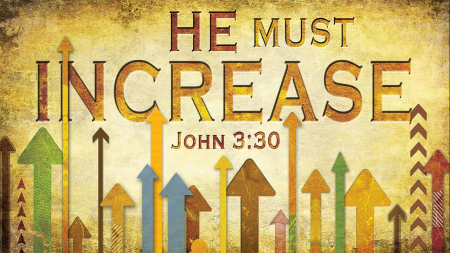
He must become greater and greater, and I must become less and less.

John 3:30, NLT

Before our Lord appeared, John the Baptist had incredible popularity.  Thousands and thousands came to him as he preached in the wilderness of Judea.  However, when Jesus initiated His own ministry, people left in droves to follow Him.  Imagine having a wildly successful thing going, and the next day having it fizzle.

I have discovered that it is one thing to be the center of attention, and quite another to be a minor player.  John the Baptist was the MVP, but overnight he was sent to the farm team (baseball metaphor).  Men and women reach for center stage, to be in the limelight.  But very few can move in the other direction gracefully.

A conductor was asked what the hardest instrument to play.  The interviewer expected that it would be a saxophone or trombone or some other.  The conductor just smiled,  and said, “The hardest is the second violin”.

How great victory was that which Jonathan must have gained over himself, when he rejoiced to see David raised above him! He discerned the mind of God in David, and had so learned to delight in God, that he did not see in David one who was to outshine him, but another faithful man raised up for God and Israel.”   

 
–Robert C. Chapman
 
Jonathan understood who David really was.  He had a sense of who was to be the new king. He had a conviction that understood David’s destiny and giftings.  Jonathan turned his back decisively on being made king.  Ambition was not in his vocabulary.  He could rejoice with David. Knowing this, Jonathan became a free man.

We must not aspire to being a leader as much as learning to become a true follower.

The need at the moment isn’t so much better leaders, but stronger followers. Often we struggle with this, somehow we believe, we’ll become “second class” disciples if we submit to another’s vision or giftings. The way of true servanthood is difficult for many. But to be a real follower will often mean not to strive or assert, but to surrender. That’s the way of Jesus.
 
Thomas a Kempis counseled,

“Be desirous, my son, to do the will of another rather than thine own.”

  
That is an interesting place to find yourself.  But that is the need of the moment.  He must increase, become greater, and I must decrease, become lesser.  There can be no room for personal aggrandizement. 

We need people who know how to play second fiddle.


The Strange Ramblings of a Broken Believer

Related image

“My grace is all you need. My power works best in weakness.”

2 Corinthians 12:9, NLT

“If we find ourselves with a desire that nothing in this world can satisfy, the most probable explanation is that we were made for another world.”   

— C.S. Lewis

I think I am often a creature of habit, far more than I’d like to admit. I rather think we choose our habits and inclinations.  They, in turn, decide our paths.  But I suppose we give ourselves too much credit, to decide and direct.  Simply put, we are not that big. I honestly don’t think we have the power to steer our lives the way we like. That is what I’m thinking about today anyway.

Somebody once told me, “The purpose of life is not to find your freedom, but to find your master.” 

I don’t live that way, at least my inner propensity does not include God.  Did you ever think something like this?  “I wish God did not exist.  I want to be in charge, and I want to do, how I want to do, when I want to do it!”

Living it all with no rules and no accountability! Somehow I still seem to find myself sitting on my throne. I like this!

But as we get older, our hair goes gray and we look in the mirror and see bags and wrinkles, we realize how vulnerable and how tenuous life really is.  If we are honest and sufficiently self-aware, we understand that we will never be able to seize control of the known universe.

“Life is what happens while you are making other plans,” John Lennon observed. 

It seems that reality springs on you, and you have this bolt out of the blue that shocks you to the core.  Life has happened, and you didn’t even realize it.

I sometimes look at myself in the mirror, not in vanity, but in steady amazement.  The ugly tattoos, and the ‘track marks’ are from another life. I have scars on my wrists from a couple of suicide attempts.  I have an amazing surgical zipper scar from a brain tumor.  I have severe ataxia that makes me walk with a cane. I have lost the use of my right hand in an accident. But I am also learning how to be broken.  And everything that has happened has happened for a reason.

C.S. Lewis once said, “Experience is a brutal teacher, but you learn. My God, do you learn.”  

I sense that he did learn, otherwise he couldn’t have said that.

Re-reading this I decided that I ramble a lot.  Forgive me.  Maybe there is scrap or two in it for someone.

“I came to you in weakness—timid and trembling.”

1 Corinthians 2:3

bry-signat-1 (1)