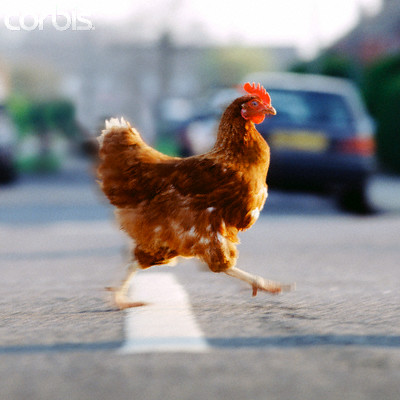
 Why Did the Chicken Cross the Road?
Seldom has such a riddle penetrated our thinking as this issue. Here is a list that approximates an answer on this very important subject. (It is helpful to have a working knowledge of philosophy and history, but not really necessary.)
Mohammed Aldouri (Iraqi ambassador): The chicken did not cross the road. This is a complete fabrication. We don’t even have a chicken.
Aristotle: To actualize its potential.
Buddha: If you ask this question, you deny your own chicken-nature.
George W. Bush: We don’t really care why the chicken crossed the road. We just want to know if the chicken is on our side of the road or not. The chicken is either with us or it is against us. There is no middle ground here.
Bill Clinton: I did not cross the road with THAT chicken. What do you mean by chicken? Could you define chicken, please?
Howard Cosell: It may very well have been one of the most astonishing events to grace the annals of history. An historic, unprecedented avian biped with the temerity to attempt such an herculean achievement formerly relegated to homo sapien pedestrians is truly a remarkable occurrence.
Salvador Dali: The Fish.
Darwin: Chickens, over great periods of time, have been naturally selected in such a way that they are now genetically dispositioned to cross roads.
Jacques Derrida: Any number of contending discourses may be discovered within the act of the chicken crossing the road, and each interpretation is equally valid as the authorial intent can never be discerned,because structuralism is DEAD, DAMMIT, DEAD!
Einstein: Whether the chicken crossed the road or the road moved beneath the chicken depends upon your frame of reference.
Emerson: The chicken didn’t cross the road; it transcended it.
Emily Dickinson: Because it could not stop for death.
Epicurus: For fun.
Louis Farrakhan: The road, you will see, represents the black man. The chicken “crossed” the black man in order to trample him and keep him down.
Freud: The fact that you are at all concerned that the chicken crossed the road reveals your underlying sexual insecurity.
Bill Gates: I have just released the new Chicken Office 2000, which will not only cross roads, but will lay eggs, file your important documents, and balance your checkbook.
Goethe: The eternal hen-principle made it do it.
Grandpa: In my day, we didn’t ask why the chicken crossed the road. Someone told us that the chicken had crossed the road, and that was good enough for us.
Heisenberg: We are not sure which side of the road the chicken was on, but it was moving very fast.
Hemingway: To die. In the rain.
Hippocrates: Because of an excess of light pink gooey stuff in its pancreas.
David Hume: Out of custom and habit.
Saddam Hussein: This was an unprovoked act of rebellion and we were quite justified in dropping 50 tons of nerve gas on it.
Carl Jung: The confluence of events in the cultural gestalt necessitated that individual chickens cross roads at this historical juncture, and therefore synchronicitously brought such occurrences into being.
Martin Luther King, Jr.: I envision a world where all chickens will be free to cross roads without having their motives called into question.
Captain Kirk: To boldly go where no chicken has gone before.
Timothy Leary: Because that’s the only kind of trip the Establishment would let it take.
John Lennon: Imagine all the chickens crossing roads in peace.
Machiavelli: So that its subjects will view it with admiration, as a chicken which has the daring and courage to boldly cross the road, but also with fear, for whom among them has the strength to contend with such a paragon of avian virtue? In such a manner is the princely chicken’s dominion maintained.
Karl Marx: It was a historical inevitability.
Moses: And God came down from the Heavens, and He said unto the Chicken, “Thou shalt cross the road.” And the chicken crossed the road, and there was much rejoicing.
Agent Mulder: You saw it cross the road with your own eyes. How many more chickens have to cross the road before you believe it?
Ralph Nader: The chicken’s habitat on the original side of the road had been polluted by unchecked industrialist greed. The chicken did not reach the unspoiled habitat on the other side of the road because it was crushed by the wheels of a gas-guzzling SUV.
Nietzsche: Because if you gaze too long across the Road, the Road gazes also across you.
Richard M. Nixon: The chicken did not cross the road. I repeat, the chicken did NOT cross the road.
Plato: For the greater good.
Pyrrho the Skeptic: What road?
Ronald Reagan: I forget.
Colonel Sanders: I missed one?
Jean-Paul Sartre: In order to act in good faith and be true to itself, the chicken found it necessary to cross the road.
Jerry Seinfeld: Why does anyone cross a road? I mean, why doesn’t anyone ever think to ask, “What the heck was this chicken doing walking around all over the place, anyway? Where do they get these chickens?”
Dr. Seuss: Did the chicken cross the road? Did he cross it with a toad? Yes, the chicken crossed the road, but why it crossed, I’ve not been told!
B.F. Skinner: Because the external influences which had pervaded its sensorium from birth had caused it to develop in such a fashion that it would tend to cross roads, even while believing these actions to be of its own free will.
The Sphinx: You tell me.
Oliver Stone: The question is not, “Why did the chicken cross the road?” Rather, it is, “Who was crossing the road at the same time, whom we overlooked in our haste to observe the chicken crossing?”
Mr. T: If you saw me coming you’d cross the road too!
Thoreau: To live deliberately and suck all the marrow out of life.
Torquemada: Give me ten minutes with the chicken and I’ll find out.
Mark Twain: The news of its crossing has been greatly exaggerated.
Voltaire: I may not agree with what the chicken did, but I will defend to the death its right to do it.
Wittgenstein: The possibility of “crossing” was encoded into the objects “chicken” and “road”, and circumstances came into being which caused the actualization of this potential occurrence.
Molly Yard: It was a hen!
59.656900
-151.488000


 A young man had come to a decision. “I will not be attending Church. I need to stand on my feet, and be a Christian my own way.” He was quite adamant about this, and his young wife hadn’t the slightest about what to do. It seems he had grown somewhat hard and coarse over the last few months. He had quit attending services for the last few Sundays.



 Broken Believers