Two O’ Clock in the Morning Poetry, #7

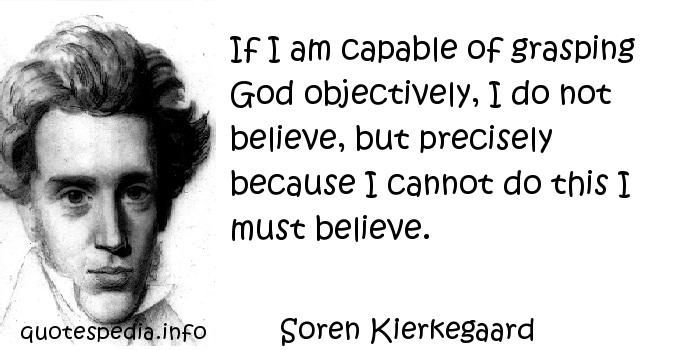
soren_kierkegaard_god_6322


Søren Aabye Kierkegaard (/ˈsɔrən ˈkɪərkəɡɑrd/ or /ˈkɪərkəɡɔr/Danish: [ˈsɶːɐn ˈkiɐ̯ɡəɡɒːˀ] ( listen)) (5 May 1813 – 11 November 1855) was a Danish philosophertheologianpoetsocial critic, and religious author who is widely considered to be the first existentialist philosopher.[5] He wrote critical texts on organized religionChristendommoralityethicspsychology and philosophy of religion, displaying a fondness for metaphor, irony and parables. Much of his philosophical work deals with the issues of how one lives as a “single individual”, giving priority to concrete human reality over abstract thinking, and highlighting the importance of personal choice and commitment.[6] He was a fierce critic of idealist intellectuals and philosophers of his time, such as Swedenborg,[7] HegelGoetheFichteSchellingSchlegel, and Hans Christian Andersen.

Kierkegaard’s Insight into Creative People

“A poet is an unhappy being whose heart is torn by secret sufferings, but whose lips are so strangely formed that when the sighs and the cries escape them, they sound like beautiful music and then people crowd about the poet and say to him: “Sing for us soon again;” that is as much as to say, “May new sufferings torment your soul.”‘

For a person who gives out creatively means to sweat drops of blood; it is torment that teaches us new words. Pain comes surely as the morning sun rises. There maybe a hint of duplicity as the patron sees the pain– but demands his art, nevertheless.

Søren Kierkegaard

Some of Kierkegaard’s key ideas include the concept of Truth as Subjectivity, the knight of faith, the recollection and repetition dichotomyangst, the infinite qualitative distinction,faith as a passion, and the three stages on life’s way. Kierkegaard’s writings were written in Danish and were initially limited to Scandinavia, but by the turn of the 20th century, his writings were translated into major European languages, such as French and German. By the mid-20th century, his thought exerted a substantial influence on philosophy,[16]theology,[17] and Western culture.[18]

Soren-Kierkegaard-quote“Revelation is marked by mystery, eternal happiness by suffering, the certitude of faith by uncertainty, easiness by difficulty, truth by absurdity; if this is not maintained, then the esthetic and the religious merge in common confusion. … The religious lies in the dialectic of inwardness deepening and therefore, with regard to the conception of God, this means that he himself is moved, is changed. An action in the eternal transforms the individual’s existence.”

This was part of Kierkegaard’s theory of “indirect communication.” He wrote:

“No anonymous author can more slyly hide himself, and no maieutic can more carefully recede from a direct relation than God can. He is in the creation, everywhere in the creation, but he is not there directly, and only when the single individual turns inward into himself (consequently only in the inwardness of self-activity) does he become aware and capable of seeing God.” Concluding Unscientific Postscript, Hong 1992 p. 243

Despite everything people ought to have learned about my maieutic carefulness, in addition to proceeding slowly and continually letting it seem as if I knew nothing more, not the next thing — now on the occasion of my new upbuilding discourses they will probably bawl out that I do not know what comes next, that I know nothing about sociality. You fools! Yet on the other hand I owe it to myself to confess before God that in a certain sense there is some truth in it, only not as men understand it — namely, that when I have first presented one aspect sharply, then I affirm the other even more strongly. Now I have my theme of the next book. It will be called: Works of LoveJournals of Soren Kierkegaard VIII 1A4 ~~source, Wikipedia

Soren-Kierkegaard_Design-Crush

Rolling Stones Theology

I was time travelling today.  I journeyed back to Christmas, 1972.  I had told my parents that life could only have meaning, if I could have just one thing.  I held out in hope that on Christmas morning, that I would open up a “rock tumbler.”

I was an 11 year old boy, and I imagined that I could turn gravel from the driveway into polished gems.  I would make jewelry for my mom, and then I would go on to know the thrill of turning ugly stones into precious jewels.  Somehow, doing this would give me a profound purpose. I guess I wanted to become a alchemist– turning gravel into gems.

This is all I wanted.  I dreamed of having my polisher– a rock tumbler that would be all and everything I wanted.  I was fixated, and just knew this was my destiny.  I would become a lapidarist! Today, I haven’t changed, I am always looking for the right stone.

Opening up our gifts, I had eyes only for my new rock tumbler.  I ripped open my present and tore into the box.  Within 10 minutes I had it up and going.

The principle was simple:

  • Step 1— Add the stones, and the “grit.” Resist putting in too many stones.
  • Step 2— Measure out the water.  The idea is to make a “slurry.”
  • Step 3— Let the machine run, don’t open the drum every 30 minutes. This takes time, and patience.
  • Step 4— A trick– add a tablespoon of sugar to the final polishing stage. It adds an extra gleam.

The Church is a lot like a rock tumbler.  The Holy Spirit places us in a fellowship with others.  We are rough and drab, we show nothing that would suggest a polish or gleam.  There is nothing beautiful about us.  We really understand this.

We join others who have been picked up.  Different grit is then added.  There are special types– some are very coarse and others are quite fine.  Water is added.  (The whole process is to parallel what happens at the beach, but purposefully accelerating it in your drum.)

As the drum rotates, things are constantly changing as they move.  The water and grit roll between the stones.  The stones themselves move with each other, sometime counter, but they smooth out all roughness and coarseness.  Some rocks are harder, and not easily polished.  Sometimes, the grit will need to be changed to speed up the process.  Whatever happens, we need to trust Him to do the right thing.

I really don’t want to bore you with all the different details.  But each step has a connection to authentically spiritual things.  We are a mixture of stones with different shapes and angles. There are a lot of variables, and it gets tedious.  The polishing takes a lot of time. There is the need for patience.  We often bring ‘a thirst for the instant,’ and for the quick work.  Polishing a rock takes a lot of time– months.  And we take years– maybe sometimes even decades.

“And you are living stones that God is building into his spiritual temple. What’s more, you are his holy priests. Through the mediation of Jesus Christ, you offer spiritual sacrifices that please God.”  1Peter 2:5, NLT

We are all in this process, what is hidden is being revealed.  We may bounce off each other, (here comes that ‘flinty’ sister again!)  But the Spirit is the superintendent of the process.  He will change the grit, add more water, or add others to the tumbler. He knows exactly what He is doing. No one will get overlooked.

Related articles

My Comfort Food

comfort foods collage

Lord, you know the hopes of the helpless.
Surely you will hear their cries and comfort them. Psalm 10:17

Even when I walk
through the darkest valley,
I will not be afraid,
for you are close beside me.
Your rod and your staff
protect and comfort me. Psalm 23:4

You will restore me to even greater honor
and comfort me once again. Psalm 71:21

When doubts filled my mind,
your comfort gave me renewed hope and cheer. Psalm 94:19

Now let your unfailing love comfort me,
just as you promised me, your servant. Psalm 119:76

My eyes are straining to see your promises come true.
When will you comfort me? Psalm 119:82

These are the verses that speak of a Psalms comfort,

  • comfort sought
  • comfort given
  • comfort strengthening

Undoubtedly we have a God who comforts His people. That is his favorite thing to do, it is like the “special of the house.” He cooks up five-star entrees, and these all meet us on a seriously high level.

“Comfort food is traditionally eaten food (which often provides a nostalgic or sentimental feeling to the person eating it), or simply provides the consumer an easy-to-digest meal, soft in consistency, and rich in calories, nutrients, or both. The nostalgic element most comfort food has, may be specific to either the individual or a specific culture. Many comfort foods are flavorful; some may also be easily prepared.” From Wikipedia, http://en.wikipedia.org/wiki/Comfort_food.

My comfort foods are Wisconsin based and farm fresh.  Favorites are pan fried blue-gill, 0r perch, and fried potatoes. Honey glazed carrots, and homemade white bread, with real butter and jam. Whole milk straight from our cow, and cream two inches thick from a gallon jug. Very sharp Colby cheese with hot homemade apple pie, with an open lattice crust. And coffee, of course, with cream.

These dishes comfort me on some basic level, and I’m sure you have one or more favorites. Simple, but satisfying dishes made by a loved one. They are far more than mere calories, they provide things greater than you can see. “Mom’s home cooking” plain with no pretense.

“Taste and see that the Lord is good.
    Oh, the joys of those who take refuge in him!” Psalm 34:8

God feeds us comfort food.  A true easiness and calm, imparted by Grace to our hearts. The Holy Spirit has a title on His desk– “The Comforter.” Why is He called that? Because that is what He specializes in and masters. He is our dear sufficiency and satisfaction, freely set on our tables.

Don’t just look– eat up (just like mom insisted we do)!

3 “All praise to God, the Father of our Lord Jesus Christ. God is our merciful Father and the source of all comfort. He comforts us in all our troubles so that we can comfort others. When they are troubled, we will be able to give them the same comfort God has given us. 5 For the more we suffer for Christ, the more God will shower us with his comfort through Christ. 6 Even when we are weighed down with troubles, it is for your comfort and salvation! For when we ourselves are comforted, we will certainly comfort you. Then you can patiently endure the same things we suffer. 7 We are confident that as you share in our sufferings, you will also share in the comfort God gives us.”

–1 Corinthians 1:3-7, NLT

recite-25825-95458975-1jznxku

Pathp

Deciding What Makes Up Wisdom

kind-words1

“Often wise sayings fall on barren ground; but a kind word is never ever thrown away.” Sir Arthur Helps

There are so many things to grasp. Our own recovery practically insists we grab vital truths. When we latch on them, we must stick to them no matter what. When we lose someone, or even lose ourselves, we must listen so much closer– the Lord will send someone to our side.

Some rules though:

  • Curiosity is not ever the same as caring.
  • Losing ones balance is never the same as losing ones testimony.
  • A gentle touch can mean more than a powerful revelation.
  • Words of kindness are better than cold truth.
  • To really hear is better than a speech of true words.
  • We must live out the questions we whisper to God
  • Practising prayer is better than just simply praying.
  • Similar experiences that emphasize a connection is never the same as the individuals.
  • Our questions to God reveal far more than His answers.
  • When we do decide to dance, our true friends will dance too.

Ok, I must admit these are not always true and concrete in my heart. My life seems to be a cavern of emptiness; there is little inside but a silly reputation. But it’s a blanket that can’t warm my chilly heart.

12 “Since God chose you to be the holy people he loves, you must clothe yourselves with tenderhearted mercy, kindness, humility, gentleness, and patience. 13 Make allowance for each other’s faults, and forgive anyone who offends you. Remember, the Lord forgave you, so you must forgive others. 14 Above all, clothe yourselves with love, which binds us all together in perfect harmony.”

Colossians 3:12-14, NLT

“Share each other’s burdens, and in this way obey the law of Christ.”

Galatians 6:2

“It is a sin to belittle one’s neighbor;
    blessed are those who help the poor.”

Proverbs 14:21

recite-25825-95458975-1jznxku