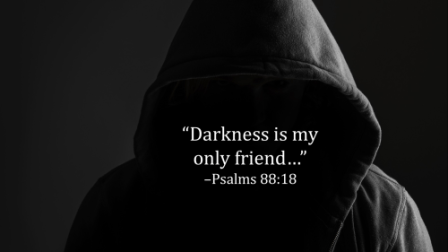
“Darkness is My Only Companion”

Ambrose of Milan (340-397)

Our theology makes all the difference in fighting depression, writes Kathryn Greene-McCreight, Author of “Darkness, Is My Only Companion” and Episcopal priest.

In his Problem of Pain, C. S. Lewis says that suffering is uniquely difficult for the Christian, for the one who believes in a good God. If there were no good God to factor into the equation, suffering would still be painful, and  ultimately meaningless.

For the Christian, who believes in the crucified and risen Messiah, suffering is always meaningful. It is meaningful because of the one in whose suffering we participate, Jesus. This is neither to say, of course, that suffering will be pleasant, nor that it should be sought. Rather, in the personal suffering of the Christian, one finds a correlate in Christ’s suffering, which gathers up our tears and calms our sorrows and points us toward his resurrection.

In the midst of a major mental illness, we are often unable to sense the presence of God at all. Sometimes all we can feel is the complete absence of God, utter abandonment by God, the sheer ridiculousness of the very notion of a loving and merciful God. This cuts to the very heart of the Christian and challenges everything we believe about the world and ourselves.

I have a chronic mental illness, a brain disorder that used to be called manic depression, but now is less offensively called bipolar disorder. I have sought help from psychiatrists, social workers, and mental health professionals; one is a Christian, but most of my helpers are not. I have been in active therapy with a succession of therapists over many years, and have been prescribed many psychiatric medications, most of which brought quite unpleasant side effects, and only a few of which relieved my symptoms. I have been hospitalized during the worst times and given electroconvulsive therapy treatments.

All of this has helped, I must say, despite my disinclination toward medicine and hospitals. They have helped me to rebuild some of “myself,” so that I can continue to be the kind of mother, priest, and writer I believe God wants me to be.

During these bouts of illness, I would often ask myself: How could I, as a faithful Christian, be undergoing such torture of the soul? And how could I say that such torture has nothing to do with God? This is, of course, the assumption of the psychiatric guild in general, where faith in God is often viewed at best as a crutch, and at worst as a symptom of disease.

How could I, as a Christian, indeed as a theologian of the church, understand anything in my life as though it were separate from God? This is clearly impossible. And yet how could I confess my faith in that God who was “an ever-present help in trouble” (Ps. 46:1) when I felt entirely abandoned by that God? And if this torture did have something to do with God, was it punishment, wrath, or chastisement? Was I, to use a phrase of Jonathan Edwards’s, simply a “sinner in the hands of an angry God”?

I started my journey into the world of mental illness with a postpartum depression after the birth of our second child. News outlets are rife with stories of women who destroy their own children soon after giving birth. It is absolutely tragic. Usually every instinct in the mother pushes toward preserving the life of the infant. Most mothers would give their own lives to protect their babies. But in postpartum depression, reality is so bent that that instinct is blocked. Women who would otherwise be loving mothers have their confidence shaken by painful thoughts and feelings.

Depression is not just sadness or sorrow.

When I am depressed, every thought, every breath, every conscious moment hurts.

And often the opposite is the case when I am hypomanic: I am scintillating both to myself, and, in my imagination, to the whole world. But mania is more than speeding mentally, more than euphoria, more than creative genius at work. Sometimes, when it tips into full-blown psychosis, it can be terrifying. The sick individual cannot simply shrug it off or pull out of it: there is no pulling oneself “up by the bootstraps.”

And yet the Christian faith has a word of real hope, especially for those who suffer mentally. Hope is found in the risen Christ. Suffering is not eliminated by his resurrection, but transformed by it. Christ’s resurrection kills even the power of death, and promises that God will wipe away every tear on that final day.

But we still have tears in the present.

We still die. In God’s future, however, death itself will die. The tree from which Adam and Eve took the fruit of their sin and death becomes the cross that gives us life.

The hope of the Resurrection is not just optimism, but keeps the Christian facing ever toward the future, not merely dwelling in the present. But the Christian hope is not only for the individual Christian, nor for the church itself, but for all of Creation, bound in decay by that first sin: Cursed is the ground because of you … It will produce thorns and thistles for you …” (Gen. 3:17-18).

This curse of the very ground and its increase will be turned around at the Resurrection. All Creation will be redeemed from pain and woe. In my bouts with mental illness, this understanding of Christian hope gives comfort and encouragement, even if no relief from symptoms. Sorrowing and sighing will be no more. Tears will be wiped away. Even fractious [unruly, irritable] brains will be restored.

“Darkness: My Only Companion”

Kathryn Greene-McCreight is assistant priest at St. John’s Episcopal Church in New Haven, Connecticut, and author of Darkness Is My Only Copanion: A Christian Response to Mental Illness (Brazos Press, 2006).

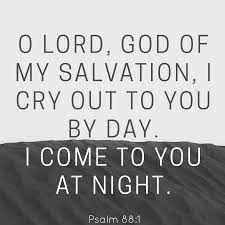
Click to read Psalm 88

When You Lose a Child: Grief

‘Who gathered this flower?’ The gardener answered, ‘The Master.’ And his fellow servant held his peace.”

It was November 13th, in the year of our Lord 1999, was unlike any day I have ever experienced. A beating with a baseball bat would seem preferable. On this cold afternoon, hell was unleashed on my wife and I. What we encountered was soul-wrenching and profoundly tragic.

Perhaps a parent’s worst nightmare is the loss of a child.

On this day we lost Elizabeth Grace. She was stillborn, which is rare these days– or so I have been told. She entered this world fully formed, a beautiful baby girl. Today, she would have been 24 years old, and maybe married, planning a family of her own?

“But now he is dead. Why should I fast? Can I bring him back again? I shall go to him, but he will not return to me.”

2 Samuel 12:23, (When David’s newborn son died.)

Our loss was grievous, but we know that there are others.

Plenty of families have suddenly lost a child. I can truly commiserate with them. Somehow we are connected in a perverse way. It seems like an exclusive club, that requires a secret handshake, or something. Suddenly without warning, you are thrown into personal chaos, and very little is remotely decipherable, even to a believer.

The book of Ecclesiastes that there is a definite “time to mourn.”  Matthew tells us, “Blessed are those who mourn.” He does go on to say. “for they shall be comforted.” This comfort is available for any who chooses to take it, but you can refuse it if you really want to.

Grief unites us all, but Jesus loves us infinitely.

I can’t imagine meeting life without his care and comfort. He has been outstandingly gracious to this family. Sure there was pain, but there was also tenderness and a kind grace. Still, sometimes it may have felt like a “kick in the head.” (But I assure you– it was grace.)

What I still can’t understand is simply this. What would it have cost God to allow Elisabeth to live? I mean, what ‘skin off His nose’ would’ve it taken to let her live? To this day I still have questions, but I have decided to trust. (I trust Him after all, to save my soul.)

Those who have suffered will comprehend and grasp, the noxious environment of grief and loss.

But we can only take what we are dealt. The sadness is there, but so is His comfort. Make no mistake, His love matches (and even exceeds) the pain and the loss of a child. Truly, God is wonderful and He is good.

I do know that He loves me, a weirdly rascalish, struggling disciple. He holds me close to His precious heart, and I will have no other gods except Him. I will not take up umbrage with Him on this. But I must believe that someday soon, I will truly and completely understand this.

She’s waiting for us.

Lynn and I celebrate her birthday every year.


When You Need to Cover Nakedness

“And don’t build an altar that requires steps; you might expose yourself when you climb up”.

Exodus 20:26

“Most important of all, continue to show deep love for each other, for love covers a multitude of sins.”

1 Peter 4:8

While I lived in the SOS Ministry house in the Mission District of San Francisco a dear brother taught me this principle.  Living in Christian community is a really wonderful thing.  But it also could be a challenge at times.  What Michael shared, allowed my understanding to grow to meet the need of the moment.

The principle is this:  

We are called to cover up our brother’s nakedness.

 Throughout the scripture “being naked, or nakedness” is always a shame.  It comes welded to the concept of being vulnerable or exposed to the sight of everyone else.  It also carries the idea of sin; it is sin that everyone can see; it is very obvious.

For those of us who often sin, we evolve the idea of keeping a lid on it, and being secretive with it.  There will be people who will never know.  Often sex sin, drug and alcohol sin, both are kept hidden from view of family and friends, and the Church.

Noah and His Nakedness, Genesis 9

“Noah became a farmer and planted a vineyard. When he drank wine made from his grapes, he became drunk and lay naked in his tent. Ham, the father of Canaan, looked at his naked father and told his brothers outside. Then Shem and Japheth got a coat and, carrying it on both their shoulders, they walked backwards into the tent and covered their father.”

“They turned their faces away so that they did not see their father’s nakedness.”  

Genesis 9:20-24

It’s hard to process this patriarch’s gross sin. 

However in all fairness Noah had lost everything in the flood, so perhaps we should be gentle with him. On the other hand, people who cover up the nakedness of others seem to be gentle and humble.  They would never, ever dream of making a scandal.  They are trustworthy and understand to a great degree the things that make a man or woman of God.

Leviticus 18 is the “magnum opus” of nakedness.

We are pretty much told over and over in this chapter, not to ever uncover another. Actually is pretty emphatic and somewhat redundant. But I think the Lord wanted it repeated this way.

Our vulnerabilities are there for all to see.  But there are also men and women who go out of their way to protect and shield.  They are safe people, in the classic sense of the word.  They cover-up, but never in negative or criminal way, but in love and blessing. (If it is a serious crime, the police should be involved.)

Mature believers will step forward and protect the open areas of others. 

Quite often we are exposed, open to attack on our weaknesses.  Mature believers will step forward and protect the open areas of others.  They will refuse to judge or point out sins.  But they will stand in the gap, shielding and protecting.

God’s final word on nakedness is in Revelation 3:18, and this is a good place to conclude this post,

“My advice to you is to buy pure gold from me, gold purified by fire—only then will you truly be rich. And to purchase from me white garments, clean and pure, so you won’t be naked and ashamed; and to get medicine from me to heal your eyes and give you back your sight.”

*bry-signat (1)

Battle Scars

knight

It is a bad habit to try to teach without personal knowledge. We can preach, and yet we do not possess. This is one of the occupational hazards of those of us in our profession. It also seems to carry a horrible curse of spiritual sterility, that the wise believer can discern.

It’s been over 20 years since a diagnosis of Bipolar 1 was made. I believe I was BP in my teens. Life is a roller-coaster for me, up and down, with a twist or two along the way. I am now fairly aware at 58 that much of my earthly existence has already been lived. Life can become such a grind. I’m tired and broken and ready for eternity.

“One should go to sleep as homesick passengers do, saying, “Perhaps in the morning we shall see the shore.”

–Henry Ward Beecher

Billy Bray (a bearer of an unfortunate name) was an illiterate Cornish evangelist in the 1850s. He was heard to pray this: “Lord, if any have to die this day, let it be me, for I am ready.” By faith, I think I do understand these sentiments. I am ready to go as well.

I love collecting good quotes. But here’s two more good ones:

“God buries His workmen but carries on His work.”   -Charles Wesley
“If we really think that home is elsewhere and that this life is a “wandering to find a home,” why should we not look forward to the arrival?”  – C.S. Lewis

Sorry if I’m being too maudlin. But the battle is so long, and it doesn’t ever let up, does it? We all can become weary after a while. What we need is to be ‘shut in’ with the Lord. The Word reminds us:

Strengthening the souls of the disciples, encouraging them to continue in the faith, and saying that through many tribulations we must enter the kingdom of God”

Acts 14:22

“Tribulations” are common, and each must battle through them. And without being melodramatic, we each must walk through the blazing furnace. But I can also boldly attest that there is more than enough grace for each of us. We just need to become desperate enough. (Which shouldn’t be too hard).

Armor is given. Wearing it means you’ll survive (and thrive) to see another day. Those who may suggest that the Christian life is a “bed of roses,” I would say that they haven’t read Ephesians 6. If there is no war, why would the Holy Spirit tell us to put it on?

“Finally, be strong in the Lord and in the strength of his might. 11 Put on the whole armor of God, that you may be able to stand against the schemes of the devil.” 

Eph. 6:10-11

We are just starting to learn we must fall in love with Jesus. He receives us with a massive kind of love. And His mercy meets us at every doubtful corner. You have His Word on it. Simply ask Him to come to you. 

bry-signat-1-1

cropped-christiangraffiti1-2