

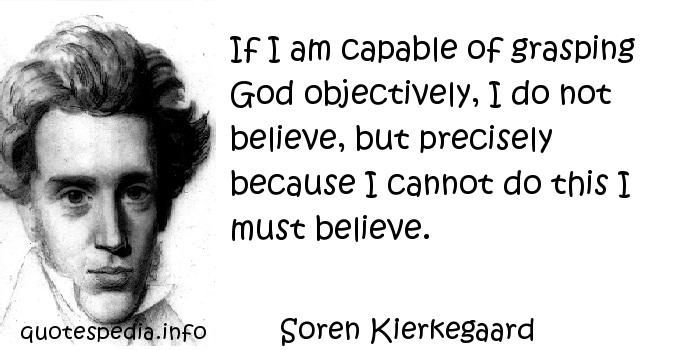
Søren Aabye Kierkegaard (/ˈsɔrən ˈkɪərkəɡɑrd/ or /ˈkɪərkəɡɔr/; Danish: [ˈsɶːɐn ˈkiɐ̯ɡəɡɒːˀ] ( listen)) (5 May 1813 – 11 November 1855) was a Danish philosopher, theologian, poet, social critic, and religious author who is widely considered to be the first existentialist philosopher.[5] He wrote critical texts on organized religion, Christendom, morality, ethics, psychology and philosophy of religion, displaying a fondness for metaphor, irony and parables. Much of his philosophical work deals with the issues of how one lives as a “single individual”, giving priority to concrete human reality over abstract thinking, and highlighting the importance of personal choice and commitment.[6] He was a fierce critic of idealist intellectuals and philosophers of his time, such as Swedenborg,[7] Hegel, Goethe, Fichte, Schelling, Schlegel, and Hans Christian Andersen.
Kierkegaard’s Insight into Creative People
“A poet is an unhappy being whose heart is torn by secret sufferings, but whose lips are so strangely formed that when the sighs and the cries escape them, they sound like beautiful music and then people crowd about the poet and say to him: “Sing for us soon again;” that is as much as to say, “May new sufferings torment your soul.”‘
For a person who gives out creatively means to sweat drops of blood; it is torment that teaches us new words. Pain comes surely as the morning sun rises. There maybe a hint of duplicity as the patron sees the pain– but demands his art, nevertheless.
Søren Kierkegaard
Some of Kierkegaard’s key ideas include the concept of “Truth as Subjectivity“, the knight of faith, the recollection and repetition dichotomy, angst, the infinite qualitative distinction,faith as a passion, and the three stages on life’s way. Kierkegaard’s writings were written in Danish and were initially limited to Scandinavia, but by the turn of the 20th century, his writings were translated into major European languages, such as French and German. By the mid-20th century, his thought exerted a substantial influence on philosophy,[16]theology,[17] and Western culture.[18]
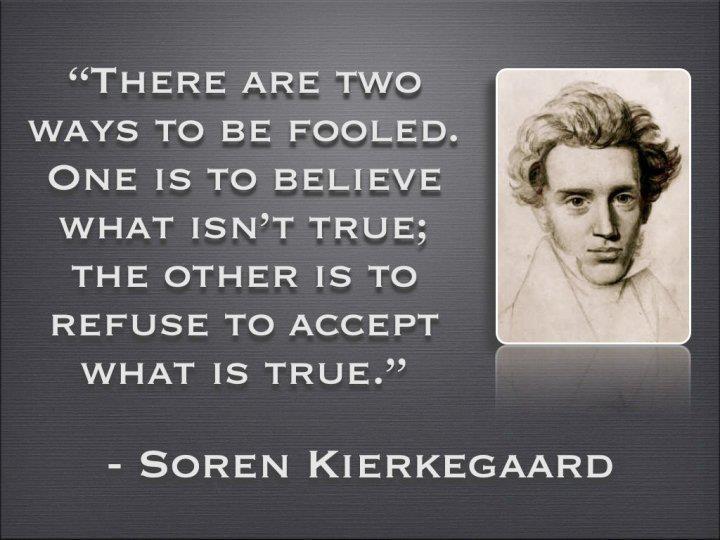 “Revelation is marked by mystery, eternal happiness by suffering, the certitude of faith by uncertainty, easiness by difficulty, truth by absurdity; if this is not maintained, then the esthetic and the religious merge in common confusion. … The religious lies in the dialectic of inwardness deepening and therefore, with regard to the conception of God, this means that he himself is moved, is changed. An action in the eternal transforms the individual’s existence.”
This was part of Kierkegaard’s theory of “indirect communication.” He wrote:
“No anonymous author can more slyly hide himself, and no maieutic can more carefully recede from a direct relation than God can. He is in the creation, everywhere in the creation, but he is not there directly, and only when the single individual turns inward into himself (consequently only in the inwardness of self-activity) does he become aware and capable of seeing God.” Concluding Unscientific Postscript, Hong 1992 p. 243
Despite everything people ought to have learned about my maieutic carefulness, in addition to proceeding slowly and continually letting it seem as if I knew nothing more, not the next thing — now on the occasion of my new upbuilding discourses they will probably bawl out that I do not know what comes next, that I know nothing about sociality. You fools! Yet on the other hand I owe it to myself to confess before God that in a certain sense there is some truth in it, only not as men understand it — namely, that when I have first presented one aspect sharply, then I affirm the other even more strongly. Now I have my theme of the next book. It will be called: Works of Love. Journals of Soren Kierkegaard VIII 1A4 ~~source, Wikipedia

Related articles
- The Philosophy of Kierkegaard, the First Existentialist Philosopher, Revisited in 1984 Documentary (openculture.com)
- Google Doodle celebrates Danish philosopher Søren Kierkegaard ‘the father of … (independent.co.uk)
- Encountered by One who has established kinship with us in time: celebrating Søren Kierkegaard (cruciality.wordpress.com)
- Kierkegaard On Imagination (disquietreservations.blogspot.com)
- Soren Kierkegaard’s Crises (mmckenz11.wordpress.com)




 Broken Believers