I often hear people say that the bad things that happen to them are God’s punishment for something wrong they have done. I have a friend who desires to find someone to marry, but has said she doesn’t think God will ever bring her a mate because of all the wrong she has done in the past with respect to relationships. In the news we hear televangelists say natural disasters are God’s punishment for the sins of the people in the area hit by the disaster.
James wrote, “Every good and perfect gift is from above, coming down from the Father of the heavenly lights, who does not change like shifting shadows. He chose to give us birth through the word of truth, that we might be a kind of firstfruits of all he created.” James 1:17-18 (NIV). God desires to give good gifts, not punishment.
I also think of Job, a man who endured great suffering and loss. But none of it was punishment from God. Rather, all of his sorrows came from Satan, albeit with God’s permission, so that Satan would see that God’s redeemed and faithful servants would never reject Him simply because of trials they face. SeeJob 1-2 (NIV).
For the believer in Christ Jesus, all the punishment for our sins has already been meted out at the cross. As Jesus said, “It is finished.” John 19:30 (NIV). To believe that we need to suffer punishment for our own sin is to believe that Jesus’ sacrifice was insufficient. The apostle John wrote, “My dear children, I write this to you so that you will not sin. But if anybody does sin, we have one who speaks to the Father in our defense—Jesus Christ, the Righteous One. He is the atoning sacrifice for our sins, and not only for ours but also for the sins of the whole world.” 1 John 2:1-2 (NIV). God does not seek to punish, but to restore and redeem those He loves.
There are, however, natural consequences of sin.
If we are gluttonous, we are likely to be overweight and suffer various illnesses that come from poor eating habits.
If we get drunk, especially habitually, we will suffer in terms of health problems, possibly losing a job, or having financial difficulties because we spend too much money on alcohol.
If we get involved with other drugs, the same problems can happen, perhaps even worse if they are illegal drugs because we could end up in prison for breaking the law.
If we are sexually promiscuous we may contract diseases, end up with a child we didn’t want, or will suffer emotional damages and loneliness.
If we gossip and badmouth others, we will damage others view of us and damage our relationships.
Every sin has natural consequences. Sometimes we are fortunate to avoid the worst of the natural consequences, but not always. And all sin results in the natural consequence of separating us from God because our guilt and shame cause us to avoid God. That has been the case from the first sin in the Garden of Eden, when Adam and Eve hid from God.
When the woman saw that the fruit of the tree was good for food and pleasing to the eye, and also desirable for gaining wisdom, she took some and ate it. She also gave some to her husband, who was with her, and he ate it. Then the eyes of both of them were opened, and they realized they were naked; so they sewed fig leaves together and made coverings for themselves.
Then the man and his wife heard the sound of the LORD God as he was walking in the garden in the cool of the day, and they hid from the LORD God among the trees of the garden. But the LORD God called to the man, “Where are you?”
He answered, “I heard you in the garden, and I was afraid because I was naked; so I hid.”
Genesis 3:6-10 (NIV).
God knows what is best for us and has declared what is sin based on His superior knowledge of what is beneficial for our physical and emotional well-being. Just as He gave to Adam and Eve all that they needed in the Garden, He desires to give us good and perfect gifts.
In addition to the natural consequences of individual sinful behavior, the sinful nature of mankind over the centuries has brought into our lives a brokenness that leads to pain and suffering. The evil nature of some people can lead to suffering by others, such as a violent man who beats his wife, or the drunk driver who causes an accident that kills others, or a serial killer who tortures his victims. Our sinfulness is also engrained in our DNA and can lead to sickness and disease that brings suffering as well.
So if you are suffering and think that God is punishing you, think again. Return to God and seek His face, seek the good and perfect gifts that He has offered. Lean on Jesus in your suffering because He desires to restore and redeem you, not cause you more suffering. “This is the message we have heard from him and declare to you: God is light; in him there is no darkness at all.” 1 John 1:5 (NIV). Come into the light and rest in His love.
Before I entered college I hardly gave a thought to cancer and terminal illness. But ever since those college days death by disease has walked beside me all the way. Two of my college acquaintances died of leukemia and cancer of the lymph glands before they were 22. At seminary I watched Jim Morgan, my teacher of systematic theology, shrivel up and die in less than a year of intestinal cancer. He was 36. In my graduate program in Germany my own “doctor-father,” Professor Goppelt, died suddenly just before I was finished. He was 62—a massive coronary. Then I came to Bethel, the house of God! And I taught for six years and watched students, teachers, and administrators die of cancer: Sue Port, Paul Greely, Bob Bergerud, Ruth Ludeman, Graydon Held, Chet Lindsay, Mary Ellen Carlson—all Christians, all dead before their three score and ten were up. And now I’ve come to Bethlehem and Harvey Ring is gone. And you could multiply the list ten-fold.
What shall we say to these things? Something must be said because sickness and death are threats to faith in the love and power of God. And I regard it as my primary responsibility as a pastor to nourish and strengthen faith in the love and power of God. There is no weapon like the Word of God for warding off threats to faith. And so I want us to listen carefully today to the teaching of Scripture regarding Christ and cancer, the power and love of God over against the sickness of our bodies.
I regard this message today as a crucial pastoral message, because you need to know where your pastor stands on the issues of sickness, healing, and death. If you thought it was my conception that every sickness is a divine judgment on some particular sin, or that the failure to be healed after a few days of prayer was a clear sign of inauthentic faith, or that Satan is really the ruler in this world and God can only stand helplessly by while his enemy wreaks havoc with his children—if you thought any of those were my notions, you would relate to me very differently in sickness than you would if you knew what I really think. Therefore, I want to tell you what I really think and try to show you from Scripture that these thoughts are not just mine but also, I trust, God’s thoughts.
Six Affirmations Toward a Theology of Suffering
So I would like everyone who has a Bible to turn with me to Romans 8:18–28. There are six affirmations which sum up my theology of sickness, and at least the seed for each of these affirmations is here. Let’s read the text:
I consider that the sufferings of this present time are not worth comparing with the glory that is to be revealed to us. For the creation waits with eager longing for the revealing of the sons of God; for the creation was subjected to futility, not of its own will but by the will of him who subjected it in hope; because the creation itself will be set free from its bondage to decay and obtain the glorious liberty of the children of God. We know that the whole creation has been groaning in travail together until now; and not only the creation, but we ourselves, who have the first fruits of the Spirit, groan inwardly as we wait for adoption as sons, the redemption of our bodies. For in this hope we were saved. Now hope that is seen is not hope. For who hopes for what he sees? But if we hope for what we do not see, we wait for it with patience.
Likewise the Spirit helps us in our weakness; for we do not know how to pray as we ought, but the Spirit himself intercedes for us with sighs too deep for words. And he who searches the hearts of men knows what is the mind of the Spirit, because the Spirit intercedes for the saints according to the will of God.
We know that in everything God works for good with those who love him, who are called according to his purpose. (RSV)
1. All Creation Has Been Subjected to Futility
My first affirmation is this: the age in which we live, which extends from the fall of man into sin until the second coming of Christ, is an age in which the creation, including our bodies, has been “subjected to futility” and “enslaved to corruption.” Verse 20: “The creation was subjected to futility.” Verse 21: “The creation will be freed from slavery to corruption.” And the reason we know this includes our bodies is given in verse 23: not only the wider creation but “we ourselves (i.e., Christians) groan in ourselves awaiting sonship, the redemption of our bodies.” Our bodies are part of creation and participate in all the futility and corruption to which creation has been subjected.
Who is this in verse 20 that subjected creation to futility and enslaved it to corruption? It is God. The only other possible candidates to consider would be Satan or man himself. Perhaps Paul meant that Satan, in bringing man into sin, or man, in choosing to disobey God—perhaps one of them is referred to as the one who subjected creation to futility. But neither Satan nor man can be meant because of the words “in hope” at the end of verse 20. This little phrase, subjected “in hope,” gives the design or purpose of the one who subjected creation to futility. But it was neither man’s nor Satan’s intention to bring corruption upon the world in order that the hope of redemption might be kindled in men’s hearts and that someday the “freedom of the glory of the children of God” might shine more brightly. Only one person could subject the creation to futility with that design and purpose, namely, the just and loving creator.
Therefore, I conclude that this world stands under the judicial sentence of God upon a rebellious and sinful mankind—a sentence of universal futility and corruption. And no one is excluded, not even the precious children of God.
Probably the futility and corruption Paul speaks of refers to both spiritual and physical ruination. On the one hand man in his fallen state is enslaved to flawed perception, misconceived goals, foolish blunders, and spiritual numbness. On the other hand, there are floods, famines, volcanoes, earthquakes, tidal waves, plagues, snake bites, car accidents, plane crashes, asthma, allergies, and the common cold, and cancer, all rending and wracking the human body with pain and bringing men—all men—to the dust.
As long as we are in the body we are slaves to corruption. Paul said this same thing in another place. In 2 Corinthians 4:16 he said, “We do not lose heart, but though our outer man (i.e., the body) is decaying (i.e., being corrupted) yet our inner man is being renewed day by day.” The word Paul uses for decay or corrupt here is the same one used in Luke 12:33 where Jesus said, Make sure your treasure is in heaven “where thief does not come near and moth does not corrupt.” Just like a coat in a warm, dark closet will get moth eaten and ruined, so our bodies in this fallen world are going to be ruined one way or the other. For all creation has been subjected to futility and enslaved to corruption while this age lasts. That is my first affirmation.
2. An Age of Deliverance and Redemption Is Coming
My second affirmation is this: there is an age coming when all the children of God, who have endured to the end in faith, will be delivered from all futility and corruption, spiritually and physically. According to verse 21, the hope in which God subjected creation was that some day “The creation itself also will be set free from its slavery to corruption into the freedom of the glory of the children of God.” And verse 23 says that “We ourselves groan within ourselves waiting eagerly for our adoption as sons, the redemption of our bodies.” It has not happened yet. We wait. But it will happen. “Our citizenship is in heaven from which we await a Savior, the Lord, Jesus Christ, who will transform the body of our lowliness to be like the body of his glory” (Philippians 3:20, 21). “In a moment, in the twinkling of an eye, at the last trumpet, for the trumpet will sound and the dead will be raised incorruptible and we shall be changed” (1 Corinthians 15:52). “He will wipe away every tear from our eyes, and there shall be no longer any death; and there shall be no longer any mourning or crying or pain; the first things have passed away” (Revelation 21:4).
There is coming a day when every crutch will be carved up, and every wheelchair melted down into medallions of redemption. And Merlin and Reuben and Jim and Hazel and Ruth and all the others among us will do cartwheels through the Kingdom of Heaven. But not yet. Not yet. We groan, waiting for the redemption of our bodies. But the day is coming and that is my second affirmation.
3. Christ Purchased, Demonstrated, and Gave a Foretaste of It
Third, Jesus Christ came and died to purchase our redemption, to demonstrate the character of that redemption as both spiritual and physical, and to give us a foretaste of it. He purchased our redemption, demonstrated its character, and gave us a foretaste of it. Please listen carefully, for this is a truth badly distorted by many healers of our day.
The prophet Isaiah foretold the work of Christ like this in 53:5–6 (a text which Peter applied to Christians in 1 Peter 2:24):
But he was wounded for our transgressions, he was bruised for our iniquities; upon him was the chastisement that made us whole, and with his stripes we are healed. All we like sheep have gone astray; we have turned every one to his own way; and the Lord has laid on him the iniquity of us all. (RSV)
The blessing of forgiveness and the blessing of physical healing were purchased by Christ when he died for us on the cross. And all those who give their lives to him shall have both of these benefits. But when? That is the question of today. When will we be healed? When will our bodies no longer be enslaved to corruption?
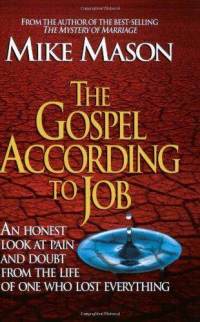
Today, I want to bring out this book, out into the spotlight. It is a tremendous devotional that makes its way through the book of Job. I have leaned on it, and it has held me nicely. I challlenge you to get a copy of this, and to let it work in the confines of your spirit and mind. ––Bryan
“An Honest Look at Pain and Doubt from the Life of One who Lost Everything”
_______________________
A“Once I met a man who, like Abraham, had moved his entire household halfway around the world on the strength of a vision from God. When I asked him to tell me the story, he answered that there were three versions of that story, and which one did I want to hear? First, there was the version of the story that he told to Christians. Then there was the version he told to non-Christians. Finally, there was the truth. Job is a book that tells things from the third point of view. Probably, along with Ecclesiastes, it does this better than any other book in the Bible.
Not that the other Scriptures do not tell the truth. But Job tells the truth in a way that makes it almost impossible to pervert the truth into pious pabulum. A few years ago I went through a difficult time. Never mind what the problem was. It was nothing compared to the trials of Job. In fact, it was nothing at all compared to the sufferings of many of my neighbors right there on the quiet street where I lived.
But pain is pain, and suffice it to say that my pain was enough to drive me to my knees, totally defeated, half-crazy at times, and crying out for relief. Month after month the battles raged on, thick, dark, agonizing. I prayed, but somehow prayer did not ‘work.’ Usually nothing at all worked, except lying low and gritting my teeth until, for reasons entirely obscure to me, the straightjacket of oppression began to loosen a little––at least enough for me to get on with my life for another day or so before the screws tightened again. What else could I do? How was I to fight this?
In retrospect I can see that a large part of my anguish was rooted in the fact that there really was nothing I could do to control what was happening to me. I was absolutely helpless, and it is this, perhaps, that is the soul of suffering, this terrifying impotence. It is a little taste of the final and most terrifying impotence of all, which is death.
We Christians do not like to think about being absolutely helpless in the hands of our God. With all of our faith, and with all of His grace, we still prefer to maintain some semblance of control over our lives. When difficulties arise, we like to think that there are certain steps we can take, or attitudes we can adopt, to alleviate our anguish and be happy. Sometimes there are. But anyone who has truly suffered will know that when it comes to the real thing there is no help for it, no human help whatsoever.
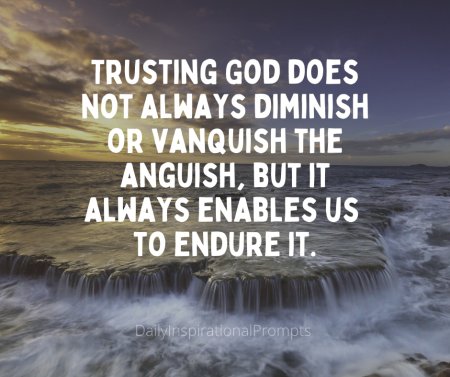
Simply put, when we are in a deep dark hole we cannot think our way out; neither can we hope, sing, pray, or even love our way out. In fact there is absolutely nothing either we or anyone else can do to better our situation. We can have faith, yes; but in itself faith will not change anything. Neither faith, nor any other good thing that a person might have or do, can actually lift the cloud, move the mountain, or bring about an end to the problem.
Only the Lord Himself can do that, and when He does, as Exodus 6:6 puts it, “Then you will know that I am the Lord your God, who brought you out from under the yoke.”How will we know? Simply because nothing and no one else could possibly have done it. In this kind of crucible, therefore, we come to a new understanding of what it means to be saved, what it means to be snatched away from the brink of destruction.
Here we get down to the bedrock of the gospel. During my night of anguish, I turned to the book of Job, and there I began to make contact with the gospel in a way that somehow I never had in studying the New Testament. Reading Job, I found myself experiencing in new and astonishing depth the reality of Jesus’ promise in John 8:32,
“You will know the truth, and the truth will set you free.”
There is the unquestionable presence of affliction that is present in our lives. Affliction is the general term for specific instances of trials, tribulations, persecutions, emotional or physical pain and suffering.
The ancient Assyrians used the word for “affliction” as the same word to describe their method of a public execution, which involved being impaled to the ground. Rocks were gradually piled high until the victim expired. The combination of being impaled and the rocks piled on you was quite devastating.
And you know what? That is a terribly specific concept of what afflictions feel like. Just ask someone, it is exceedingly terrible to be in pain and feel ‘buried’ at the same time. There is a feeling of suffocating in suffering. Some have described it, like being ‘hit with a 2×4’. You have just been completely blindsided.
In the letters from the Early Church there was a patentability, or openness when it came to persecution and pain. The writers of the New Testament operated out of a profound awareness of the pain of the believers of their day.
“We think you ought to know, dear brothers and sisters, about the trouble we went through in the province of Asia. We were crushed and overwhelmed beyond our ability to endure, and we thought we would never live through it.” 2 Cor. 1:8
“We are pressed on every side by troubles, but we are not crushed. We are perplexed, but not driven to despair.” 2 Cor. 4:8
“You have greatly encouraged me and made me happy despite all our troubles.” 2 Cor. 7:4
‘The Ostrich Effect’ in Affliction
One of the most extensive arguments concerning ‘affliction’ develops around the nature of the atonement. The thought is that Jesus died and rose to bless me. Sin and sickness, poverty or lack are not part of God’s plan for the redeemed.
Now, it is possible to refute this in this little post. But I will try to nudge you a bit to examine the issues of the Early Church. Know however that there are many people who will follow the ostrich’s example and bury their heads to avoid reality of affliction. But, I can understand this impulse– this desire to honor God, even if we “play word games” with our faith.
I also know first-hand that the struggles are hard. Wrestling with them is a brutal way to live the abundant life. Failure and frustration are trying to short circuit our faith. And our faith must be protected and valued.
“Afflictions add to the saints’ glory. The more the diamond is cut, the more it sparkles; the heavier the saints’ cross is, the heavier will be their crown.”
–Thomas Watson
What Does the Scripture Say About Affliction?
“Dear friends, don’t be surprised at the fiery trials you are going through, as if something strange were happening to you.” 1 Peter 4:12
“…where they strengthened the believers. They encouraged them to continue in the faith, reminding them that we must suffer many hardships to enter the Kingdom of God.” Acts 14:22
“I have told you all this so that you may have peace in me. Here on earth you will have many trials and sorrows. But take heart, because I have overcome the world.” John 16:33
“The wisdom of God appears in afflictions. By these He separates the sin which He hates, from the son whom He loves. By these thorns He keeps him from breaking over into Satan’s pleasant pastures, which would fatten him indeed, but only to the slaughter.”
-James H. Aughey
I want to try to visit this subject again. We will trust that ‘real light’ will come to our twilight worlds.