Life Off the Grid

“You used to live in sin, just like the rest of the world, obeying the devil—the commander of the powers in the unseen world. He is the spirit at work in the hearts of those who refuse to obey God.”

Ephesians 2:2, NLT

“We know that we are children of God and that the world around us is under the control of the evil one.”

1 John 5:19

An “off-the-grid” lifestyle is living disconnected from basic utilities (such as electric, water supply, etc.)  It has essentially become a significant movement as many seek a life separated from what is perceived as intrusion.  These new homes are autonomous; they provide an alternative to a “life plugged into society” and choosing to be detached from the popular culture.

From what I’ve read, it seems like it is very similar to what the Old Order Amish and Conservative Mennonites have done for centuries.  It seems to be more than “survivalism” and many off-grid people believe they are experiencing a deeper standard of living by being independent.

The Bible teaches that there is a world system that has us enmeshed.  The system is everywhere you see injustice, disease, bondage, wars and pain.  It seems to have a very comprehensive presence of organized wickedness, and it is quite pervasive–it is seen everywhere.

There is a way however, of disconnecting yourself from this spiritual grid.  But there seems to be a consistent pressure on us as Christians to stay connected to this world system.  Those who desire to live off-grid face a degree of scorn and “rolling-of-the-eyes.”  This should be anticipated.  Humans have a tremendous desire for conformity.

The evil found in this world can be intense.  In Bible narrative we see judgement brought on organized societies for their hatred of godliness and godly people.  Satan’s dark fantasy is to control and determine the destiny of all that he can.  The world as we know it, “is  under the control of the evil one.“  The future antichrist will centralize darkness so it does the will of his father, the devil.

The Apostle John had a crisp and clear vision of the spiritual landscape in an extraordinary way.  Many times he speaks clearly.  And at other times John uses symbols and coded information to reveal what is coming.  His writings, especially 1 John and Revelation are embedded with the truths that he saw.

“Don’t love the world or anything that belongs to the world. If you love the world, you cannot love the Father. “

1 John 2:15, CEV

“Off-the-grid” living may have many advantages and appeal, on a physical plane.  (Each of pay a ‘princely’ sum to the electric and water companies.)  But unplugging yourself from this world’s system takes the help of the Holy Spirit.  May the Father guide you in this.

People were eating, drinking, and getting married right up to the day that the flood came and Noah went into the big boat. They didn’t know anything was happening until the flood came and swept them all away. That is how it will be when the Son of Man appears.

Matt. 24:38-39, CEV

 ybic, Bryan

&

&
A Mighty Fortress, Understood

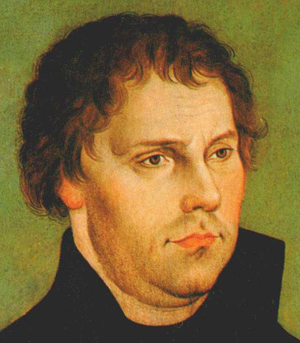
martin_luther2 (1)Martin’s Depression

The hymn A Mighty Fortress Is Our God gloriously celebrates God’s power. It was penned by the great 16th-century reformer Martin Luther, who believed God’s power could help believers overcome great difficulties — even depression. Given his pastoral heart, he sought to bring spiritual counsel to struggling souls. His compassion for those souls shines in numerous places, including his sermons, lectures, Bible commentaries and ‘table talks’. In addition, he devoted many letters to counseling troubled folk.

Luther’s writings reveal his knowledge of various emotional difficulties. For example, in August 1536 he interceded for a woman named Mrs. Kreuzbinder, whom he deemed insane. He described her as being “accustomed to rage” and sometimes angrily chasing her neighbor with a spear.

In addition, Luther’s wife, Kate, struggled with pervasive and persistent worry indicative of generalized anxiety disorder. Prince Joachim of Anhalt, to whom Luther often wrote, exhibited signs of obsessive-compulsive disorder, and he believed he had betrayed and crucified Christ. Conrad Cordatus, a pastor and frequent guest at Luther’s table, exhibited signs of hypochondriasis, a disorder involving preoccupation with fears of having a serious disease.

Besides observing mental difficulties in others, Luther had a compelling reason to affirm their reality. Luther himself endured many instances of depression. He described the experience in varied terms: melancholy, heaviness, depression, dejection of spirit; downcast, sad, downhearted. He suffered in this area for much of his life and often revealed these struggles in his works. Evidently he did not think it a shameful problem to be hidden.

Satan as the “accuser of the brethren,” causes Christians to dwell on past sins. Such thoughts induce melancholy and despair. Concerning a friend’s depressive thoughts, Luther wrote, “Know that the devil is tormenting you with them, and that they are not your thoughts but the cursed devil’s, who cannot bear to see us have joyful thoughts.”   Luther recognized a spiritual truth about depression. One can expect Satan’s persistence until faith is destroyed, but in the midst of depression God is with us. He never leaves us alone. In the midst of trouble He draws near to us.

Sometimes the invisible God draws near through visible people, and they become the bearers of God’s comforting and strengthening words to troubled souls.  What’s more, God seeks to assure us of His love and esteem. And through His Word, He counters Satan’s lies with His truth.

Some Martin Luther Quotes

Luther's Seal
Luther’s Seal

“All who call on God in true faith, earnestly from the heart, will certainly be heard, and will receive what they have asked and desired.”

“Faith is a living and unshakable confidence, a belief in the grace of God so assured that a man would die a thousand deaths for its sake.”

“Christ took our sins and the sins of the whole world as well as the Father’s wrath on his shoulders, and he has drowned them both in himself so that we are thereby reconciled to God and become completely righteous.”

*

“A Mighty Fortress is Our God,” by Luther

1. A mighty fortress is our God,
a bulwark never failing;
our helper he amid the flood
of mortal ills prevailing. 
For still our ancient foe
doth seek to work us woe;
his craft and power are great,
and armed with cruel hate, on earth is not his equal.  

2. Did we in our own strength confide,
our striving would be losing,
were not the right man on our side,
the man of God’s own choosing.
Dost ask who that may be? 
Christ Jesus, it is he;
Lord Sabaoth, his name,
from age to age the same,
and he must win the battle.  

3. And though this world, with devils filled,
should threaten to undo us,
we will not fear, for God hath willed
his truth to triumph through us. 
The Prince of Darkness grim,
we tremble not for him;
his rage we can endure,
for lo, his doom is sure;
one little word shall fell him. 

*

ybic, Bryan

Quotes from, http://christian-quotes.ochristian.com/

Looking at the Flip Side of Love


The other day Pastor Bryan posted an article titled “Making Some Sense of a Deep and Kind Love: 1 Corinthians 13.” It reminded me of a poem I recently wrote on my own blog, Linda Kruschke’s Blog. So I decided to offer it up here for your consideration.

This poem was born as I was pondering 1 Corinthians 13, and it occurred to me that I might gain a better understanding of what love really is if I looked at it from the opposite side. Taking each description of love in this wonderful passage of scripture, I turned it on its head and saw what hate is. Afterall, hate is the opposite of love.

So here is my poem illustrating what the opposite of 1 Corinthians 13 looks like. (I don’t want to spoil anything, but the final line is my favorite.)

Hate Is . . .

Hate is impatient,
toe tapping, eye-rolling,
in a hurry for instant gratification

Hate is mean,
treating others unkindly,
bullying, and insulting

Hate is envious,
not happy for others’ prosperity,
wanting what others have,
and for them not to have it

Hate is boastful,
puffed up, pointing to self-accomplishments,
not recognizing contributions of others

Hate is not humble,
but is arrogant, filled with hubris
proudly thinking oneself better than all,
pretentious and vain, always vain

Hate is rude,
abusive and insulting, vulgar,
disrespectful, and never caring for others

Hate is self-seeking,
it’s-all-about-me attitude,
selfish and egotistical, self-important

Hate is easily angered,
irritated by the slightest mistake,
hot-headed, unwilling to forgive

Hate keeps a record of wrongs,
every little sin catalogued and indexed,
ready as part of its arsenal of hostility

Hate delights in evil,
revels in rebelling against authority,
is pleased to go its own way

Hate despises truth,
closes its ears to teaching,
refuses instruction and correction

Hate attacks,
harms loved ones and strangers alike,
injures all in its way without care

Hate distrusts,
lacks faith in God or anything,
doubts there is anything good

Hate despairs,
has no hope for a future,
lives in misery and sorrow

Hate gives up,
at the smallest obstacle it gives in,
is defeated by the tiniest tribulation

Hate never wins

Always remember that last line. Hate never wins. Satan never wins. And love never fails, ever! God’s love prevail for all of us on the cross.

Take the Next Turn for Truth

 “And ye shall know the truth, and the truth shall make you free.”

John 8:32, King James Version (KJV)


This is one of those verses that seems like a cliché.  It has been sanded down and polished to the point where its beginning to lose its outrageousness and distinctiveness.  It still sounds noble though, and we do respect it.  Typically it is one of the first verses we commit to memory.

But what is it saying?  We  look around and see so much ignorance and fear, even among the ‘educated.’  There is the fear of cancer, the fear of misguided children, the fear of sudden poverty, the fear of growing old, and much more.  It seems human beings are attracted to fear like a moth is to a candle.

Ignorance is just as prevalent.  Many see, but few understand.  We make His message very simple, so all can know.  But the backlash is many are miffed by our simple message.  In Mexico, in one of those pathetic camps, I heard the most anointed gospel presentation I have ever heard in all my years in ministry.  A very young American girl stood up in front 80 kids.  She shared using a glove with five colors of the gospel.  I sat and I wept.  The nearness of the Lord was so strong, and the message was so real.

We are often a confused people. The Bible’s favorite metaphor is that we are misguided and misdirected sheep.  Sheep, mind you!  Much of the time our ignorance doesn’t come out of simplicity.  It comes out of complicating ideas and circuitous understanding.  We think we will be able to latch on to meaning and understanding if only we read difficult books, or take that course in philosophy. We are buffeted by the complexities. (But surely then we will grasp the truth!?)

“And ye shall know the truth, and the truth shall make you free.”  One of the ways we come to recognize truth will be seen in a subsequent freedom.  Only people of the truth have real liberty.  And perhaps that is the best way there is to be a free person.  Bondage to sin is way overrated; ignorance and confusion puts you in terrible servitude to the whims of your sinful desires, and Satan and his kingdom.  But when we comprehend what is truth, it gives us an appetite for even more of His rule in our lives.