Don’t Waste Your Sorrows

“You have given me many troubles and bad times, but you will give me life again. When I am almost dead, You will keep me alive.”

Psalm 71:20, NCV

“He was despised and rejected by men,
    a man of sorrows and acquainted with grief;”

Isaiah 53:3, ESV

Everyone hurts sometimes. We all will face our special sorrows. But there are times when our pain pounds us intensely, and it can get really bad. The darkness rolls in on our souls like a caustic fog. We might devastatingly discover that there are things that are worse than terrible.

I have never spoken out like this, but my wife and I had a daughter who died— she was stillborn. She was doing great, up to a week before her due date. We knew that in seven days, we would be able to see her– face-to-face.

Elizabeth Grace Lowe died shortly after birth from strangulation. It was a sudden and unexpected tragedy that left us devastated.

We were completely undone. 

“For the Lord will not reject forever,
For if He causes grief,
Then He will have compassion
According to His abundant lovingkindness.
For He does not afflict willingly
Or grieve the sons of men.”

Lamentations 3:32-33, NASB

There is pain, but there are also promises.

There can be brutal sadness, but there are also Psalms. There is a blessing for all those who grieve. This topic deserves far more attention than this simple post. (If you’re in the thick of things, I’m trusting the Holy Spirit will help you to your next step.)

There can be such sorrow in this life.

Much more than the human heart can possibly contain. But our Savior has a title (one of many.) He is the “Man of Sorrows.” He is the one who is “on point.” He leads us through such intense hostility. He is there when the switch is flipped and it becomes instantly dark. We can’t, won’t, and will not leave you to face your pain alone.

There are a few things that I want to communicate to you.

These have come out of great darkness. I have tried awfully hard to be a disciple, even through the worst of it. They may be right, wrong or just okay, I don’t really know…

  1. God takes the full blame for our pain and sorrow. He doesn’t shift the blame or deny His presence in our sufferings. Sometimes you need to adjust your theology. Maybe it’s hard to trust Him right now–that’s more than understandable. In eternity, I believe, it’ll make perfect sense.
  2. Jesus has fully shared our sorrow. All that you are feeling right now, He feels. If you feel you are at a minus 10, then He does as well. As you suffer, He is your shadow. He knows.
  3. Nothing is ever wasted. We really shouldn’t treat these moments of sorrow as a waste. Have you ever wondered at Jesus’ ‘economy’ after the 5000 were fed?  He assigns value to the leftovers. The disciples pick up their baskets and collect everything again. Nothing will go to waste. Nothing.
  4. This pain, this sorrow is the intensive crash course in becoming a person of mercy. You now will always walk with a limp. At times the scars will be quite visible to those who can really see. This will become forever a healed wound (but a wound nevertheless.) It helps to seek out others who have walked this same path. I don’t think I will ever fully trust a person who doesn’t walk with some kind of limp.
  5. You will need (but maybe not accept) the transformation of your suffering into glory. This will take some time, and it almost feels like your not progressing at all. I encourage you to re-think each of these simple points. The Holy Spirit may be working, perhaps behind the scenes.
  6. Finally remember this: God is not a monster, stomping on us like a boy crushes ants. He has carried all of our pain and illness. He clearly comes alongside every suffering believer.

It is Satan who would suggest to you that God is a Celestial Menace, not worthy of our love. I will be very blunt with you, that idea has to be implicitly rejected. Its origins are satanic.

“The moment an ill can be patiently handled, it is disarmed of its poison, though not of its pain.”

    Henry Ward Beecher

“The LORD is close to the brokenhearted; he rescues those whose spirits are crushed.”

Psalm 147:3, NLT

You Must Keep Walking

The Narrows slot canyon at Zion National Park is 18 miles long and if you want to walk up it you’re in the water—often very deep water, with a strong current and rocky bottom—all the way. It’s not for the weak or faint of heart.

Sometimes in life, we find ourselves in a deep, dark valley. Often it feels more like a narrow slot canyon where no sunshine can reach.

My husband and I hiked part of the way up the Narrows last summer. There was no way I could make it the full 18 miles. Even the mile we did trek was almost too much for me. My wristband that says “I can and I will” reminded me of the hope I needed to make it back downriver.

Life itself isn’t for the faint of heart.

It’s impossible without hope. Thankfully, hope never dies. And God never leaves us alone. Never.

David reminds us in Psalm 23 that no matter how dark the slot canyon of life becomes, we are not alone. We must always remember these words, “Yea, though I walk through the valley of the shadow of death, I will fear no evil for thou art with me.” We are only walking through the dark valley and on our darkest days, hope is there.

Please dear heart, keep walking.

If you find yourself walking in darkness, unable to see the light, you must keep walking. Even if you can barely muster a crawl, keep moving forward through the dark valley. You can and you will reach the other side. And when you do, you’ll find hope was there all along.

My own valley of the shadow of death lasted more than seven years.

At the time, I felt all hope was lost. But looking back I can see that my Savior never left me. Hope never died, dim though it was.

I pray you may one day look back and see that hope has never left you either.

Linda L. Kruschke blogs at Another Fearless Year.

Without Your Wound, Where Would Your Power Be? 

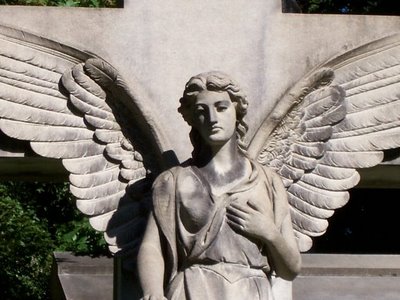
angel6

The subject of “the pool at Bethesda” alludes to the Thorton Wilder play, “The Angel that Troubled the Waters.” 

The play is based on the biblical verses of John 5:1-4, however, it changes the end of the parable. 

The play tells of a physician who comes to the pool of Bethesda, hoping to see the stir, and then be the first in the water, and healed of his melancholy and debilitating depression.  An angel appears and troubles the water. Everybody at the pool hopes to be the first one in and to be healed of their disability.

…………………………………………………………………

An angel appears and blocks the physician at the very moment he is ready to step into the pool and be healed.

angel1

Angel: “Drawback, physician, this moment is not for you.”

Physician: “Angelic visitor, I pray thee, listen to my prayer.

Angel: “This healing dear physician, is not for you.”

Physician: “Surely, surely, the angels are wise. Surely, O Prince, you are not deceived by my apparent wholeness. Your eyes can see the nets in which my wings are caught; the sin into which all my endeavors sink half-performed, cannot be concealed from you.”

Angel: “I know.”

Physician: “Oh, in such an hour was I born, and doubly fearful to me is the flaw in my heart. Must I drag my shame, Prince and Singer, all my days more bowed than my neighbor?”

Angel: Without your wound where would your power be?” 

“It is your very sadness that makes your low voice tremble into the hearts of men. The very angels themselves, cannot persuade the wretched, and blundering children on earth, as can one human being broken on the wheels of living.

Later, the person who enters the pool first, and was healed rejoices in his good fortune, then turns to the physician before leaving and says:

“But come with me first, an hour only, to my home. My son is lost in dark thoughts. I — I do not understand him, and only you have ever lifted his mood.”

“Only an hour… my daughter, since her child has died, sits in the shadow. She will not listen to us, but she will listen to you.”

For me, the play pierces me with the understanding that comes from this wonderful line— “Without your wound where would your power be?“ That causes me to look at my many weaknesses with a very different perspective.

Paul’s teachings offer us a powerful revelation: it is through our weaknesses that we can authentically minister to others, just as Jesus did going to the cross. This concept, slowly permeating my understanding, emphasizes the transformative nature of my own pain and vulnerability.

Paul boldly declares that it is the very things we perceive as weak that have the potential to cultivate strength and truth within us and to others. It is my sincere hope that brokenbelievers.com, through its ministry, will impact lives by embracing this profound truth.

I hope so anyway. Pray for Linda. Pray for me.

I first encountered this excerpt in the book, “Abba’s Child: The Cry of the Heart for Intimate Belonging,” by Brennan Manning. The book is a worthy read, and if you can find it, you’ll be blessed.

Please check out Brennan Manning’s Facebook page for more info.

Please check out my newest, alaskabibleteacher.com.


An Injured Oyster

“A pearl is a beautiful thing that is produced by an injured life. It is the tear [that results] from the injury of the oyster.”

“The treasure of our being in this world is also produced by an injured life. If we had not been wounded, if we had not been injured, then we will not produce the pearl.”

 –Stephan Hoeller

God’s business is pearl-planting. He’s simply looking for a soft heart that can be cultivated.

His intention is never to harm but to only enrich us. When Lynn and I lost our daughter, Elizabeth, the pain was incredible. We looked and saw healthy families all around us. I began to accuse God and compare us with them. We hurt, they did not, and it seemed so unfair. It’s been awfully hard. But as time moved on, I slowly felt the growth inside.

A pearl of great price, because it came to us as a result of our daughter’s tragic death.

Our lives have been injured, and perhaps my illness has exacerbated things. Maybe physical issues or pain are a definite part of your life. There is a myriad of ways we can hurt. At times we are angry. But remember, God has a plan and He also understands completely. When Jesus meets you in heaven–he will do so with nail-pierced hands.

Jesus understands you. He sees the pain.

“I wish, brothers and sisters, that we could all imitate the pearl oyster–A hurtful particle intrudes itself into its shell, and this vexes and grieves it. It cannot reject the evil, but what does it do but “cover” it with a precious substance extracted out of its own life, by which it turns the intruder into a pearl!”

Oh, that we could do so with the provocations we receive from our fellow Christians, so that pearls of patience, gentleness, and forgiveness might be bred within us by that which otherwise would have harmed us.

     Charles Spurgeon

#