Walking in the Darkness

  • We are afflicted in every way, but not crushed
  • perplexed, but not driven to despair
  • persecuted, but not forsaken
  • struck down, but not destroyed;

2 Corinthians 4:8-9, ESV

The issues we face can be formidable. Our relationships and our circumstances can bring daunting obstacles to joyful Christlike living. We live out at times from unpleasant realities and less than ideal situations. We are broken believers who follow Jesus through our deadly minefields.

Struggling with mental illness is just as much a challenge as with any other handicap. The young man struggling with bipolar disorder or someone else who faces a clinical depression, may seem to be tangled up in something quite brutal and very hopeless. “Will I ever find normal again?

I know that struggle and at times it has ripped me apart. But I suppose the grinding hopelessness is the worst part of that.

I want to encourage you in this. The issues we face on a daily basis are hard. And we don’t minimize their complexity or diminish their bitterness. They can be awful. But the Holy Spirit is with you in the midst of your issues. That’s a promise.

There is a wisdom emanating from the fire. It’s only waiting for discovery. The flames can not destroy us when God shows up.

I believe that the constant presence of difficulty produces a faith and tenderness that can’t be just prayed for.

The most kind and gentle people are those who themselves have been afflicted.

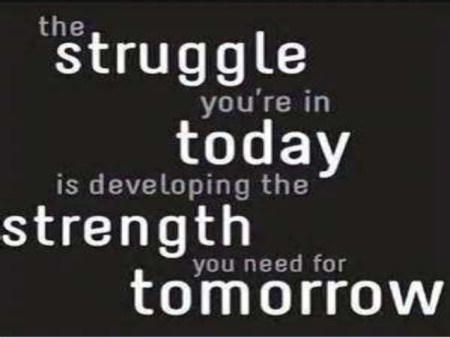
Please understand we have a real challenge. We have to walk through the trials or tests, not around them. We see a mountain, and God gives us a shovel. But He also gives us the strength we need.

But I’ve discovered a tenuous joy in these issues— more precisely, a joy because of them. Our illness is not meant to destroy us. That is not why God has allowed you to be afflicted.

I definitely did not choose this path I’m on.

Think about Jesus’ great love for people with hard issues:

Luke 7:21

Jesus has special spot for the afflicted, we see him repeated touching them. He drew them like a magnet draws iron. And he is the same today in our time. It is comforting to know that he cares for us and that we are understood. Let him draw you into his caring presence.

Our disabilities do not trouble him. Yes, I know the issues are formidable. But your obedience in them is an exquisitely special commodity to Jesus. I believe He values the shaking faith of broken people far more than the happy shiny people with no pain or scars.

Faith is precious in his sight and holds its value for all eternity.

Understanding this should be a cause for joy for the broken believer. Having the lightness of heart, right in the middle of our disability, often transforms these issues into a lighter burden. We are  beaten but not totaled. Incredibly challenged but not completely devastated. The apostle wrote this in his letter to the Corinthians, and it gives us hope.

I have learned that if I can bless a difficult thing it will bless me.

If we curse it and it will curse us. If you bless a situation, it has no power to hurt you, and even if it is troublesome for a time, it will gradually fade out, but only you can only sincerely bless it.  

There’s a deep joy waiting for those who choose to do this.

I guarantee it!

OCD: Rituals and Obsession

“I couldn’t do anything without rituals. They invaded every aspect of my life. Counting really bogged me down. I would wash my hair three times as opposed to once because three was a good luck number and one wasn’t. It took me longer to read because I’d count the lines in a paragraph. When I set my alarm at night, I had to set it to a number that wouldn’t add up to a ’bad’ number.”

“I knew the rituals didn’t make sense, and I was deeply ashamed of them, but I couldn’t seem to overcome them until I had therapy.”

“Getting dressed in the morning was tough, because I had a routine, and if I didn’t follow the routine, I’d get anxious and would have to get dressed again. I always worried that if I didn’t do something, my parents were going to die. I’d have these terrible thoughts of harming my parents. That was completely irrational, but the thoughts triggered more anxiety and more senseless behavior. Because of the time I spent on rituals, I was unable to do a lot of things that were important to me.”

People with obsessive-compulsive disorder (OCD) have persistent, upsetting thoughts (obsessions) and use rituals (compulsions) to control the anxiety these thoughts produce. Most of the time, the rituals end up controlling them.

For example, if people are obsessed with germs or dirt, they may develop a compulsion to wash their hands over and over again. If they develop an obsession with intruders, they may lock and relock their doors many times before going to bed. Being afraid of social embarrassment may prompt people with OCD to comb their hair compulsively in front of a mirror-sometimes they get “caught” in the mirror and can’t move away from it. Performing such rituals is not pleasurable. At best, it produces temporary relief from the anxiety created by obsessive thoughts.

Other common rituals are a need to repeatedly check things, touch things (especially in a particular sequence), or count things. Some common obsessions include having frequent thoughts of violence and harming loved ones, persistently thinking about performing sexual acts the person dislikes, or having thoughts that are prohibited by religious beliefs. People with OCD may also be preoccupied with order and symmetry, have difficulty throwing things out (so they accumulate), or hoard unneeded items.

Healthy people also have rituals, such as checking to see if the stove is off several times before leaving the house. The difference is that people with OCD perform their rituals even though doing so interferes with daily life and they find the repetition distressing. Although most adults with OCD recognize that what they are doing is senseless, some adults and most children may not realize that their behavior is out of the ordinary.

OCD affects about 2.2 million American adults, and the problem can be accompanied by eating disorders, other anxiety disorders, or depression.  It strikes men and women in roughly equal numbers and usually appears in childhood, adolescence, or early adulthood. One-third of adults with OCD develop symptoms as children, and research indicates that OCD might run in families.

The course of the disease is quite varied. Symptoms may come and go, ease over time, or get worse. If OCD becomes severe, it can keep a person from working or carrying out normal responsibilities at home. People with OCD may try to help themselves by avoiding situations that trigger their obsessions, or they may use alcohol or drugs to calm themselves.

OCD usually responds well to treatment with certain medications and/or exposure-based psychotherapy, in which people face situations that cause fear or anxiety and become less sensitive (desensitized) to them.

Source: http://www.nimh.nih.gov/index.shtml

Bryan Lowe

The Power of My Wound

A Poem by Linda K.

Healing doesn’t happen all at once.
Sexual trauma runs too deep,
is much too complex for simple remedies.

We have no Star Trek sickbay
or magic tricorder
to bind up the wounds,
erase the battle scars.

And would we want to if we could?
Would we walk away,
pretend it never happened,
we were never assaulted
violated… hated… berated…
made to feel shame and doubt?

Could we ignore the very truth of what we
know was wrong… evil… the vilest of all?
Could we simply walk away
and cease to bear witness
for those who come after?
Or maybe for those violated before
our own innocence was vanquished
but are yet to heal at all?

If we could be healed completely
in an instant, in the blink
of a selfish, knowing eye…

But to do so meant leaving
our sisters, our friends,
our daughters, even strangers,
without the hope of their presence?

Could we? Should we?

Because to heal 100 percent
I think is to forget every ounce,
every moment, of
the pain and struggle.

And to forget is to lose compassion.
So perhaps it is worth the
ups and downs of scars
that appear healed but sometimes,
more often than we’d like, bleed tears
of understanding helping others
feel not so alone.

Often I pray for complete healing.
For years I prayed to forget.
But then I remember that
without my wound
I am not me.

Without my wound
the scarring of my heart and soul,
I am powerless.

aasignLinda

AnotherFearlessYear.net