Anger That Will Destroy You

“Be not quick in your spirit to become angry, for anger lodges in the heart of fools.”

-Ecclesiastes 7:9

“Of the Seven Deadly Sins, anger is possibly the most fun. To lick your wounds, to smack your lips over grievances long past … to savor to the last toothsome morsel both the pain you are given and the pain you are giving back — in many ways it is a feast fit for a king. The chief drawback is that what you are wolfing down is yourself. The skeleton at the feast is you.”

-Frederick Buechner

What really happens when I get angry? I suppose my B/P goes up and I get all red, but just perhaps it’s a bit more than that. The Bible is painfully clear on the subject of anger. It seems there is an anger that is righteous; and one that is unrighteous. It is the latter I’m most familiar with, unfortunately. And repeatedly our anger, the earthly kind, is condemned by Scripture. It is terribly wrong, and it is sin.

Merriam-Webster defines anger as “a strong feeling of displeasure and usually of antagonism, or rage.” This definition seems right on. First–it’s a strong feeling. There is an intensity to it, and it ‘clouds’ my sense of what is reasonable. Second–it has some form of frustration and irritation. Third–it escalates into “rage.” And I suppose that anger at this particular level is where it really, really gets destructive. At this point we become totally irrational and unbelievably destructive. When we get to this point we become “fools.”

I remember clearly having a dog that killed a chicken. My dad took the carcass and wired it to the dogs neck. After some time that chicken began to rot. It putrefied to the point where pieces of that carcass started to fall off. I can still see the dog’s eyes rolling, and he was slobbering all over. the place. That dog never even touched another chicken. It completely cure him. (I suppose the ASPCA would object today.)

I suppose that is what carnal anger is like. It’s something that we carry around and it defiles us. We learn that evil attaches itself to each of us and pollutes us. We soon realize that this kind of life is really death. When anger is attached to us, we are poisoned inside. Someone once said that “he who angers you, conquers you.”

No matter how just your words might be, you ruin everything when you speak with anger.”

–John Chrysostom

There is another kind of anger though. It’s the kind that is turned on when we are angry with ourselves. We call this “self-condemnation.” Internalized disgust with yourself is extremely corrosive to our personality and our spirits. Instead of an authentic confidence in what Jesus’ has done, we look inside with hate, anger and disgust. We condemn and put ourselves under a twisted form of justice that is not biblical, nor is it true.

When we become angry with ourselves (and yes, we sin constantly) we dismiss the sacrifice of Jesus and His forgiveness. We become a law unto ourselves, and we pass a guilty judgement on our sinfulness. Christians are quite often ‘crippled’ by self-condemnation and a vicious guilt. Perhaps we are the most ‘visible’ when it comes to this kind of self-hatred.

Satan is the prime instigator of this attack. He desires to split you from fellowship with God. That is the way he functions, you might say that this is his evil ‘ministry.’ His specialty is guilt, an inciting an unholy anger which we turn inward. We give him the right to accuse us before God. We no longer see the blood of Christ as our covering for our sin. He indicts us before a holy God, and all we see is our guilt. Is it any wonder that we are angry with ourselves?

“The salvation and the power and the kingdom of our God and the authority of his Christ have now come. The accuser of our brothers and sisters, who accused them day and night before our God, has been thrown down.” (Revelation 12:10)

I suppose this anger at ourselves is perhaps our most difficult challenge we face. More believers are ‘hamstrung’ by this than any other sin. When we turn on ourselves, we become angry and self-condemned. We avoid His healing presence, His Word and the fellowship of other saints. Most of all, we don’t want to pray or worship.

Dear one, come to Jesus, and bring along your issues. He is the one who loves you. He died, and He has covered you with His blood. He is God’s Passover lamb who takes away all your sin. Jesus’ present day ministry is not just sitting on a golden throne, He is actively interceding for you even as you read this.

” He poured out his life unto death, and was numbered with the transgressors. For he bore the sin of many, and made intercession for the transgressors.” (Isaiah 53:12)

Your forgiven brother,

Bryan

My Scapegoat

“And Aaron shall lay both his hands on the head of the live goat, and confess over it all the iniquities of the people of Israel, and all their transgressions, all their sins. And he shall put them on the head of the goat and send it away into the wilderness by the hand of a man who is in readiness.”

Leviticus 16:21

The ritual was profoundly simple. Every year two goats were brought into the Temple. Goat #1 was sacrificed for the sins of the high priest. Goat #2 was not killed, but became the “scapegoat.” The priest would lay his hands on its head, and the nation’s sins would be transmitted and then carried to the desert.

This ritual finds fulfillment in Jesus Christ, for He absorbs our sin and carries it away.

Scripture is clear on this. Maybe this might help. Back in the 1970s I remember sponges printed with a politician’s advertising his platform/promises. At first the sponge was paper thin. But when you added water it expanded into a full-size sponge.

For some weird reason that communicates what happened at the cross. Jesus received my sin, darkness, and iniquity. He absorbed it all, and I’m free. He is my scapegoat. He carries all of my dark darkness.

“Surely He has borne our griefs (sicknesses, weaknesses, and distresses) and carried our sorrows pains [of punishment], yet we [ignorantly] considered Him stricken, smitten, and afflicted by God [as if with leprosy].”

Isaiah 53:4, Amplified

You Must Take Him Out

1 Samuel 17, ESV

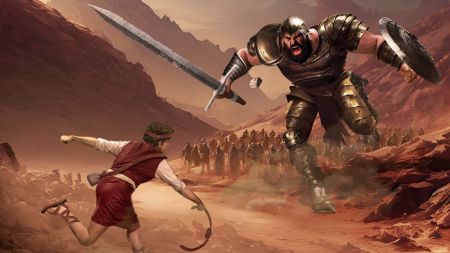
Men are going to die unless something happens. But then up steps David, he is untried in battle, but within him is an eager commitment to a faith in Jehovah.  Fear has consumed the hearts and minds of the Jews, which are now full of ‘scary Goliath fears’ and confusion. 

These guys are pretty much scared.  The Scripture says “they were terrified and deeply shaken.” This is an irrational fear. It’s not from God.

David steps out and into the confusion.  He is just a shepherd boy, but he’s resistant to the fear that attacks his brothers.  He identifies the giant before him as evil, and that giant stands in the way of the Father’s will.  David advances without fear.

The space once occupied by fear has been filled up by faith.

This story, is much more than a story.  It may entertain schoolchildren, but it is so much more for us as believers.  Most definitely you will be called upon to face a Goliath of your own.  He’s waiting for you, and you must step forward in faith.

So much points to Goliath’s superiority. 

He is a man-of-war; dedicated, well trained in the ways of death.  Goliath is confident that he will destroy you.  But David steps out.  He is trusting in God alone.  He steps forward with no armor but God.

David is about to kill Goliath, with just a stone from his sling. 

He swings, throws and embeds a rock into the giants forehead– right between his eyes!  The giant collapses, and David moves forward,  and he cuts off the giant’s head. 

Each of us face an enormous evil. 

We’re facing something that is monstrous and destructive.  We cannot reason with it.  We can only face it with the weapons the Father provides for us.  When we advance to that source, we must do so with a faith that is real and undefeated.

Some reading this are pounded with failure.  I understand. But you’re called to take out your personal darkness.

At times, we think that we can negotiate our way to victory.  We hope to rationalize our enemy away by thinking positively about him.  We think we can move against him by being clever.  That does not work.

“By the strength of God’s grace, you trusted the Almighty and conquered your Goliath. The first giant is dead. Satan is masquerading as your former enemy so he can slip past your faith and regain entrance into your life. Resist him.”

     Francis Frangipane


bry-signat (1)

&

The Throne of Mega Grace

“Let us then with confidence draw near to the throne of grace, that we may receive mercy and find grace to help in time of need.”

Hebrews 4:16, ESV

As verses go, this is one of the more significant. There are plenty of promises to be found in the scriptures but Hebrews 4:16 has a meaningful spot in my walk. When I think about it, and consider its implications, I have very little to say but “hallelujah!”

Jesus is our great High Priest. That word “great” clearly underscores His value to us. It shouldn’t really surprise us: the word in Greek is “megas” which means preeminent, all intensive and all abundant. (The idea can also mean ‘weight.’)

Some versions of the Bible use “boldness” instead of confidence. I like boldness but confidence is good too. Both words are wonderful. (One version uses “bravely!”).

His absolute power as a Priest is forever and ever.

He is now our precious mediator. Jesus is now our go-between of our ugly sin and His incredible holiness. He has created a spiritual super-highway for those who chose to come to Him through a saving faith. He has done this all by Himself. It was what He wanted.

The throne He sits on is now known as our “throne of grace.”

“Ancient Jewish Rabbis taught that God had two thrones, one of mercy and one of judgment. They said this because they knew that God was both merciful and just, but they could not reconcile these two attributes of God. They thought that perhaps God had two thrones to display the two aspects of His character. On one throne He showed judgment and on the other throne mercy. But here, in light of the finished work of Jesus, we see mercy and judgment reconciled into one throne of grace.”

David Guzik

Mercy and grace. Help in our time of need. If you’re anything like me, my neediness is perpetual. I need Jesus all the time, and He has made it clear through His Word that He’s always available to us. His throne room is never off-limits. He has given us the keys!

“The greatest privilege God gives to you is the freedom to approach Him at any time.”

    Wesley L. Duewel

I have a new site and I hope you visit: alaskabibleteacher.com