We must (MUST!) pray as believers in Jesus. Prayer is the oxygen of our spiritual life. We must breathe, or else. When I go to my doctor she puts an 0ximeter on my finger so she can assess how my lungs are using oxygen. I suppose if we would put it on our “spiritual finger,” might it reveal something?
We don’t know exactly how to pray, I think communicating with God isn’t natural. We must be taught. The disciples wanted desperately how to pray–they didn’t know how, (Luke 11:1-2). So, we too must have Jesus teach us.
We can only learn how if the Spirit teaches us.
Also, we must practice praying. We may do it terribly rotten, but we should never give up–it’s not natural–it’s supernatural. But we learn by doing. We may get discouraged but keep at it. Even if you’re a pro, the Holy Spirit will make sure you keep learning. Our walk should always grow deeper.
For me praying the Psalms is good practice, and there are 150 of them. The Jewish people have a 4000-year start on us–they’ve used the Psalms as their prayer/praise book. My sense is that this covers every human need–the entirety of our spiritual walk!
I think that Psalms 103 might be a great place to get started.
I’ve been told by some that the “Lord’s Prayer” is quite useful as well. I guess if you honestly take it phrase by phrase, something good will happen. I’m still learning (and I suspect I still will).
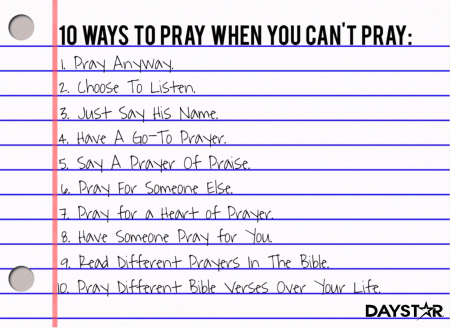
Below we find a way to jumpstart our prayer life. I hope you can use it.
One more thought. “Conversational Prayer” is a good thing for me lately. Talk with Jesus as if He was in the same room with you (He is) and just converse. Share your ups and downs, and it’s okay if you feel messed up. Relax. He’s your Father!
“When his family heard about this, they went to take charge of him, for they said, “He is out of his mind.”
Mark 3:21, NIV
Even our Lord’s own family did not believe Him. I can see them gathering out of concern, not only for concern for Jesus, but for the family name– perhaps they felt a need even to protect themselves? They talked at length, and decided on an intervention, to take custodial care– as families must do at these difficult times.
Jesus had been saying things, disturbing things.
He had resolutely confronted the religious system, and then rebuked King Herod and the civil government. He was living on an edge, and the sense that His family had was that He had become mentally unhinged. He had been cavorting with decidedly irreligious and wicked people. He lived in constant bedlam, with people mobbing Him for healing.
His teaching seemed extremely radical, almost absurd. His “parables” contained bizarre ideas. And the massive crowds actually would chase Him, trying to anticipate His next move. He was essentially a celebrity – a “rock star.” I suppose we have no idea, of His appeal to the masses.
We have some choices that must be made. What do we make of Jesus? Is Jesus Christ:
Legend
Lunatic
Liar
Lord and GOD?
In his famous book Mere Christianity, C.S. Lewis makes this statement,
“A man who was merely a man and said the sort of things Jesus said would not be a great moral teacher. He would either be a lunatic–on the level with a man who says he is a poached egg–or he would be the devil of hell.”
“You must take your choice. Either this was, and is, the Son of God, or else a madman or something worse. You can shut him up for a fool or you can fall at his feet and call him Lord and God. But let us not come with any patronizing nonsense about his being a great human teacher. He has not left that open to us.”
The accusation has often been the case for His followers. Some of Paul’s friends thought he was crazy when he went blazing over land and sea to carry the gospel to every city. But his answer was, “No, I am not crazy; the love of Christ controls me” (2 Cor. 5:14).
This was a good kind of crazy.
He was being used by Jesus to continue the ministry that Jesus had started– the establishment of the Kingdom of God.
I believe it is a far deeper insanity,that seals up the truth and the light and keeps it away from unbelievers. It is crazy to know total forgiveness and unconditional love, and then to avoid opportunities to share that same love. Now, that is crazy!
Our fear of being ostracized and mocked is an intense experience. Peer pressure is not just something our teens go through. We are always in danger of being molded into the world’s image.
Who are we?
Our Lord and Master was vilified, He was falsely accused of insanity. But perhaps, it is the other way around. Perhaps it is this world, and its bondages and sicknesses that is ill.
We’re to be energized by contact with God’s Spirit. He fills us up, enables us to run full tilt, stretching and straining. The muscles in the neck popping out, and lunging for the tape. This is Paul’s understanding of his daily walk.
Paul was an athlete in the Spirit.
These days, developing a spiritual athleticism would not be such a bad idea. We live in a society where we sit and watch the NFL: there are 22 men on the field, desperately in need of rest, and they’re surrounded by 50,000 people desperately in need of exercise. We have become a society of observers and that is a shame.
God loves us, sent his only Son to die for us. God sets us up with a energy-packed, Red Bull. And I respond with an anemic, 2% milk religion. And that perhaps is the real tragedy.
There’s a real tendency for entropy as a follower of Jesus. Things have a real tendency to wind down, and start moving in the opposite direction. I think all of us can relate to the “Sunday Syndrome.” In this truly wonderful world of fellowship, worship and the Word we seem to come together. Life is good on a Sunday morning. And it should be.
But we wind down, and by Thursday we have sinned and compromised a hundred times or more. Life is not good on a Thursday afternoon. Because of our mental illness this degradation downward is usually worse. We experience a whole lot of shame and guilt. And that poisons our spirits.
Throw into the mix some depression, anxiety, or OCD and it makes consistency even harder. It’s a challenge to maintain a credible Christian walk. It’s kind of the deflated feeling four hours after downing three Red Bulls.
Paul, always an interesting fellow, described his own personal walk with Jesus in Philippians 3:10f. in the Message Bible.
10-11I gave up all that inferior stuff so I could know Christ personally, experience his resurrection power, be a partner in his suffering, and go all the way with him to death itself. If there was any way to get in on the resurrection from the dead, I wanted to do it.
12-14 I’m not saying that I have this all together, that I have it made. But I am well on my way, reaching out for Christ, who has so wondrously reached out for me. Friends, don’t get me wrong: By no means do I count myself an expert in all of this…
“...but I’ve got my eye on the goal, where God is beckoning us onward—to Jesus. I’m off and running, and I’m not turning back.
Can you really tap into all of that energy?
Paul is downright aggressive here, he models a “muscular Christianity” that pushes through every obstacle, whether within or without. Most of our translations use the word “work” when translating “effort”. The Church fathers used the word “energy” instead. There is a distinction.
Energy, or “energize” denotes an outside source for power. I energize my electric razor when I plug it in at night. It takes a charge and runs accordingly on demand.
We are told to press in, and to reach.
We’re to be energized by contact with God’s Spirit. He fills us up, enables us to run full tilt, stretching and straining. The muscles in the neck popping out, and lunging for the tape. This is Paul’s understanding of his daily walk.
Paul was an athlete in the Spirit.
These days, developing a spiritual athleticism would not be such a bad idea. We live in a society where we sit and watch the NFL: there are 22 men on the field, desperately in need of rest, and they’re surrounded by 50,000 people desperately in need of exercise. We have become a society of observers and that is a shame.
God loves us, sent his only Son to die for us. God sets us up with a energy-packed, Red Bull. And I respond with an anemic, 2% milk religion. And that perhaps is the real tragedy.
I think this post will wander around a bit, we’ll see if the Father will speak to us somehow.
I really think our lives are made up of the decisions we’re making. At least, it sometimes sees that way.
Some decisions are like ‘forks’ in the road. They’re made and then they shunt us in another direction. Most are minor–(will it be McDonalds or Pizza Hut?) But the biggies really alter us–very quickly we see that the road is going to take us in a radically different path.
Sometimes, if we’re honest, we will admit to backtracking; retracing our route back to the point we turned. A lot of time it’s too late, and the moment has past. But we will sometimes learn that sometimes even our detours are part of the journey. (Amazing, isn’t? But He controls it all, and that’s comforting.)
I think I’m starting to learn how to receive correction from others.
I’ve been mulling over the decision of the Ethiopian eunuch in Acts 8:30-31, he wanted to understand the truth:
“So when Philip ran toward the chariot, he heard the man reading from Isaiah the prophet [on his Kindle]. Philip asked, “Do you understand what you are reading?”
31 He answered, “How can I understand unless someone explains it to me?” Then he invited Philip to climb in and sit with him.”
We see here such a very ‘thoughtful humbleness’– a teachableness of the heart that this eunuch seems to have learned. He is confident enough in himself to acknowledge that he just doesn’t know. He invites Philip to a Bible study in the chariot.
We are responsible for our receptivity to truth.
It’s our personal decision to either seek or not seek, to learn, or not to learn. No one else can do this for us. We come to a decision point and we go the way things seem to direct us, or we don’t. Again, we must choose.
Sometimes to not make a decision, is a decision.
The book of Proverbs is saturated with ideas on being guided by our humility when it comes in contact with truth. Furthermore, there are many warnings about receiving correction and reproof gracefully. For me, I’m learning slowly to receive hard counsel.
When my wife and I made the decision to work in the migrant camps in Mexico there was one elder who kept saying “no!” At first it was a real issue for us. We sort of resented it. But we began to see the blessing of his resistance. It caused us to really analyze our decision, and “count the cost.” We were stepping into a very hard place, and we needed that voice. We were being called to break in “new ground.” It was to be a challenge.
It seems that scriptural truth is almost always negative when it’s first encountered. It often irritates more than it comforts.
It often will not sit well, and I will try to shake it off. But truth can be remarkably persistent. ‘Forgive your brother’, the Holy Spirit says. And you say right away, ‘Not a chance!’ But, give it time, and the Word will soften rock. If you respond properly, humbly, you be able to make the right decision.
One more thing, Jesus told us in Matthew 18:3,
“I promise you this. If you don’t change and become like a child, you will never get into the kingdom of heaven.”
We’ll need to be a complete alteration in our hearts if we are to accommodate His command. Becoming a child is more difficult as an adult– then becoming an adult is for a child. Becoming small again takes a great amount of brokenness and it’s never really mastered.
God fully intends to work with you in this.
God wants you to learn teachableness. He brings others to direct you. The Holy Spirit ignites the Word that’ll light your path. He doesn’t seem to ever give up. He is wonderfully persistent–He never really does give up.
“The intelligent man is always open to new ideas. In fact, he looks for them.”









 Broken Believers