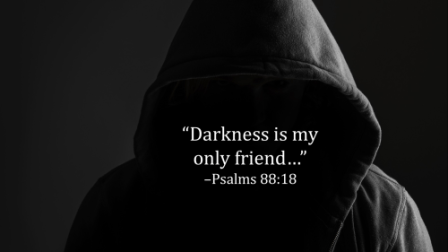
“Darkness is My Only Companion”

Ambrose of Milan (340-397)

Our theology makes all the difference in fighting depression, writes Kathryn Greene-McCreight, Author of “Darkness, Is My Only Companion” and Episcopal priest.

In his Problem of Pain, C. S. Lewis says that suffering is uniquely difficult for the Christian, for the one who believes in a good God. If there were no good God to factor into the equation, suffering would still be painful, and  ultimately meaningless.

For the Christian, who believes in the crucified and risen Messiah, suffering is always meaningful. It is meaningful because of the one in whose suffering we participate, Jesus. This is neither to say, of course, that suffering will be pleasant, nor that it should be sought. Rather, in the personal suffering of the Christian, one finds a correlate in Christ’s suffering, which gathers up our tears and calms our sorrows and points us toward his resurrection.

In the midst of a major mental illness, we are often unable to sense the presence of God at all. Sometimes all we can feel is the complete absence of God, utter abandonment by God, the sheer ridiculousness of the very notion of a loving and merciful God. This cuts to the very heart of the Christian and challenges everything we believe about the world and ourselves.

I have a chronic mental illness, a brain disorder that used to be called manic depression, but now is less offensively called bipolar disorder. I have sought help from psychiatrists, social workers, and mental health professionals; one is a Christian, but most of my helpers are not. I have been in active therapy with a succession of therapists over many years, and have been prescribed many psychiatric medications, most of which brought quite unpleasant side effects, and only a few of which relieved my symptoms. I have been hospitalized during the worst times and given electroconvulsive therapy treatments.

All of this has helped, I must say, despite my disinclination toward medicine and hospitals. They have helped me to rebuild some of “myself,” so that I can continue to be the kind of mother, priest, and writer I believe God wants me to be.

During these bouts of illness, I would often ask myself: How could I, as a faithful Christian, be undergoing such torture of the soul? And how could I say that such torture has nothing to do with God? This is, of course, the assumption of the psychiatric guild in general, where faith in God is often viewed at best as a crutch, and at worst as a symptom of disease.

How could I, as a Christian, indeed as a theologian of the church, understand anything in my life as though it were separate from God? This is clearly impossible. And yet how could I confess my faith in that God who was “an ever-present help in trouble” (Ps. 46:1) when I felt entirely abandoned by that God? And if this torture did have something to do with God, was it punishment, wrath, or chastisement? Was I, to use a phrase of Jonathan Edwards’s, simply a “sinner in the hands of an angry God”?

I started my journey into the world of mental illness with a postpartum depression after the birth of our second child. News outlets are rife with stories of women who destroy their own children soon after giving birth. It is absolutely tragic. Usually every instinct in the mother pushes toward preserving the life of the infant. Most mothers would give their own lives to protect their babies. But in postpartum depression, reality is so bent that that instinct is blocked. Women who would otherwise be loving mothers have their confidence shaken by painful thoughts and feelings.

Depression is not just sadness or sorrow.
When I am depressed, every thought, every breath, every conscious moment hurts.

And often the opposite is the case when I am hypomanic: I am scintillating both to myself, and, in my imagination, to the whole world. But mania is more than speeding mentally, more than euphoria, more than creative genius at work. Sometimes, when it tips into full-blown psychosis, it can be terrifying. The sick individual cannot simply shrug it off or pull out of it: there is no pulling oneself “up by the bootstraps.”

And yet the Christian faith has a word of real hope, especially for those who suffer mentally. Hope is found in the risen Christ. Suffering is not eliminated by his resurrection, but transformed by it. Christ’s resurrection kills even the power of death, and promises that God will wipe away every tear on that final day.

But we still have tears in the present.

We still die. In God’s future, however, death itself will die. The tree from which Adam and Eve took the fruit of their sin and death becomes the cross that gives us life.

The hope of the Resurrection is not just optimism, but keeps the Christian facing ever toward the future, not merely dwelling in the present. But the Christian hope is not only for the individual Christian, nor for the church itself, but for all of Creation, bound in decay by that first sin: Cursed is the ground because of you … It will produce thorns and thistles for you …” (Gen. 3:17-18).

This curse of the very ground and its increase will be turned around at the Resurrection. All Creation will be redeemed from pain and woe. In my bouts with mental illness, this understanding of Christian hope gives comfort and encouragement, even if no relief from symptoms. Sorrowing and sighing will be no more. Tears will be wiped away. Even fractious [unruly, irritable] brains will be restored.

“Darkness: My Only Companion”

Kathryn Greene-McCreight is assistant priest at St. John’s Episcopal Church in New Haven, Connecticut, and author of Darkness Is My Only Copanion: A Christian Response to Mental Illness (Brazos Press, 2006).

Click to read Psalm 88

A Very English Pigeon

“I will instruct you and teach you in the way you should go; I will counsel you with my eye upon you.”

Psalm 32:8

In April 2002, I was sitting in a cavernous waiting room at King’s Cross in London, England.  I was waiting for a bus to Cambridge, UK.  I sat all alone and stared at the tiled floor at my feet.  The doctors had warned me not to travel alone, but I ignored their advice.

And now I was starting to really unravel.

Depression had followed me all the way from Alaska to England. I had pushed my limits and was completely drained and was becoming very confused.  I began to cry out to the Lord, very desperately. Sometimes madly. (Read Psalm 88.)

As I sat there staring intensely at the floor, several pigeons seemed to put on a show, just for me. They were fat little guys, apparently scratching out a good living. Several very large windows were open, and these pigeons seemed to have no fear as they took advantage of a meal from bored travelers.

All of a sudden something very odd happened. 

A pigeon came across the floor and “presented” himself, right square in front of me.  I watched him intently and saw that he was crippled, one of his feet was nothing more than a twisted claw.  He had been profoundly injured in such a way, that he would never be the same.  He was damaged, and yet somehow he was surviving, but even more, and he was thriving!

It was like experiencing a lightning bolt. God’s own light switch was being flipped.

I saw that pigeon, and I saw myself, and it was a moment of clarity, a shining grace.  In the mega-hustle of 13.6 million people in London, and in the midst of my own profound mental crisis, I knew God’s caring touch and it gave me real grace, love, and goodness–far greater than all my sin and confusion. He was just letting me know that He was very, very close. (See Psalm 34:18.)

I had seen my damaged pigeon, completely oblivious to self-pity.

I started to call out to the Father out of my confusion.  Within a few minutes, I found myself sitting on the top level of a double decker bus, with the driver aware of my problems and who specifically drove me to the place I was staying. 

I was being cared for. Between a crippled pigeon and the dutiful ministrations of a bus driver, I’d finally found my hotel. (See Matthew 6:26.) 

I have come to realize that this trip to England was not for me to see Big Ben, Parliament, or wander the academic schools of Cambridge University.  Rather I was brought there to make contact with a certain pigeon, who was waiting to meet me and pass on vital instructions. 

The Father shared things that I need to know.  British castles and churches are beautiful and worth seeing but I must admit I’ve forgotten much. I hope I can return someday.

But on this trip, all I really needed to see was a crippled English pigeon who was just waiting to meet me.

Rainy Day People

“Bear one another’s burdens, and so fulfill the law of Christ.”

Galatians 6:2

“Gently encourage the stragglers, and reach out for the exhausted, pulling them to their feet. Be patient with each person, attentive to individual needs.” 

1 Thessalonians 5:14, Message

“A word spoken at the right time is like gold apples in silver settings.”

Proverbs 25:11

Proverbs tells us that giving good counsel is more valuable than gold or silver.  I have met many people who have an opinion about my problems, but few really know how to listen. Discernment is pretty much crucial, and maybe 1 of every 40 will really understand me.

Sometimes I must unload my issues and be understood by someone.  

Personally, I need someone who has been profoundly depressed and finally stumbled out into the light.  It’s not that I don’t love certain believers, but they haven’t been “checked out” on this particular problem. 

It’s like flying a plane or operating heavy equipment, skills that are learned by experience.

It seems to me that it’s not only a gift, but a skill or capability that can be developed over time. Handling God’s Word intelligently and carefully under the direction of the Holy Spirit is a mark of a rainy day believer.

I’m also convinced that good counsel invariably comes from a good person. 

At one time I thought any mature Christian believer had a right to give guidance, but that really wasn’t always the case. Now I believe God can use anyone He chooses, but He also employs those who He has given specific gifts to. I’m glad He’s done it this way.

I don’t diminish relationships, but I do know that certain people are not tested on certain problems.  This may be simplistic, or a little harsh, but when I had my brain tumor, I did not want my car mechanic to fix me, I wanted a neurosurgeon. Someone who knew and discerned what was really happening.

Choose your rainy day people carefully. Build a connection. Mark them out before things get out of hand.

If you’re reading this, and you have an issue that’s starting to escalate, you need to reach out.  The enemy wants you to withdraw. Ask the Holy Spirit for His help in this.  He is the Comforter and the Wonderful Counselor.  He’ll direct you, and help you.  That is what He does. That is His job.

“Rainy day people always seem to know when it’s time to call,

Rainy day people don’t talk, they just listen till they’ve heard it all. Rainy day lovers don’t lie when they tell ‘ya they’ve been down like you.

Rainy day people don’t mind if you’re crying a tear or two.”

Gordon Lightfoot, 1975

&

Forgiveness Healed My Heart

Trigger warning: This post is about suicidal thoughts and hopelessness. If you are currently struggling with suicidal thoughts, please reach out to someone at one of the hotlines we have posted here.

I had all but given up. I mentally cataloged the various prescription and over-the-counter pills in my medicine cabinet. There were enough to end my hopelessness forever. I truly believed my one-and-a-half-year-old son and my long-suffering husband would be better off without me.

I saw no other way to escape this deep depression that had engulfed me for what seemed like forever. I had tried everything—academic accolades, career, marriage, counseling, antidepressants, alcohol, exercise, motherhood, even religion—but nothing pulled me from my pit of misery. Near-constant tears were destined to drown me if I didn’t kill myself first.

I credit God for stopping me from following through that day. His Word says, “The angel of the Lord encamps around those who fear him, and he delivers them.” Psalm 34:7. His word did not fail me when an angel stopped my hand from a dreadful mistake. 

“For no word from God will ever fail.” 

Luke 1:37.

When a friend learned of the depths of my despair, she invited me to a women’s Bible study. It had been a long time since I had engaged in any formal study of the Scriptures. I was nervous because I felt certain they would see me for the fraud I felt I was.

But those ladies didn’t judge me or tell me I just needed more faith. Instead, they loved me and lifted to God my simple prayer: “I just don’t want to be depressed anymore.” It took me over a month to whisper that prayer request, but it didn’t take Jesus long to answer it.

The answer came in a most unlikely way—through a dream.

I had been harboring bitterness toward a number of people who had harmed me, but the worst offender was the boy who had raped me when I was only 14. I had often said that he ruined my life. One night I dreamed I was going about my ordinary life, buying groceries, taking bills to the Post Office, and depositing a check at the bank. As I completed each errand I turned to find my attacker, down on his knees, asking me to forgive him. Each time I brushed past him, refusing to accept his apology.

I awoke from that dream with the knowledge that forgiveness would set me free. Yet I knew I could not do it alone. I sat on the edge of my bed and prayed for God’s help to forgive all those grudges I had recorded in my heart. Cleansing tears streamed down my face as I poured out my prayer to Jesus.

That very hour I felt something was different. The darkness had been lifted and the light of hope streamed in. That was over twenty years ago and although I can still be a bit melancholy, I have never again felt the deep and abiding hopelessness that tried to lure me to the medicine cabinet.

Your sister in Christ, Linda

AnotherFearlessYear.net