Impulsive Peter

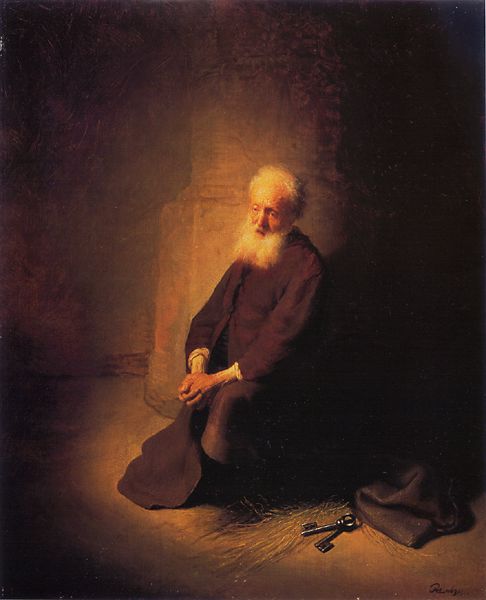
Peter was the magnificent failure.  But I’m grateful for his story.  As we examine his life and his actions and decisions, we see a man who was so much like us.  I relate and understand Peter more then any other disciple in the New Testament.  He was so real. He was so impulsive. He spoke before he thought, jumped in without looking and acted without thinking it through. Let’s take a look at Peter’s life after he met Jesus.

1) Peter, the fisherman-– When Jesus came to where  the boat was kept, Peter latched on immediately to become a disciple.  Jesus said, “Follow Me” and that is all Peter needed to hear.  (Matt 4:18-20; Matt. 14:25-31).

2) Peter, the bold-– There was a situation on a boat in a terrible storm.  It was between 3:00 am and 6:00 am.  These men are desperately exhausted, and they were still three miles from safety.  They suddenly see what appears to be a ghost, walking through the vicious storm to the boat.  It is Jesus!  He is walking on water, as if it were a sidewalk!

Peter shouts out– “Lord, if it is really you, allow me to leave this boat and let me come to you!”  Peter steps out of the boat, and begins to walk– on water!  But the wind whipping frightened him, and he began to sink.  We see Jesus, reaching out to grab Peter, to save him from drowning.  Before we judge him too harshly, how many of us would do what Peter did?

3) Peter, the confessor— Jesus asked His disciples who they thought He was. Peter was the first to acknowledge Jesus’ deity as the Son of the living God. (Matt. 16:15-16)

4) Peter, the witness— Peter, along with James and John, have been chosen to accompany Jesus to go up to a mountain top to pray.  When they arrive, something happens to Jesus.  He is ‘transfigured’, His clothes shimmer and turn white.    Then Moses and Elijah appeared, talking with Jesus. Being a man of action and not knowing what else to do, Peter offered to build shelters for the three holy men. An authoritative voice from heaven let him know that this was a time to worship, and to learn (Matt 17:1-4, Luke 9:28-36).

5) Peter, the reluctant one— Just before their last Passover, Jesus starts acting strange.  He strips off His outer garments, until He is down to His underwear.  He fills a basin with water, grabs a towel, and then begins to wash everyone’s feet.  He has become the servant to His disciples.  And Jesus will declare that this specific path is for every disciple that will follow.  Peter is incensed, and declares himself to be immune from this claim.

6) Peter, the boaster— Jesus explains that the disciples cannot follow Him.   Peter boasted that he would lay down his life for Jesus. This brought Jesus’ prediction that Peter would deny Him three times that very night. I wonder what Peter thought about this. He may have found it hard to believe, but we know that Jesus never lies.

When Jesus is arrested, Peter follows the cohort into the Temple.  It is at this point, Peter begins to outright deny Jesus.  It seems Peter can’t vocalize any support for His teacher and master.  In his craven fear, Peter denies Him who spoke and taught him.  How very sad,  (John 13 and 18).

7) Peter the repentant— Jesus appeared to them again by the Sea of Gaililee.  It is Peter, who from his fishing boat, identifies Jesus as Jesus.  Once again, he jumps out of the boat, but this time to swim to the shore.  The others follow in the boat.  Jesus has started a fire, and fish are frying. On the shore, when they had finished eating, Jesus restores Peter. Peter reaffirmed his love for Jesus three times – the same number of times he had denied Him. Jesus said to Peter, “Follow me.”

From that point, Peter followed Jesus closely. He went on to be a great preacher of the gospel and a leader of the church. He wrote 1st and 2nd Peter in the New Testament.  In the Book of Acts, we see Peter cooperating closely with the Holy Spirit.  His compulsiveness has been majorly modified and adapted to fit into the Kingdom.  Peter is now a man restrained and directed into God’s Kingdom.
1brobry-sig4 (2)


cropped-christiangraffiti1-3-1


Tourette Syndrome [Awareness]

To understand and name something is often half the battle.  An understanding of Tourette Syndrome can help us to serve people who painfully struggle with this particular challenge.

What is Tourette syndrome?

Tourette syndrome (TS) is a neurological disorder characterized by repetitive, stereotyped, involuntary movements and vocalizations called tics. The disorder is named for Dr. Georges Gilles de la Tourette, the pioneering French neurologist who in 1885 first described the condition in an 86-year-old French noblewoman.

The early symptoms of TS are almost always noticed first in childhood, with the average onset between the ages of 7 and 10 years. TS occurs in people from all ethnic groups; males are affected about three to four times more often than females.

It is estimated that 200,000 Americans have the most severe form of TS, and as many as one in 100 exhibit milder and less complex symptoms such as chronic motor or vocal tics or transient tics of childhood. Although TS can be a chronic condition with symptoms lasting a lifetime, most people with the condition experience their worst symptoms in their early teens, with improvement occurring in the late teens and continuing into adulthood.

What are the symptoms?

Tics are classified as either simple or complex. Simple motor tics are sudden, brief, repetitive movements that involve a limited number of muscle groups. Some of the more common simple tics include eye blinking and other vision irregularities, facial grimacing, shoulder shrugging, and head or shoulder jerking.  Simple vocalizations might include repetitive throat-clearing, sniffing, or grunting sounds.

Complex tics are distinct, coordinated patterns of movements involving several muscle groups. Complex motor tics might include facial grimacing combined with a head twist and a shoulder shrug. Other complex motor tics may actually appear purposeful, including sniffing or touching objects, hopping, jumping, bending, or twisting. Simple vocal tics may include throat-clearing, sniffing/snorting, grunting, or barking. More complex vocal tics include words or phrases.

Perhaps the most dramatic and disabling tics include motor movements that result in self-harm such as punching oneself in the face or vocal tics including coprolalia (uttering swear words) or echolalia (repeating the words or phrases of others). Some tics are preceded by an urge or sensation in the affected muscle group, commonly called a premonitory urge. Some with TS will describe a need to complete a tic in a certain way or a certain number of times in order to relieve the urge or decrease the sensation.

Tics are often worse with excitement or anxiety and better during calm, focused activities. Certain physical experiences can trigger or worsen tics, for example tight collars may trigger neck tics, or hearing another person sniff or throat-clear may trigger similar sounds. Tics do not go away during sleep but are often significantly diminished.

What is the course of TS?

Tics come and go over time, varying in type, frequency, location, and severity.  The first symptoms usually occur in the head and neck area and may progress to include muscles of the trunk and extremities. Motor tics generally precede the development of vocal tics and simple tics often precede complex tics.  Most patients experience peak tic severity before the mid-teen years with improvement for the majority of patients in the late teen years and early adulthood. Approximately 10 percent of those affected have a progressive or disabling course that lasts into adulthood.

Can people with TS control their tics?

Although the symptoms of TS are involuntary, some people can sometimes suppress, camouflage, or otherwise manage their tics in an effort to minimize their impact on functioning. However, people with TS often report a substantial buildup in tension when suppressing their tics to the point where they feel that the tic must be expressed. Tics in response to an environmental trigger can appear to be voluntary or purposeful but are not.

What causes TS?

Although the cause of TS is unknown, current research points to abnormalities in certain brain regions (including the basal ganglia, frontal lobes, and cortex), the circuits that interconnect these regions, and the neurotransmitters (dopamine, serotonin, and norepinephrine) responsible for communication among nerve cells. Given the often complex presentation of TS, the cause of the disorder is likely to be equally complex.

What disorders are associated with TS?

Many with TS experience additional neurobehavioral problems including inattention; hyperactivity and impulsivity (attention deficit hyperactivity disorder—ADHD) and related problems with reading, writing, and arithmetic; and obsessive-compulsive symptoms such as intrusive thoughts/worries and repetitive behaviors. For example, worries about dirt and germs may be associated with repetitive hand-washing, and concerns about bad things happening may be associated with ritualistic behaviors such as counting, repeating, or ordering and arranging.

People with TS have also reported problems with depression or anxiety disorders, as well as other difficulties with living, that may or may not be directly related to TS.  Given the range of potential complications, people with TS are best served by receiving medical care that provides a comprehensive treatment plan.

1brobry-sig4 (2)


cropped-christiangraffiti1-3-1

Source for this post: http://www.ninds.nih.gov/disorders/tourette/detail_tourette.htm#147223231

Great site at: http://tsa-usa.org/

Seeing the Real Thing, [Heroes]

army_moh

“All praise to God, the Father of our Lord Jesus Christ. God is our merciful Father and the source of all comfort. 4 He comforts us in all our troubles so that we can comfort others. When they are troubled, we will be able to give them the same comfort God has given us. 5 For the more we suffer for Christ, the more God will shower us with his comfort through Christ. 6 Even when we are weighed down with troubles, it is for your comfort and salvation!”

2 Corinthians 1:3-6

“Grace is given to heal the spiritually sick, not to decorate spiritual heroes”

–Martin Luther

I don’t know if I have ever met a Medal of Honor recipient, and somehow I’m sure that I would’ve remembered.  I most certainly have not met ‘a spiritual hero’.  I imagine them however to be quite dynamic, gushing over with humility and love.  Somewhat like being a ‘Superman of the Soul’.

Through His Holy Spirit, we were chosen not because we are superheroes, but because we are sick.  God doesn’t inspect us for exceptional qualities that we may someday possess.  Instead He is a paramedic, intervening with grace and mercy in our distress and helping us in our desperation.

Perhaps, there are some who secretly want to be ‘decorated’.  They love the attention and covet glory.  Faith is not really a medicine; it is more like a decoration.  It pins on its chest the Medal of Honor.  The highest award you can receive–the holy medallion of faith (with oak leaf clusters, of course).

Having had lived for a few years in a ‘third world country’,  I’ve gotten to observe up close believers who are pathetically poor.  I have seen poverty crush people like a boy crushes a bug on the sidewalk.  The sense I have can be summed up in a phrase, a ‘desperate gratitude’ for His grace.

Jesus has come and gathered up all their sin and shame and evil, and carried it away from them.  Their walk with Him now is in gratitude, not in attainment.  Here in the USA that ‘seeing’ has become myopic.  We struggle to see clearly.  Actually, we can be almost dangerous if we don’t see this.

We cannot envision anything clearly without an adjustment to our eyes.  There has to be a desperation that moves in and heals us.  Something that will pull our faith like a magnet.

We are not collecting ‘merit badges’, but medication and rolled-up bandages.  We hurt– our friends and family hurt, people we haven’t met yet, hurt.

“The mercies of God make a sinner proud, but a saint humble.”   Thomas Watson


cropped-christiangraffiti1-3-1

When Eating is Out-of-Control

Out of control eating

What is Binge Eating Disorder (BED)?  

Individuals with binge eating disorder (BED) engage in binge eating, but in contrast to people with bulimia nervosa (BN) they do not regularly use inappropriate compensatory weight control behaviors such as fasting or purging to lose weight. Binge eating, by definition, is eating that is characterized by rapid consumption of a large amount of food by social comparison and experiencing a sense of the eating being out of control.

Binge eating is often accompanied by uncomfortable fullness after eating, and eating large amounts of food when not hungry, and distress about the binge eating. There is no specific caloric amount that qualifies an eating episode as a binge. A binge may be ended by abdominal discomfort, social interruption, or running out of food.

Some who have placed strict restrictions on what and when it is OK to eat might feel like they have binged after only a small amount of food (like a cookie). Since this is not an objectively large amount of food by social comparison, it is called a subjective binge and is not part of binge eating disorder.

When the binge is over, the person often feels disgusted, guilty, and depressed about overeating.  For some individuals, BED can occur together with other psychiatric disorders such as depression, substance abuse, anxiety disorders, or self-injurious behavior.  The person suffering from BED often feels caught up in a vicious cycle of negative mood followed by binge eating, followed by more negative mood.  Over time, individuals with BED tend to gain weight due to overeating; therefore, BED is often, but not always, associated with overweight and obesity. Previous terms used to describe these problems included compulsive overeating, emotional eating, or food addiction.

***

For the rest of this article, please go to the NAMI site at:   

http://nami.org/Template.cfm?Section=By_Illness&template=/ContentManagement/ContentDisplay.cfm&ContentID=65853   


cropped-christiangraffiti1-3-1