My Psalm for My Savior

Psalm 116:7 – painted canvas, melodyjoy1983, http://www.etsy.com

This poem is written in the pantoum form and is based on Psalm 116, which is my favorite Psalm. I find that the repetition of lines in this form lends itself well to Christian poetry of lament and praise. I hope you are blessed by this offering.

My Psalm for My Savior

For you, O Lord, have delivered my soul from death
The anguish of death and darkness entangled me
I called on the name of the Lord: “O Lord, save me!”
Praise my God, my Savior who came to my rescue

The anguish of death and darkness entangled me
My eyes filled with tears, my feet stumbled under me
Praise my God, my Savior who came to my rescue
Rescued me from my trouble, sorrow, and darkness deep

My eyes filled with tears, my feet stumbled under me
The Lord, my God, heard my cry for love and mercy
Rescued me from my trouble, sorrow, and darkness deep
Now I know His grace and mercy are mine to keep

The Lord, my God, heard my cry for love and mercy
He saw the anguished turmoil of my broken soul
Now I know His grace and mercy are mine to keep
I will forever praise His glorious name, Jesus

He saw the anguished turmoil of my broken soul
I called on the name of the Lord: “O Lord, save me!”
I will forever praise His glorious name, Jesus
For you, O Lord, have delivered my soul from death

    John Newton

Please check Linda’s site. It’s always a blessing!

That Spectacular Sparkle

Trials are hard, and at times they seem to suffocate us and weaken our walk with God. David shares with us his own difficulty in these six verses.

A Very Brief Commentary of Psalm 13

For the choir director: A psalm of David.

Lord, how long will you forget me? Forever?
    How long will you look the other way?
How long must I struggle with anguish in my soul,
    with sorrow in my heart every day?
    How long will my enemy have the upper hand?

V. 1-2, David believes that he has been forgotten. A phrase is repeated an astounding four times, “How long?”  It seems that impatience is a significant issue for him. It makes David ‘human,’ he’s not a marble statue in a museum!

Often when it gets this outrageous, we desperately look around to find anything to fill the gap. Anything. 

Something else struck me. Within these two verses, you’ll find five hard questions. Whenever you find a question in the psalms especially, you must stop reading and take a closer look–why is he asking this?

V. 2, “Anguish…sorrow, every day.” Somehow David is alert enough to recognize (and admit) that his life is saturated with real difficulty. It seems it comes and when it comes there’s  no relief– it’s a constant, gnawing, challenging pain which can be physical, emotional, spiritual (or all three at once).

Turn and answer me, O Lord my God!
    Restore the sparkle to my eyes, or I will die.
Don’t let my enemies gloat, saying, “We have     defeated him!” Don’t let them rejoice at my downfall.

V. 3,  Turn and answer me, O Lord my God! Restore the sparkle to my eyes, or I will die.” (I love this version–“sparkle). David knew that life could be exceptional, it was meant to gleam and shine. There is much more than just breathing to life. He instead speaks of being restored. 

V. 4, Also, he is quite aware that his life is being threatened. The word, “gloat” is an interesting translation. It has the idea of “relishing someone else’s failure.” The dark prince savors your defeat. He has been looking forward to this desperate moment. The enemy rejoices at each of your failures.

But I trust in your unfailing love.
    I will rejoice because you have rescued me.
I will sing to the Lord
    because he is good to me.

V. 5,  But I trust in your unfailing love. I will rejoice because you have rescued me.” The Lord has covered David with His hand. His life has been saved by a love that never falters, weakens. or hesitates. He knows that no matter what happens, God has rescued him.

Notice how David responds to the great trial of his faith and the wonderful goodness of God:

  • I trust. 
  • I rejoice.
  • I sing.

V. 6,  Tremendous. When we finally get to this last verse, we see that we have truly traveled with David. And we have learned how to sing, even if we’ve lost everything and we live in constant pain. It doesn’t really matter any more. What a good teacher David is.

Jewelers display their gems on a black background. The darkness intensifies the brightness of the jewels. They become even more beautiful to look at. David is singing and praising the Lord for His nearness.

The darkness has only strengthened his faith.

Bryan Lowe

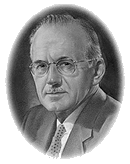
A.W. Tozer, on Having a Personal Revival

How to Have a Personal Revival,
Serious Repentance and Restitution, and
Steps to Spiritual Growth.

by A.W. Tozer

1) Put yourself in the way of the blessing. 

It is a mistake to look for grace to visit us as a kind of benign magic, or to expect God’s help to come as a windfall apart from conditions known and met. There are plainly marked paths that lead straight to the green pastures; let us walk in them.  To desire revival, for instance, and at the same time to neglect prayer and devotion is to wish one way and walk another.

2) Do a thorough job of repenting. 

Do not hurry to get it over with.  Hasty repentance means shallow spiritual experience and lack of certainty in the whole life.  Let godly sorrow do her healing work. Until we allow the consciousness of sin to wound us, we will never develop a fear of evil. It is our wretched habit of tolerating sin that keeps us in our half-dead condition.

3) Make restitution whenever possible. 

If you owe a debt, pay it, or at least have a frank understanding with your creditor about your intention to pay, so your honesty will be above question. If you have quarreled with anyone, go as far as you can in an effort to achieve reconciliation. As fully as possible make that crooked things straight.

*****

Thought 

Repentance and restitution result when we seriously reflect on what God shows us in His Word. What is it of which we need to repent and is there restitution to be made?


Scripture

“Bring forth fruit that is consistent with repentance [let your lives prove your change of heart];”

Matthew 3:8 (Amplified Bible)

Prayer

My tendency, Lord, is not to take seriously my sin that hurts other people and to leave unrepaired the damage I have left in the lives of others. Make me sensitive, Lord!


tozer
Aiden Wilson Tozer was born on April 21, 1897, on a small farm in Western Pennsylvania, the third of six children. And although he would inspire millions with his preaching and writing, he was given very little education during his childhood.

A. W. Tozer was 66 when he died of a heart attack on May 12, 1963. Buried in a small cemetery in Akron, his tombstone simply and appropriately reads, “A Man of God.” He left behind many books that continue to give Christians encouragement and guidance. His writings are as fresh today as when he was alive. His honest and colloquial humor has been known to sweep up congregations in gales of laughter. And his wisdom has left them silent and stunned. For almost 50 years Tozer walked with God, and even though he is gone, he continues to minister to those who are eager to experience God.

Bitter Water

In Exodus 15 there’s an incident that carries weight for today. Israel has come to the springs of Marah. The water is bitter. The people turn to Moses. They challenge him and the complaint voraciously. “Why have you brought us here?” They press Moses to the point of mutiny. They are furious.

Some commentators believe this bitter water was a laxative, and anyone who drank this “bitter” water made many trips to the outhouse!

Moses is shown a branch of a common tree. The Lord speaks a word of ďirection he’s to throw the branchaďirectly into the spring. It’ll cure the water, and make it sweet.

It seems to me that Jesus’ awful cross cures the bitterness we absorb as we make our way through life.