Impulsive Peter

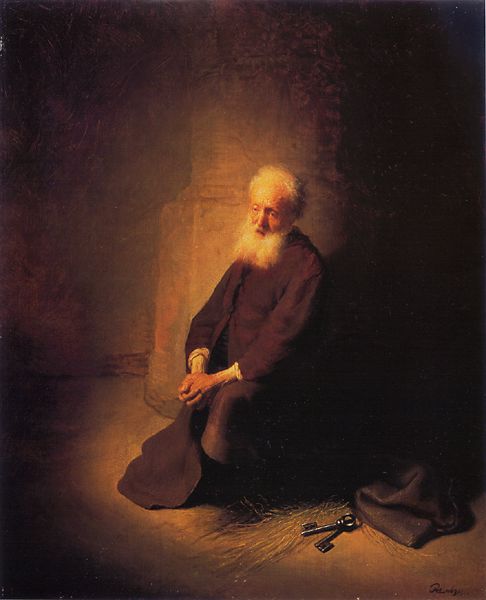
Peter was the magnificent failure.  But I’m grateful for his story.  As we examine his life and his actions and decisions, we see a man who was so much like us.  I relate and understand Peter more then any other disciple in the New Testament.  He was so real. He was so impulsive. He spoke before he thought, jumped in without looking and acted without thinking it through. Let’s take a look at Peter’s life after he met Jesus.

1) Peter, the fisherman-– When Jesus came to where  the boat was kept, Peter latched on immediately to become a disciple.  Jesus said, “Follow Me” and that is all Peter needed to hear.  (Matt 4:18-20; Matt. 14:25-31).

2) Peter, the bold-– There was a situation on a boat in a terrible storm.  It was between 3:00 am and 6:00 am.  These men are desperately exhausted, and they were still three miles from safety.  They suddenly see what appears to be a ghost, walking through the vicious storm to the boat.  It is Jesus!  He is walking on water, as if it were a sidewalk!

Peter shouts out– “Lord, if it is really you, allow me to leave this boat and let me come to you!”  Peter steps out of the boat, and begins to walk– on water!  But the wind whipping frightened him, and he began to sink.  We see Jesus, reaching out to grab Peter, to save him from drowning.  Before we judge him too harshly, how many of us would do what Peter did?

3) Peter, the confessor— Jesus asked His disciples who they thought He was. Peter was the first to acknowledge Jesus’ deity as the Son of the living God. (Matt. 16:15-16)

4) Peter, the witness— Peter, along with James and John, have been chosen to accompany Jesus to go up to a mountain top to pray.  When they arrive, something happens to Jesus.  He is ‘transfigured’, His clothes shimmer and turn white.    Then Moses and Elijah appeared, talking with Jesus. Being a man of action and not knowing what else to do, Peter offered to build shelters for the three holy men. An authoritative voice from heaven let him know that this was a time to worship, and to learn (Matt 17:1-4, Luke 9:28-36).

5) Peter, the reluctant one— Just before their last Passover, Jesus starts acting strange.  He strips off His outer garments, until He is down to His underwear.  He fills a basin with water, grabs a towel, and then begins to wash everyone’s feet.  He has become the servant to His disciples.  And Jesus will declare that this specific path is for every disciple that will follow.  Peter is incensed, and declares himself to be immune from this claim.

6) Peter, the boaster— Jesus explains that the disciples cannot follow Him.   Peter boasted that he would lay down his life for Jesus. This brought Jesus’ prediction that Peter would deny Him three times that very night. I wonder what Peter thought about this. He may have found it hard to believe, but we know that Jesus never lies.

When Jesus is arrested, Peter follows the cohort into the Temple.  It is at this point, Peter begins to outright deny Jesus.  It seems Peter can’t vocalize any support for His teacher and master.  In his craven fear, Peter denies Him who spoke and taught him.  How very sad,  (John 13 and 18).

7) Peter the repentant— Jesus appeared to them again by the Sea of Gaililee.  It is Peter, who from his fishing boat, identifies Jesus as Jesus.  Once again, he jumps out of the boat, but this time to swim to the shore.  The others follow in the boat.  Jesus has started a fire, and fish are frying. On the shore, when they had finished eating, Jesus restores Peter. Peter reaffirmed his love for Jesus three times – the same number of times he had denied Him. Jesus said to Peter, “Follow me.”

From that point, Peter followed Jesus closely. He went on to be a great preacher of the gospel and a leader of the church. He wrote 1st and 2nd Peter in the New Testament.  In the Book of Acts, we see Peter cooperating closely with the Holy Spirit.  His compulsiveness has been majorly modified and adapted to fit into the Kingdom.  Peter is now a man restrained and directed into God’s Kingdom.

1brobry-sig4 (2)


cropped-christiangraffiti1-3-1


A More Comfortable Discipleship

“Then Jesus said to his disciples, “If any of you wants to be my follower, you must turn from your selfish ways, take up your cross, and follow me.” 

Matt. 16:24, NLT

This is a head scratcher. The issue for me is that it is the disciples who are being addressed.  Jesus has words with them.  And what He shares is intense and demanding.  He invalidates any discipleship that doesn’t say “No!” to oneself. This what is meant by self denial.

The desire to follow must be present, a true longing to walk with Jesus.  We must be willing, but this is only the starting point.  This would-be-follower is to go a step further.  He must put to death his attitudes, actions, wants and wishes.  This disciple is to turn her back on the very things she has grown and cultivated all these years as important and worthwhile.  These things are self centered and will only nullify a disciple’s walk..

There must be a major upheaval of things.  An excavation of your goals and reasons.  It all must be torn down and hauled away.  We are only following mentally, or emotionally if we will not make an end to this “natural” life.

Jesus talks about personalized crosses.  Each disciple has his own.  It is custom-made, with your monogram on it.  It is part of the discipleship attire, and many say it is out-of-style.  But each individual disciple must pick it up, settle it on his shoulder, and then step out into the crowded street.

Some say cross-carrying is a dubious and an eccentric take on Christian ethics.  Church is where we go to fulfill a religious duty we feel is necessary. Others, get a spiritual buzz from singing chorus’ or “Amazing Grace”.  But it is Christianity without a cross.

Pick it up.  Fit it on your shoulder, and focus on Jesus.  Set your gaze on Him and step into the crowd.  You are a disciple and a witness to the world and the world-system.  You who are denying self now, become real to the will of God.

1brobry-sig4 (2)

cropped-christiangraffiti1-3-1

Seeing the Real Thing, [Heroes]

army_moh

“All praise to God, the Father of our Lord Jesus Christ. God is our merciful Father and the source of all comfort. 4 He comforts us in all our troubles so that we can comfort others. When they are troubled, we will be able to give them the same comfort God has given us. 5 For the more we suffer for Christ, the more God will shower us with his comfort through Christ. 6 Even when we are weighed down with troubles, it is for your comfort and salvation!”

2 Corinthians 1:3-6

“Grace is given to heal the spiritually sick, not to decorate spiritual heroes”

Martin Luther

I don’t know if I have ever met a Medal of Honor recipient, and somehow I’m sure that I would’ve remembered.  I most certainly have not met ‘a spiritual hero’.  I imagine them however to be quite dynamic, gushing over with humility and love.  Somewhat like being a ‘Superman of the Soul’.

Through His Holy Spirit, we were chosen not because we are superheroes, but because we are sick.  God doesn’t inspect us for exceptional qualities that we may someday possess.  Instead He is a paramedic, intervening with grace and mercy in our distress and helping us in our desperation.

Perhaps, there are some who secretly want to be ‘decorated’.  They love the attention and covet glory.  Faith is not really a medicine; it is more like a decoration.  It pins on its chest the Medal of Honor.  The highest award you can receive–the holy medallion of faith (with oak leaf clusters, of course).

Having had lived for a few years in a ‘third world country’,  I’ve gotten to observe up close believers who are pathetically poor.  I have seen poverty crush people like a boy crushes a bug on the sidewalk.  The sense I have can be summed up in a phrase, a ‘desperate gratitude’ for His grace.

Jesus has come and gathered up all their sin and shame and evil, and carried it away from them.  Their walk with Him now is in gratitude, not in attainment.  Here in the USA that ‘seeing’ has become myopic.  We struggle to see clearly.  Actually, we can be almost dangerous if we don’t see this.

We cannot envision anything clearly without an adjustment to our eyes.  There has to be a desperation that moves in and heals us.  Something that will pull our faith like a magnet.

We are not collecting ‘merit badges’, but medication and rolled-up bandages.  We hurt– our friends and family hurt, people we haven’t met yet, hurt.

“The mercies of God make a sinner proud, but a saint humble.”   Thomas Watson


cropped-christiangraffiti1-3-1

The God-Players, [Death Wish]

1
The Problem Is Myself,

  by Earl Jabay


About twenty-five years ago, in a small Midwestern city, a group of young boys were playing baseball. It was a team tryout. Every boy was doing his best to impress the coach. Robbie was a catcher. Younger than the two other boys who were trying out for that position, he was, however, a real beaver. Nothing was more important to him than getting on the team. There was no question about his talent. He was good. Any spectator could see that he was better than the other two catchers.

Late in the afternoon, the coach called Robbie over to him. Robbie studied the coach’s eyes for some hint of acceptance. It was not there, but then, maybe the coach was hiding his feelings. The coach began talking about how much ability Robbie had and that he really gave a lot to the game. And then it came. “Robbie, I hate to have to tell you this, but I can’t use you.” It was like being hit on the head with a baseball bat. “But . . . why?” Robbie fought to hold back his tears.

“Robbie—two things. You’re not a team member. You never joined us. You play your game when you are out there. You are a good catcher—but a loner as a team member. “The second thing is that you have a problem with me. You play my part, coaching the players and taking over. We can’t have a ball club on that basis.” “But Coach!—I was only trying my best!” Coach reflected. “There’s more to it than that, Robbie.” You were a good ballplayer, but your enlarged ego moved you right out of the ball club. “Forget it!” cried Robbie, as he stormed off the ball field. “I wouldn’t be caught dead on your crummy team!” Even as you stormed off the field, you felt like a king. You told them you were too good for them.

When I met Robbie, he was a man in his late thirties who had recently been admitted to a mental hospital. Rob was severely suicidal. “I’ve been struggling against taking my life ever since I was a young boy. Death has somehow always had a fascination for me.” He was seated comfortably in my study, and I just let him talk. “I remember that old Ford I had just before I graduated from high school. One night I took it out to the edge of town and ran a piece of tubing from the exhaust, through the window, and into the car. Then I started up the engine. Somehow, it gave me wild excitement to see how close I could come to taking my life. I chickened out, as you can see.” He laughed hollowly. “Another time, I tried to see how close I could come to the concrete abutment of an overpass. The car was doing about fifty-five when I hit it. Two days later, I woke up in a hospital with a broken back which still gives me trouble.” I thought of all the highway deaths and wondered how many of them were, in reality, suicides. “This thing with death really frightens me.” He paused and shook his head. “Well, it does and it doesn’t. Right now, I really don’t want to kill myself. But when I get excited or things go wrong, the first thing I do is think about some weird plan to kill myself. I have literally hundreds of ways all worked out in my mind. The idea has a hold on me.

Many times, it’s almost as if a dark, brooding presence comes over me and I have no power over it. I don’t believe in the devil, but it’s like an evil power—I find myself absolutely powerless to resist it. That’s what brought me here. This time, I slashed my wrists. One part of me tells me I wanted to do it—another says I didn’t.” Rob went on to tell me what he had tried to do about his problem. “I spent years trying to figure out what kind of a nut I was to have these weird ideas. I became such a nervous wreck that I went to a psychiatrist for some tranquilizers. Thought maybe that would help.” He sighed and leaned back in his chair. “The doctor gave me some pills and suggested psychotherapy. I had already read a lot about it, so I began treatment. At the time, I claimed that it was doing a lot of good and that I was finally getting some answers. I think I had to say that to justify paying him all that money! After two years, I ran out of money—and patience. I came to know a lot about my past, but that old problem of suicide was more of a threat than ever.

“Next thing I did was go to a minister. Don’t get me wrong. I’m not religious, but I heard that this minister was a counselor, so I went to him. True, he didn’t say much about God, but he sure had a lot to say about his church. His congregation was very busy and active with all kinds of study groups and community-action programs, all of which I was invited to join. When I finally got to tell him about my problems, all I recall him saying was that I should make a decision not to kill myself, and that I should use more willpower. Oh yes, he said I should also pray. I was hoping he would pray with me, because I felt I really needed prayer, but he never suggested it. I quit going to see him.”

I looked at Rob’s face. Fatigue was written all over it. And despair. I felt pity for this man who had tried so hard to figure out why he was losing his battle against death. I sensed that Rob had a little more to say. “The only conclusion I can come to is that my biggest problem is myself. I am my own worst enemy!—always have been. I’m a double person—maybe I’m schizoid, I don’t know. I do and then I don’t want to kill myself. I don’t understand myself. I don’t even like myself. Worst of all, I can’t even control myself! For God’s sake, Chaplain, tell me what’s wrong with me!” he cried, putting his face in his hands. “Does any of this make any sense at all?”

I knew it was time to level with Rob. “Okay,” I said, keeping my voice low, “I’ll give it to you straight: you are absolutely right when you say that you are your biggest problem. And the problem with you, Rob, is that you are a god-player. What I mean is this: you have tried to create your own little world with yourself placed squarely in the center of it. God has no place in your world because you have taken His place. Your whole life is a story of how you tried to set things up according to your will and plans. You wanted to be a king and build yourself a kingdom. The truth is that you are not a god, not even a king—you are a plain, ordinary human being who has never joined the human race.” Rob was listening now, not moving a muscle. I went on. “That early episode on the ball field, in a sense, tells it all. Even then you tried to take over. You tried to take that ball club—coach and all—and make them serve you in the Kingdom of Robbie. I paused, catching my breath, but Rob remained speechless.

“Now, about this problem of suicide,” I continued. “Suicide is the ultimate act of god-playing—even though you never consciously intended it to be that. Look, when anyone attempts suicide, what does he do? He insists of having the world his way, and if he cannot have it his way, he will kill himself. The king in us would rather die than accept the world as it is. He has such a deep love for his kingship and such a strong faith in himself to bring it about, that any failure or weakness in himself must be punished with death.” Rob nodded. He didn’t like what he was hearing, but he seemed to see it was the truth, and he wanted to hear more. “The Kingdom of Self, understand, is in our heads. We spend years building this fantasy kingdom unto our own glory. The king’s thinking becomes grandiose and his feelings ultimate. He believes all things can and must be done according to his will. And another thing; the king is never wrong. He is always right. Just ask him. He’ll tell you. So when the castle really starts to fall down around his ears and the king has lost all control of the world in his mind, he will fly out of control unto his own destruction. Then the forces of self-hate and self-pity move in and become so strong that the king is powerless to withstand them. He does, therefore, what he does not want to do—he attempts to kill himself because he can’t stand himself, defeated phony king that he is. It’s not that he particularly wants to die; it’s just that there doesn’t seem to be any alternative with his kingdom in such terrible shape.” I glanced at my watch and realized I had only a few minutes before my next appointment. “One more thing before you go: you are a god-playing king. So am I. Everyone is. You failed as a king. I, too. We are both failures—in fact, we even failed to fail successfully. But we are still alive, thank God, and there is much hope for both of us. If you want to, come back this afternoon, and we’ll talk some more.”


Earl Jabay was a Christian therapist in 1950’s.  He wrote a number of books, including “The Kingdom of Self” and “The God-Players.”


cropped-christiangraffiti1-3-1