Stigma Sucks

anit-stigma-campaign-names

Mental illness doesn’t necessary mean exotic or strange– but it does mean different. It doesn’t make one bizarre, or odd. Coming to faith in Christ really settles this issue for most. While our mental illness is flaring up, yet we are still being changed by the Holy Spirit. He’s still at work–perhaps hidden, but he still is there.

We can’t really nullify the work of God. It takes as much grace to change a “normal” man as a mentally challenged one. God does not have to work any harder; there are no lost causes or last chances. All require the same grace. I really must thank God for this. Seriously.

Since I fight with depression I’ve become aware of mental illness throughout history. Many painters and poets, inventors and doctors have come from the ranks of bipolar disorder. Because many of those with manic depression and sufferers of depression have excelled; we would not have harnessed electricity if it wasn’t because a bipolar/ADHD created the light bulb.

But we are different. But we also can bring a giftedness that is necessary. We are not pariahs or leeches, but rather we are unique. Typically we may be passionate and sensitive. We are touched by something creative. Some have called depression and bipolar disorder as those “touched by fire.”

Mental illness can be seen as more of a mental difference, than a liability. We are not crazy or lunatics running amok. Sometimes others pity us; often when they do they shut us off, and permanently seal us up into a weird sense of extreme wariness. This should not be.

13 “You made all the delicate, inner parts of my body
    and knit me together in my mother’s womb.”

14 Thank you for making me so wonderfully complex!
    Your workmanship is marvelous—how well I know it.”

Psalm 139:13-14, NLT

God has created each one. We are all “knit together” by the hand of God. There are no second rates– never prototypes, not quite His best work. The blood of Christ works in spite of handicaps and personality quirks.

Some may hesitate about this. But it’s essentially an act of faith. The treasures of the Church are unique. They are the blind and the lame, the ones not always stable. What others consider marginal, or lacking, are really the valuable ones. It’s these that the Church should glory in.

During the middle ages a large church was surrounded by vandals. The priest was told that by noon the next day he must bring out the treasure of the church and pile them out on the steps. The next day, the vandals found a group of lame, weak, sick and mentally ill out on the steps. “What are these,” the leader demanded. The priest calmly said–these are the treasures of the church. 

We’ve become the audio/visual department of the Church. They see us and understand God’s gift of grace.

I encourage you to broaden your thinking on this. To stigmatize others is never a healthy, or a God honoring attitude. It indicates a small heart. If you pass false judgement, He will deal with you.


bry-signat (1)


Choosing to Walk With the Broken

10906006_10153053767554669_6363861668127076274_n

It seems the world is divided into two groups.

  1. Those all together, happy, healthy, and reasonably sane.
  2. Those with incredibly significant hang-ups.

We gravitate toward success. Even in a spiritual sense, we do so. No one wants to be associated with a ‘washed-up’ loser.  We expect success (at least in its fundamental form) to ooze out of every preacher, teacher, or ‘wanna-be’ that intends to lead us to ‘the promised land.’ We expect (or demand) it to be so.

But there are those broken ‘on the wheels of life’ who offer nothing at all.

They are busted and broke. They may once have been noble and keen; they might have stared at life as if it were their own already. They were gifted, but breakable. Alas, and they broke. And they have nothing to give. So many things have disintegrated around them, they are left without a clue, and certainly without hope from a ‘fickle’ Church.

What makes a man or woman ‘spiritual’ or holy?

Is it living up to a special standard or calling? Or maybe they look and sound good at what they do? Perhaps it is none of these. Maybe it really comes down to brokenness and humility? Perhaps we’ve looked at it all wrong.

Perhaps the real yardstick is spiritual poverty?

They are blessed who realize their spiritual poverty, for the kingdom of heaven belongs to them.”

Matthew 5:4, NCV

Make no mistake, the ‘good’ seems very good. It is easy to ‘receive’ from some preachers. They do it so seamlessly, and so correctly. We often wonder why we haven’t been so receptive before. But ‘polish’ can never replace ‘broken’ prayer.

I will trust my soul to those ‘busted’ by the meanness of life, rather than those who pretend that things are ‘rosy’ all over. Brokenness is not a given. But it really is ‘the coin of the realm’. It is how the Kingdom does ‘business.’

 But he said to me, “My grace is enough for you. When you are weak, my power is made perfect in you.” So I am very happy to brag about my weaknesses. Then Christ’s power can live in me.”

2 Corinthians 12:4, NCV

I hate to say this, but if being broken is the desperate need of the moment, then hammer me over and over again. I can’t imagine or even explain a better calling. “Bring it Father God”, (but help me if I stumble.) Oh, and one more thing: typically ‘mercy’ is absent for those who seem to live so ‘perfectly.’ (You just don’t see them with any.)

Look for mercy, and you will probably find someone truly authentic.

Take your candle, run to the darkness, and light your world, and love the unlovely while on your way.

bry-signat (1)

cropped-christiangraffiti1.jpg

That Awful Wasteland of Alzheimer’s

alzheim

What is Alzheimer’s disease (AD)?

Alzheimer’s disease (AD) is an irreversible, progressive brain disease that slowly destroys memory and thinking skills and, eventually, the ability to carry out the simplest tasks of daily living. In most people with AD, symptoms first appear after age 60. AD is the most common cause of dementia among older people, but it is not a normal part of aging. Dementia refers to a decline in cognitive function that interferes with daily life and activities.

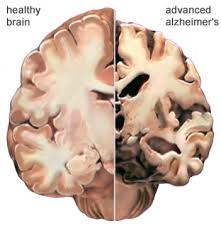
AD starts in a region of the brain that affects recent memory, then gradually spreads to other parts of the brain. Although treatment can slow the progression of AD and help manage its symptoms in some people, currently there is no cure for this devastating disease. AD is named after Dr. Alois Alzheimer, a German doctor. In 1906, Dr. Alzheimer described changes in the brain tissue of a woman who had died of an unusual mental illness. He found abnormal clumps (now called amyloid plaques) and tangled bundles of fibers (now called neurofibrillary tangles). alzheimers-brain

Today, these plaques and tangles in the brain are considered hallmarks of AD. The third main feature of AD is the gradual loss of connections between nerve cells (neurons) in the brain. This loss leads to diminished cell function and cell death. We don’t know what starts the AD process, but we do know that damage to the brain begins as many as 10 to 20 years before any obvious signs of forgetfulness appear. As nerve cells die throughout the brain, affected regions begin to shrink. By the final stage of AD, damage is widespread, and brain tissue has shrunk significantly.

How many Americans have AD?

According to recent estimates, as many as 2.4 million to 4.5 million Americans have AD. Unless the disease can be effectively treated or prevented, the number of people with AD will increase significantly if current population trends continue. That’s because the risk of AD increases with age, and the U.S. population is aging. The number of people age 65 and older is expected to grow from 39 million in 2008 to 72 million in 2030, and the number of people with AD doubles for every 5-year interval beyond age 65. In the years to come, AD is expected to pose physical and emotional challenges for more and more families and other caregivers, in addition to those with the disease. The growing number of people with AD and the costs associated with the disease also will put a heavy economic burden on society.

How long can a person live with AD?

AD is a slow disease that starts with mild memory problems and ends with severe brain damage. The time from diagnosis to death varies—as little as 3 or 4 years if the person is older than 80 when diagnosed to as long as 10 or more years if the person is younger. Other factors that affect how long a person will live with AD include the person’s sex, the presence of other health problems, and the severity of cognitive problems at diagnosis.

What is dementia?

Dementia is a general term that refers to a decline in cognitive function so extensive that it interferes with daily life and activities. This loss in the ability to think, remember, and reason is not a disease itself, but a group of symptoms that often accompanies a disease or condition. Many conditions and diseases cause dementia. Two of the most common causes of dementia in older people are AD and vascular dementia, which is caused by a series of strokes or changes in the brain’s blood supply. Other conditions that cause memory loss or dementia include:

•medication side effects

•chronic alcoholism

•certain tumors and infections in the brain

•blood clots in the brain

•vitamin B12 deficiency

•dehydration

•high fever

•some thyroid, kidney, or liver disorders

Many of these conditions are temporary and reversible, but they can be serious and should be treated by a doctor as soon as possible. Emotional problems, such as stress, anxiety, or depression, can make a person more forgetful and can be mistaken for dementia. Someone may feel sad, lonely, worried, or bored when facing retirement or coping with the death of a spouse, relative, or friend. Adapting to these changes leaves some people feeling confused or forgetful. Supportive friends and family or professional help from a doctor or counselor can help older adults adjust to big changes.

Source: National Institute of Aging, http://www.nia.nih.gov/

Melancholy in Amber

melancholy-1874halfhd

Edgar Degas, Melancholy/ c. 1874, oil on canvas, Phillips Collection, Washington D.C.

The sadness flows from this painting. Degas caught the dark despondency of his model. Her inertia becomes something we can gaze on carefully and at leisure.

This is one of my favorite paintings. For me, it captures an essence of what depression “looks” like. The anguish and the whole sense of being is seen in the expression of her face. She is frozen in her despair.

Depression immobilizes and then lays waste all that it touches. It is a vicious blight on the human soul.

amberI remember as a boy seeing a prehistoric bug caught in amber. It struck me as a bit macabre. This poor insect frozen for all to see.

Little did I realize that this was going to happen to me.

For almost 20 years I’ve tangled with clinical depression. It was initiated by a brain tumor in 2002 and has been evident since then.

Depression to me is like being frozen in a deep sadness that clings to my soul. It shows me no mercy when it is active, but I can go several weeks at a time without it being an issue.

There is a dual aspect to this. My experience is like a complete suppression of the good and optimistic, combined with an increase of despair and despondency. I despair of any future good that might occur. Everything becomes bleak and black.

My life becomes a meltdown; a cascading effect of worsening feelings.

A few points that have helped me:

  • A main point for me is to doubt the “certainties of despair.” I believe that God’s promises to me contain a “future and a hope.” This is vital. At times I feel too far gone, and completely irredeemable. I must doubt the lies of the enemy.
  • Freedom come through a real faith in God’s grace. I believe that His Holy Spirit empowers the weak. He holds my hand as I stumble in the path. My confidence is in His promises to this “weak lamb.”
  • Scripture tells me that Jesus’ present ministry is one of intercession for my soul.Who then is the one who condemns? No one. Christ Jesus who died—more than that, who was raised to life—is at the right hand of God and is also interceding for us” (Rom. 8:34.)
  • Jesus has the power to keep His flock. He also gives me a few select companions. I meet with some of “my fellow sheep” at my local church. These know me, and their friendship encourages me. They don’t condemn.

I hope that some of this helps, if anything I hope you have a window into my convoluted faith. I don’t want pretend to have all the answers. I’m not a guru. I’m a “work in progress,” and some ways far behind you, the reader.

“Wherefore he is able also to save them to the uttermost that come unto God by him, seeing he ever liveth to make intercession for them.”

Hebrews 7:25

ybic, Bryan


cropped-christiangraffiti1 (3)