Always Be Children, [Always]

Matthew 18:1-3, ESV

I have always believed that maturity brings wisdom and growth, a beautiful journey to embark on. When it comes to spiritual matters, it is an opportunity to delve deeper into the richness of faith. I eagerly embraced the challenge of expanding my understanding and exploring the profound teachings. Jesus’ devoted disciples, too, were presented with invaluable guidance and encouraging direction:

15 “Now they were bringing even infants to him that he might touch them. And when the disciples saw it, they rebuked them. 16 But Jesus called them to him, saying, “Let the children come to me, and do not hinder them, for to such belongs the kingdom of God. 

17 Truly, I say to you, whoever does not receive the kingdom of God like a child shall not enter it.”

Luke 18:15-17

Jesus makes a special effort to get his followers to see their need. He voices the dictate that they must become children again; that they must learn that the basics are the core. We won’t grow out of them.

Real faith remains childlike even as it gets old.  

As we see the children that are in our midst, we should see in them the pattern for us as we connect with the Lord, and with each other. It’s a paradox, but we mature as children, and this doesn’t ever change. Jesus told us that the Kingdom belongs to those whose faith is childlike.

Childlike faith seems to have three focuses:

  1. Areas of intimacy, coming together in the presence of the Lord as His sons and daughters.
  2. Areas of relationships, between each other as brothers and sisters in love with each other.
  3. Issues of spiritual warfare, facing the daily battle with sin and darkness with a steady awareness of the ones alongside us.

Holding a child’s faith has an extraordinary power to shape our lives in profound ways. It’s a delicate balance of innocence, trust, and vulnerability that leaves an indelible mark on our hearts and souls. The childlike belief in something greater than ourselves and it opens up a world of possibilities and invites us to embrace the wonders of the unknown with open arms.

Our Father is with us.

But what does it truly mean to hold onto a child’s faith? It goes beyond the simple act of believing in something beyond our understanding. It requires a humility that allows us to acknowledge our own limitations and embrace the beauty of our imperfections. In a world that often values strength and self-assuredness, the child’s faith reminds us of the importance of embracing vulnerability and being open to being led in fresh ways.

Picture for a moment the scenario of being suddenly clothed in nothing but our humility. It is a humbling thought, isn’t it? In that state, stripped of all pretenses and facades, we are forced to confront our true selves. We are reminded of our humanity, and our weakness with the swirling world around us. It’s in those vulnerable moments that we truly come to appreciate the depth and power of a child’s faith.

In a society that often prioritizes material success, power, and self-exaltation, we may find ourselves striving to shed our humility in favor of more desirable qualities. However, it’s precisely in cherishing our humility that we can find true wisdom and grow into more compassionate and merciful people. It’s through humility that we can connect with others on a deeper level, understanding their joys and sorrows with a genuine empathy.

Let’s embrace the innocence of a child’s faith.

Let’s allow it to ‘infect’ our lives with a sense of real wonder, curiosity, and a supernatural love. Let’s never forget the lessons it teaches us about the importance of embracing humility in our journey through life.

Let’s hold onto a child’s faith tightly, for within its grasp lies the power to transform our lives and the world around us. May it be a constant reminder of the child-like beauty that exists within each and every one of us.

Humility is the stuff Jesus uses to make a place for His Kingdom.

Becoming a person of childlike faith will take a lifetime, that is why we should stay small and keep growing in our dependence on Him.

Martin Luther

bry-signat (1)

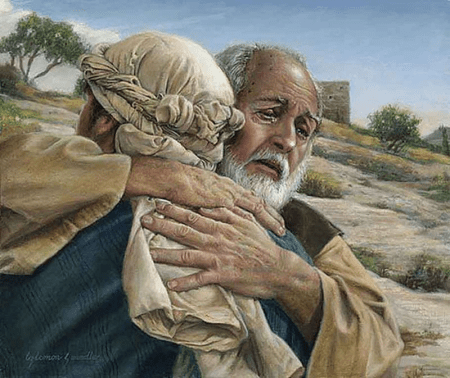
The Father is Running!

“So he returned home to his father. And while he was still a long way off, his father saw him coming. Filled with love and compassion, he ran to his son, embraced him, and kissed him.”

Luke 15:20, NLT

There comes a time when the prodigal stands up–looks around, and then decides he can’t live this way anymore, it’s now time to return home.  But he is no longer a ‘rich man’s son’, the pig-pen completely crushed that idea.  He returns home, thinking that at least he can be a slave.

The devastated prodigal now understands.

And it’s that which gives him the propulsion to leave the pigs behind, and begin to somehow be received by his father. The trip is a long one, lots of walking, and yes, it’s hard–he’s far from where he’s supposed to be. He is tired, ragged and worn.

But please dear one, you must understand this about Jesus’ parable–the story isn’t so much about the prodigal son, rather I think that the focus should really be on the father. Jesus is teaching us that the love of God is a searching/seeking kind of love, and it cannot be shut down, or go away over time. Not ever.

You see, it is a 24/7/365 day kind of love.

Think of it like high intensity radar that sweeps over extreme distances, it is always looking, seeking, and it won’t be denied.  The Father is seeking for His sons and daughters.  He intends to find them. If we refuse we will continue to feed pigs, over and over, and we will starve.

The running love of the Father is strenuous and reaching

The Father never sits on His backside, calmly watching from His throne. He reaches out and runs to us. God doesn’t sit. He is far from passive, rather He intensely yearns for His son. And God is fully into reclaiming His missing sons and daughters, just like in Jesus’ story.

He continues to search, even in when things get really bad.

Sin disfigures
Sin disfigures, a meth addict’s mug shots over time

The Father recognizes His prodigal son.  It’s funny, but gross sin often has a way that disfigures a person’s countenance. Look at the wino or meth addict on the street.

The boy who abruptly left home is not the son who returns.  There has been damage done.  His face has changed.  The Father understands this, and yes, it has been terribly hard and brutal. But that hardly matters.

I believe that this parable is the greatest of them all. 

Jesus is explaining the deep love the Father has for prodigals like us. This story is so revealing, in it we see that the Father who is running. We must know this about Him. We must internalize it and understand the compassion He has. If we stall in our discipleship it’s because we don’t grip the awesome depth of His love.

There seems to be very few people who understand a running God.

The prodigal son is a timeless parable that transcends generations, holds within it a profound message of forgiveness, redemption, and unending love. As we delve deeper into the intricate layers of this tale, we discover a powerful metaphor that illuminates the human experience and the unwavering compassion of the Father.

As the prodigal hits bottom he realizes the futility of his choices and yearns to return to the forgiving embrace of his father. Overwhelmed by guilt and shame, he makes the long journey back to the home he once took for granted. Little does he know it, behind the scenes, his father has been watching, waiting, and hoping for his return.

And then, in a moment that encapsulates the beauty of unconditional love, the father catches sight of his boy from afar. Without a second thought, the father runs towards him with outstretched arms, his love insisting on forgiveness.

We see a love that surpasses human understanding.

The parable teaches us about the power of redemption and forgiveness, reminding us that no sin is too great to be forgiven, and no distance is too far for reconciliation. It emphasizes the importance of humbly seeking forgiveness and shows that love is always within reach.

Jesus teaches us a different kind of love. It’s not based on achievements or what society says. This love is given to everyone, regardless of their flaws, but in order to have it, they must leave the pigs behind. Sometimes that isn’t always easy.

This profound depth of His love often leaves us feeling totally doubtful or skeptical.

Our logical minds struggle to grasp how such boundless love can exist, especially when we witness the failings and flaws of human love. Yet, it is precisely because love transcends logic that it is so powerful. It operates on a different plane, bypassing our human limitations and revealing a deeper truth about the nature of God’s infinite compassion.

So, let us tell others about this love that Jesus spoke of.

Let’s begin to see that this compassion will transform lives, heal wounds, and bridge divides. For when we approach Jesus’ parable with humility and faith, we may just catch a glimpse of its power and appreciate its profound beauty in a new way.

If the Church can just keep up with our running God, we will finally understand who He really is. And if we only accept the love of the Father towards prodigals—no matter what the sin—it’s then we will finally understand the white-hot love of the Kingdom of Jesus.

And the Church will finally be doing His will in the world.

Finally.

1brobry-sig4

Braiding and Waiting

wait_bench_ocean

“Yet those who wait for the Lord
Will gain new strength;
They will mount up with wings like eagles,
They will run and not get tired,
They will walk and not become weary.”

Isaiah 40:31, NASB

The particular word “wait” is a vital force that must be reckoned with. It’s not used passively in the Scriptures. It does not mean to be apathetic or lazy. Sometimes we wait in line at the grocery store, or maybe we’re waiting for a phone call. We regularly wait all the time, and usually, we don’t even realize it.

The Hebrew word for ‘wait’ is special. It’s qāvâ. It means, ‘to bind together by twisting.’

It will sometimes mean to work like a fisherman who repairs his nets to get them ready for tomorrow’s task.

(There are always holes to mend after a long night’s efforts.)

When I truly wait on God, I realize that I’m actually repairing myself for His heart and for His work.

  • Seeing His face
  • Hearing His voice
  • Keeping pace with Him, whether He moves or doesn’t

It’s a fascinating way of describing something, isn’t it? Sometimes, when we think of waiting only in the context of the English language, it can become a frustrating delay. This often causes us to miss out on the true meaning of ‘wait’. I strongly believe that the Holy Spirit wants us to understand the concept of being closely connected to God. Sadly, we are often held back by our own definitions, rather than embracing the definitions found in God’s Word.

“The LORD is good to those who WAIT for him,
to the soul who seeks him.”

Psalm 27:14

For those of us who are sick – in body or mind – being told to “wait on the Lord” can be difficult to understand and accept. It is common for us to feel frustrated with this advice and the person giving it, mainly because we don’t fully grasp the true meaning of ‘waiting.’ We get close to understanding it, but we never quite reach that understanding of that word.

“WAIT for the LORD;
be strong, and let your heart take courage;
WAIT for the LORD!”

Psalm 27:14

He becomes my strength; He is now the strong cord I am braided into. (Perhaps this is how He imparts strength and might to His people?) We need this, and the Lord is quite eager to lead us into this new kind of intimacy.

“The LORD is good to those who WAIT for him,
to the soul who seeks him.”

Lamentations 3:25

The promise in Isaiah 40:31 talks about getting new strength, like an eagle’s wings, a holy energy. This verse is important for us, especially today; we need this kind of strength right now. I just want to inspire you during your prayer time to become consciously and purposefully connected to the Lord.

It’s only then can we can put our nets back together again?

“Waiting for God is not laziness. Waiting for God is not going to sleep. Waiting for God is not the abandonment of effort. Waiting for God means, first, activity under command; second, readiness for any new command that may come; third, the ability to do nothing until the command is given.”

    G. Campbell Morgan

The Throne of Mega Grace

“Let us then with confidence draw near to the throne of grace, that we may receive mercy and find grace to help in time of need.”

Hebrews 4:16, ESV

As verses go, this is one of the more significant. There are plenty of promises to be found in the scriptures but Hebrews 4:16 has a meaningful spot in my walk. When I think about it, and consider its implications, I have very little to say but “hallelujah!”

Jesus is our great High Priest. That word “great” clearly underscores His value to us. It shouldn’t really surprise us: the word in Greek is “megas” which means preeminent, all intensive and all abundant. (The idea can also mean ‘weight.’)

Some versions of the Bible use “boldness” instead of confidence. I like boldness but confidence is good too. Both words are wonderful. (One version uses “bravely!”).

His absolute power as a Priest is forever and ever.

He is now our precious mediator. Jesus is now our go-between of our ugly sin and His incredible holiness. He has created a spiritual super-highway for those who chose to come to Him through a saving faith. He has done this all by Himself. It was what He wanted.

The throne He sits on is now known as our “throne of grace.”

“Ancient Jewish Rabbis taught that God had two thrones, one of mercy and one of judgment. They said this because they knew that God was both merciful and just, but they could not reconcile these two attributes of God. They thought that perhaps God had two thrones to display the two aspects of His character. On one throne He showed judgment and on the other throne mercy. But here, in light of the finished work of Jesus, we see mercy and judgment reconciled into one throne of grace.”

David Guzik

Mercy and grace. Help in our time of need. If you’re anything like me, my neediness is perpetual. I need Jesus all the time, and He has made it clear through His Word that He’s always available to us. His throne room is never off-limits. He has given us the keys!

“The greatest privilege God gives to you is the freedom to approach Him at any time.”

    Wesley L. Duewel

I have a new site and I hope you visit: alaskabibleteacher.com