Making a Trade

“How poor was Jacob’s motion, and how strange 

His offer! How unequal was th’ exchange!

A mess of porridge for an inheritance?

Why could not hungry Esau strive t’ enhance

His price a little? So much underfoot?

Well might he give him bread and drink to boot:

An easy price! The case is even our own;

For toys we often sell our Heaven, our Crown.”

Francis Quarles, (May 1592 – September 1644)

Reading this dusty old poem isn’t really my favorite thing to do. Contrary to public opinion, I don’t walk around the house quoting Shakespeare or even Milton. (Just so you know, right now I’m listening to baseball on the radio and thinking about a hotdog, with onion and mustard.)

But this brief poem (the best kind!) really resonated in me. I sensed the Holy Spirit focus me on the words, and deliver to me something special. I would like to think that this is going to happen to you as well. But that is not a certainty.

Quarles’ poem sketches out the story in Genesis 25, of Jacob and Esau. For many years I have been moderately perplexed by Esau’s actions and Jacob’s conniving. Esau seems stupid, and Jacob manipulates him.

“Look, I’m dying of starvation!” said Esau. “What good is my birthright to me now?”

 “But Jacob said, “First you must swear that your birthright is mine.” So Esau swore an oath, thereby selling all his rights as the firstborn to his brother, Jacob.”

“Then Jacob gave Esau some bread and lentil stew. Esau ate the meal, then got up and left. He showed contempt for his rights as the firstborn.”

Genesis 25:32-34, NLT

The issue seems to be that I am very much like Esau. And I also seem to have the manipulative style of Jacob. I can trade off my “inheritance” as quick as anyone alive. Depending upon my mercurial moods, I will trade my supernatural peace and hope for swill. And I can do this without a second thought.

Quarles poem ends with this,

“An easy price! The case is even our own;

For toys we often sell our Heaven, our Crown.”

Toys, trinkets, trifles. I trade away the things are most precious for “swill.” But I am hoping that my heart will change, and I will stop trading off what is eternal.

ybic, Bryan

You Are Complete In Him

“Beware lest anyone cheat you through philosophy and empty deceit, according to the tradition of men, according to the  basic principles of the world, and not according to Christ.

For in Him dwells all the fullness of the Godhead bodily, and you are complete in Him, who is the head of all principality and power.”  

Colossians 2:8-10

I’ve heard about how accessories can complete a look.

Lord, thank You for completing us!  And here’s a simple poem . . .

All the Fullness

We are complete in You                                                                       
for that is what You do
coming to us who are unfinished
and filling us with truth.

We are complete in You
it’s not something we can do
for nothing else can fill us
but the fullness of You.

By Debbie, her link should be a blessing, http://iftodaywehear.wordpress.com/

Prone to Fall, I Feel It

Art by Lynda Finch

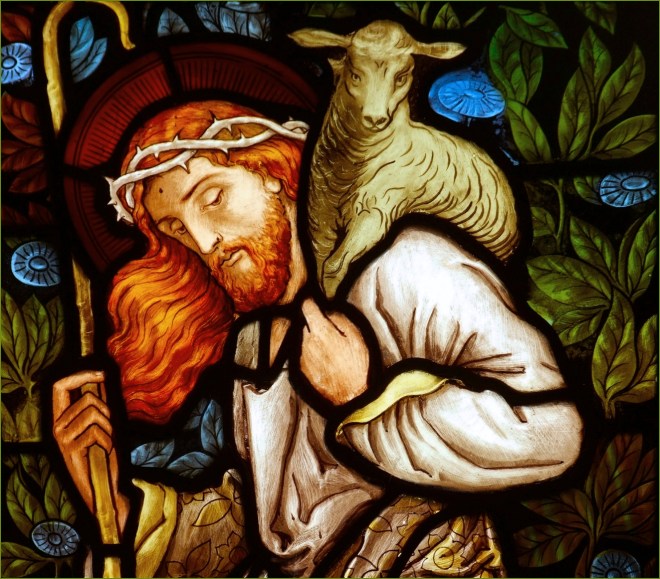
“It is true I am weak in faith, and prone to fall, but my very feebleness is the reason why I should always be where thou feedest thy flock, that I may be strengthened and preserved in safety beside the still waters. Why should I turn aside? There is no reason why I should, but there are a thousand reasons why I should not, for Jesus beckons me to come.”

“If he withdraw himself a little, it is but to make me prize his presence more. Now that I am grieved and distressed at being away from him, he will lead me yet again to that sheltered nook where the lambs of his fold are sheltered from the burning sun.”


–Charles Spurgeon
Art by Lynda Finch,

Getting to Know Your “Sheepiness”

I am the good shepherd. I know my sheep, and they know me. 

–John 10:14

The shepherds of Israel have a custom of marking their sheep to make them distinct from each other.  Each bears a unique notch or brand that makes them distinguishable from their companions.  It is not done for aesthetics, but recognition.  Christ gives each person who follows Him a certain recognizable characteristic.  He “knows His sheep.”

He recognizes their faces.  All have a common demeanor, a family resemblance.  No matter where they go, they are marked as His follower.  The Prodigal fed the pigs from his abject poverty, yet he belonged to his Father.  Our voices also mark us, they are recognizable by those who are aware.  When we speak there is a heavenly inflection and tone.  I have a dear friend from Tennesee, and he couldn’t pretend to be from Boston.  You might say we have a believer’s accent that IDs us as His own.

Last of all, He knows us by our hearts.  Peter was one who not only betrayed his Lord, but he betrayed himself.  He was not quite Peter the Rock, but Peter the weak.  Jesus sees our hearts, the flaws and weaknesses are quite obvious to Him.  We may feel like we are damaged goods.  But His power to transform is legendary and without peer.

Jesus knows His sheep, He just does not tend the best, but seeks out the least.  All who are weak and pathetic are cared for with a tender love.  Those of us who are flawed and lame are given preferential treatment, but all are loved, all needs are met.

We have no power without Jesus as our Shepherd to lead  us.  We cannot manage on our own.  Solitary sheep are nothing more than a wooly snack for predators, or they will fall desperately seeking pasture.  I encourage each to merge with a local flock, a group of imperfect believers who are following the Shepherd of love.

“The LORD is my shepherd, I shall not be in want.

 2 He makes me lie down in green pastures,
       he leads me beside quiet waters,

 3 he restores my soul.
       He guides me in paths of righteousness
       for his name’s sake.”

 Psalm 23:1-3

ybic, Bryan