So What’s Next ?

Mark 10:53, ESV

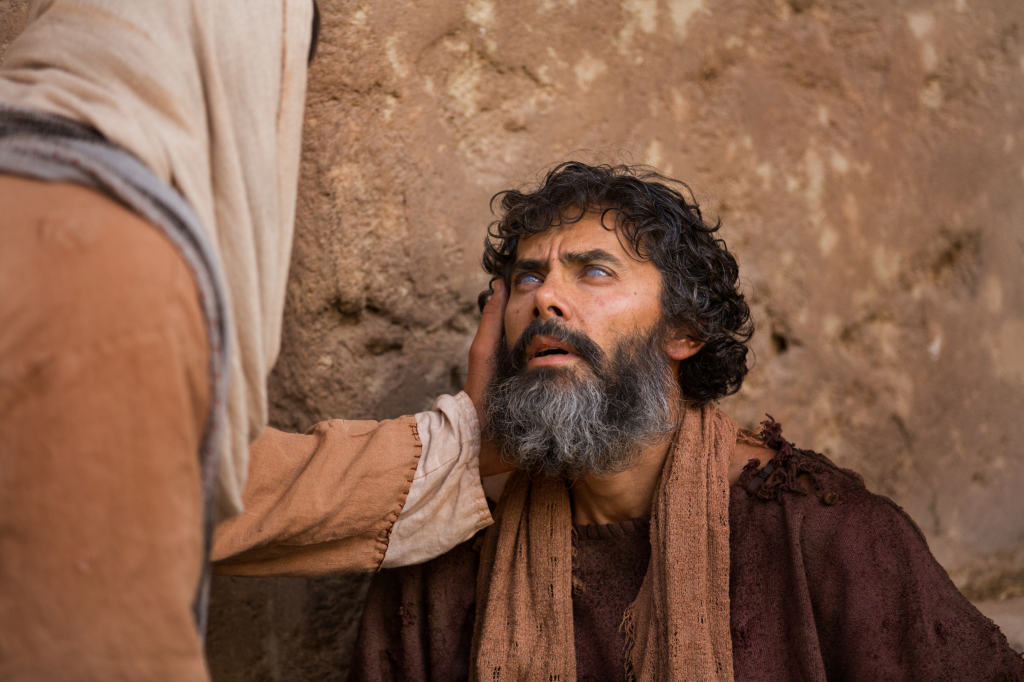
God has touched you in a profound way, (at least I hope so.) Only He could’ve done this. You’re not the same person now. Just like Jesus healed blind Bartimaeus, you too can really see. The beggar becomes a follower. (Mark 10:46-53.)

So what’s next?

There is always another step to take as we follow Jesus. Everyday there is something new. Our salvation is given freely, but we discover that it’s something active–more like a flowing stream and less like a stagnant pool. If we truly have been “healed,” we’ll want to follow. And now each day is a joyous adventure.

After all, we’ve been terribly blind for a long, long time.

Bartimaeus would never be able to truly explain what had happened to him, at least not in a perfect or complete way to the others–but no matter, it really wasn’t necessary. (But I must believe he tried.) He could see!

  • Jesus: “Go your own way.”
  • Bartimaeus: “..followed Him on the way.”

He was now a true follower. No longer a blind beggar, but he now was a true companion of Jesus and the “church.” He now walked with other believers in the Master’s band of disciples. (Having been blind and instantaneously given sight changed him forever.)

So what happened next?

I suspect Bartimaeus followed the Lord all the way. Although scripture doesn’t say what happened, I believe this ‘ex-blind’ man was now a visible witness to any with eyes to see. Bartimaeus became an authentic witness–God’s megaphone to the power and mercy of Jesus Christ.

I can’t say exactly. Each believer has a different story.

But I do know tomorrow’s life episode is going to be something fantastic, and a challenge. The fruit of the Holy Spirit is given to each who are truly being discipled to follow. The road in front of you just might be excruciatingly hard, but truly there is joy in our journey with Jesus.

“You called, You cried, You shattered my deafness, You sparkled, You blazed, You drove away my blindness, You shed Your fragrance, and I drew in my breath, and I pant for You.”

   Augustine

Blind From Birth

John 9:1-7

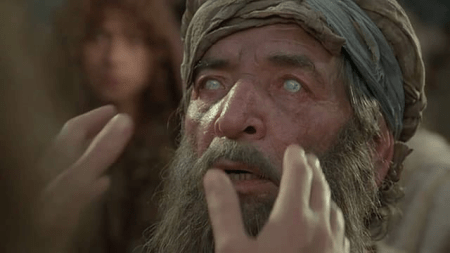
As he was walking along, he saw a man blind from birth.

“Master,” his disciples asked him, “why was this man born blind? Was it a result of his own sins or those of his parents?”

“Neither,” Jesus answered. “But to demonstrate the power of God. All of us must quickly carry out the tasks assigned us by the one who sent me, for there is little time left before the night falls and all work comes to an end. But while I am still here in the world, I give it my light.”

Then he spat on the ground and made mud from the spittle and smoothed the mud over the blind man’s eyes, and told him, “Go and wash in the Pool of Siloam” (the word Siloam means “Sent”). So the man went where nd washed and came back seeing!

Up to now I’ve tried to approach these posts from the first person viewpoint. Ihoped to understand those who met face-to-face with Jesus. I wanted to grasp what they were seeing through their own eyes. But I intend with this post to revert back to a more traditional approach to this passage.

First, we’re introduced to a man who is blind from birth.

I can’t even imagine what that would be like (just as he probably could imagine having sight). I’ve been told that he probably didn’t have a “dream” life–that requires having seen images (a dog, a tree, a mean person) and this wasn’t available to him. He never saw the color red, or seen a mountain. (He didn’t have the circuitry.)

I suppose we can only imagine what blindness like this would be.

Somehow I’ve come to an idea that this represents fallen men–we’re spiritually blind to the workings and truths of Jesus’ Kingdom. It seems a pretty good explanation of each of us–“blind from birth.”

Secondly, notice the response of the disciples who first met this unfortunate man. They don’t see his needs, rather they want to know the theology behind this. Perhaps that’s how we respond much of the time–we don’t see the needs, we only want to know the reasons. We’re not wise or discerning enough to see what’s going on–in short we’re not equipped to love or show mercy. (We haven’t got the circuitry.)

Perhaps this is how we operate as immature Christians.

We don’t engage the need, but rather we like having great theology over understanding compassion. If we really don’t love needy people, we miss so much. We don’t ever grow up. It’s easy to philosophize–it’s hard to get down and serve and really love others.

It’s funny but Jesus declares Himself to be the light of the world while speaking to the man who is born blind.

Third, we discover the gentle mercy that Jesus has when He meets needy people. Now the Lord does accommodate His followers, but not at the expense of engaging the need of the moment. Jesus is full of compassion–most especially when He meets broken people–and as His followers, we must grasp this.

Good theology is not the primary calling of Jesus’ followers.

As I mature in Christ I’m learning (slowly) that people are His real focus. He has come, not to theologize or philosophize, but to meet needs! Sure the reasons why become clearer, but that really isn’t Jesus’ primary goal. People are, not having impeccable theology.

Classes in systematic theology are good, but soup kitchens are better.

The miracle happens, and Jesus’ love and desire to restore this man is ‘front and center.’ The Lord’s methodology is interesting. Spit and mud, wiped on the blind man’s eyes. In Genesis we discover that God made man out of dirt and dust of the ground. Perhaps what He’s doing here mirrors that work.

And it’s also important to understand that Jesus never performs the exact same healing in the exact same way. For some reason He ‘tailors’ His work to the individuals deepest need. I suppose He doesn’t want us to grab a hold of a formula, as that’s what we want to have.

The story is primarily about a blind man’s healing.

It’s not theology, and it certainly isn’t about what is proper and acceptable. We really must understand this, and we really need to understand the tremendous mercy and power of God to both heal and restore.

Image: MCCC. Text from the “Living Bible,” published by Tyndale House

Words of Hope for a Baby Born Blind

Anophthalmia–the condition of being born with no eye tissue–affects about 30 out of 100,000 babies, leaving them irrevocably blind. This is the letter that a pastor wrote to a Christian couple confronted with this tragic reality.

R

 Dear John and Diane,baby-with-no-eyes

Last night, as I prayed with Noel, you were heavy on my mind. I said, “Lord, O Lord, please let me be a pastor who preaches and leads and loves in a way that makes the impossibilities of life possible for your people by a miracle of sustaining grace. Help me to know the weight and pain of this life and not to be breezy when the mountains have fallen into the sea. Help me to have the aroma of Christ’s sufferings about me. Prevent shallowness and callousness to pain. O Lord make me and my people a burden bearing people.”

O John and Diane, I am so heavy with your child’s sightlessness! God is visiting Bethlehem Church with such pain these days in the birth of broken children. Randy and Ann Erickson with their baby’s broken heart; Jan and Rob Barrett with their baby’s liver outside the body; and your precious little one! Is the Lord saying, “I have a gift for your community.” This is not one or two or three couples’ burden. This is a gift and call to the whole church.

This is a word concerning the brokenness of this fallen age of futility.

This is an invitation for you all to believe that “here we have no lasting city” (Hebrews 13:14). This is an invitation for you to “count every gain as loss for the sake of Christ” (Philippians 3:7). This is a shocking test to see if you will “lose heart” when in fact God’s purpose is to show that his grace is sufficient to renew our inner person every day to deal with the “slight momentary affliction which is preparing for us an eternal weight of glory beyond all comparison, because we look not to the things that are seen but to the things that are unseen; for the things that are seen are transient, but the things that are unseen are eternal” (2 Corinthians 4:17-18).

O Lord, open our eyes to your love in this pain. Open our eyes.

“Then Elisha prayed, and said, ‘O Lord, I pray thee, open his eyes that he may see.’ So the Lord opened the eyes of the young man, and he saw; and behold, the mountain was full of horses and chariots of fire round about Elisha” (2 Kings 6:17).

John and Diane, the mountains surrounding your lives are filled with the horses and chariots of God. Only to the eyes of unbelief does the devil have the upper hand here. God is at work in ways and for years and generations and millions of people that we cannot now imagine. This is ours to believe and to bear, no matter the cost. This is ours for this short life.

It seems to me that this life is a proving ground for the kingdom to come. Some are asked to devote forty or fifty years to caring for a handicapped child instead of breezing through life without pain. Others are asked to be blind all their lives…

But only in this life – ONLY in this life.

I want to be the kind of person who makes that “ONLY” what it really is – very short. Prelude to the infinity of joy, joy, joy. But not yet. Not entirely.

How will we ever cope with the burdens of this life if we believe this is all there is, or even the main act in this drama of reality? O Lord, give us your view of things.

May God fill you with anticipated joy.

“I consider that the sufferings of this present time are not worth comparing with the glory that is to be revealed to us.”

I love you,

Pastor John

Source: http://theworksofgod.com/2009/09/24/helpful-things-pastors-who-love-their-people/

Pastor John Piper site:  http://www.desiringgod.org/