A New Face, or a New Heart?

James H. Aughey

We live in challenging times. As people of faith, we’re slowly learning what Jesus really wants us to recognize. It seems every generation must understand all over again. Sometimes it seems we are taking two steps forward, and one step back.

Oh well.

The Church must reacquaint itself with the total love of God for all people once again.

The Father hasn’t given up on us. Repeatedly, over and over, (and then over again) we learn about His unreal faithfulness to the Church and His love for all people. But sometimes we have a hard time believing these things. Honestly, we’re not what we should be, but thank God we’re not like we were. We’re learning this as well.

He’s more faithful than the most loyal person who has ever lived!

And we also must understand this. He is always seeking those who are on the margins: the lame, blind, sick and crippled. But thank God He’s still in the business of ‘collecting’ people who are desperate. (And if you can’t really see this, perhaps you should.)

The Church, and the churches we attend, are meant for those who are sick–the outcasts. It’s primarily a hospital, and the “sentinels” (pastors and elders, and others) must understand this. We must know and believe this. And we must know for ourselves the love “that passes all understanding.”

Jesus loves everyone, but if you must know, He’s specifically looking for the outcasts.

A really good study is those persons in scripture, who in their neediness, scream out “Son of God, have mercy on me.” There are 4-5 in the Gospels who said that. Although they modify this plea/prayer in slightly different ways, all of them are terribly desperate.

I encourage you to study this out, and get a deep handle on it. 

Our churches mustn’t lose sight of this kind of love, and if your fellowship isn’t doing this, just maybe you’re the one called to implement it. And if this isn’t possible, you might consider moving on. (I loathe to advise this.)

But please reject ‘the country club’ version of the Church.

It isn’t right and it’s not the heart of God. It’s religion that comes to us in its gradient forms of foolishness. It doesn’t really reflect the intense seeking of God. Somehow, along the way, churches got lost in the routine efforts of a religious routine.

The challenge is not just getting seekers to renounce the pigpen like the prodigal did. Most understand and are ready to do this. But sometimes the issue is within us, the Church– we dare not become the older brother– (Luke 15:1-2 and vv. 30-32). Usually we will be one or the other.

The question facing the Church is this:

Do we want to see face lifts, or a heart transplant?

One is for looking better, the other describes an entire overhaul. One is cosmetic, the other is a matter of life and death and reaches the heart. One is relatively minor, the other is definitely not. What kind does your Church have?

We really must sort this out.

I suppose the sooner the better.

Blind From Birth

John 9:1-7

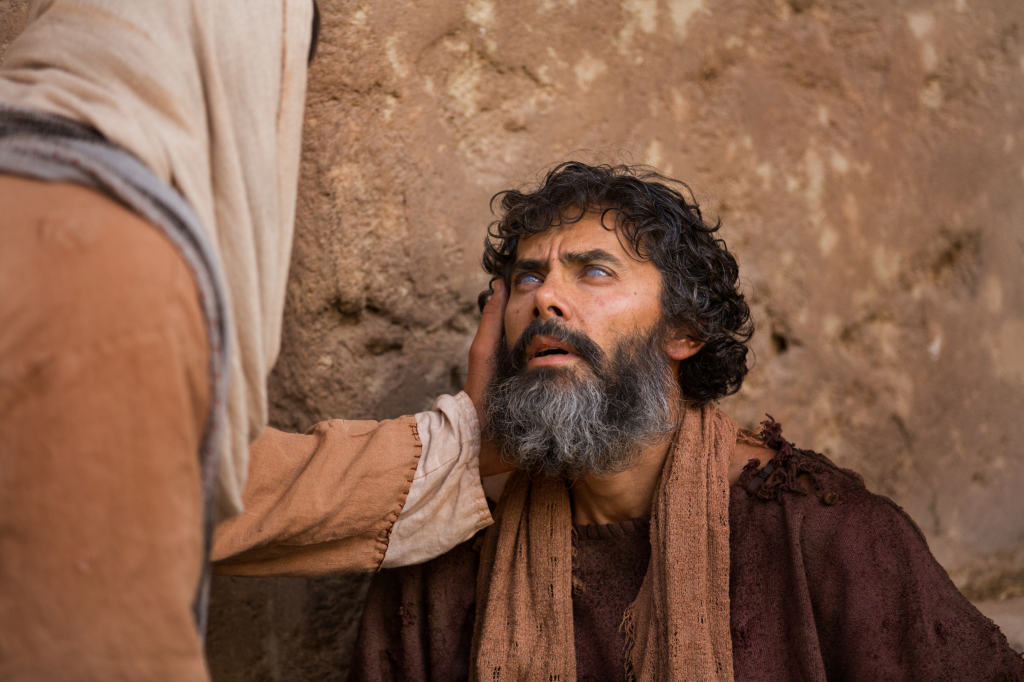
As he was walking along, he saw a man blind from birth.

“Master,” his disciples asked him, “why was this man born blind? Was it a result of his own sins or those of his parents?”

“Neither,” Jesus answered. “But to demonstrate the power of God. All of us must quickly carry out the tasks assigned us by the one who sent me, for there is little time left before the night falls and all work comes to an end. But while I am still here in the world, I give it my light.”

Then he spat on the ground and made mud from the spittle and smoothed the mud over the blind man’s eyes, and told him, “Go and wash in the Pool of Siloam” (the word Siloam means “Sent”). So the man went where nd washed and came back seeing!

Up to now I’ve tried to approach these posts from the first person viewpoint. Ihoped to understand those who met face-to-face with Jesus. I wanted to grasp what they were seeing through their own eyes. But I intend with this post to revert back to a more traditional approach to this passage.

First, we’re introduced to a man who is blind from birth.

I can’t even imagine what that would be like (just as he probably could imagine having sight). I’ve been told that he probably didn’t have a “dream” life–that requires having seen images (a dog, a tree, a mean person) and this wasn’t available to him. He never saw the color red, or seen a mountain. (He didn’t have the circuitry.)

I suppose we can only imagine what blindness like this would be.

Somehow I’ve come to an idea that this represents fallen men–we’re spiritually blind to the workings and truths of Jesus’ Kingdom. It seems a pretty good explanation of each of us–“blind from birth.”

Secondly, notice the response of the disciples who first met this unfortunate man. They don’t see his needs, rather they want to know the theology behind this. Perhaps that’s how we respond much of the time–we don’t see the needs, we only want to know the reasons. We’re not wise or discerning enough to see what’s going on–in short we’re not equipped to love or show mercy. (We haven’t got the circuitry.)

Perhaps this is how we operate as immature Christians.

We don’t engage the need, but rather we like having great theology over understanding compassion. If we really don’t love needy people, we miss so much. We don’t ever grow up. It’s easy to philosophize–it’s hard to get down and serve and really love others.

It’s funny but Jesus declares Himself to be the light of the world while speaking to the man who is born blind.

Third, we discover the gentle mercy that Jesus has when He meets needy people. Now the Lord does accommodate His followers, but not at the expense of engaging the need of the moment. Jesus is full of compassion–most especially when He meets broken people–and as His followers, we must grasp this.

Good theology is not the primary calling of Jesus’ followers.

As I mature in Christ I’m learning (slowly) that people are His real focus. He has come, not to theologize or philosophize, but to meet needs! Sure the reasons why become clearer, but that really isn’t Jesus’ primary goal. People are, not having impeccable theology.

Classes in systematic theology are good, but soup kitchens are better.

The miracle happens, and Jesus’ love and desire to restore this man is ‘front and center.’ The Lord’s methodology is interesting. Spit and mud, wiped on the blind man’s eyes. In Genesis we discover that God made man out of dirt and dust of the ground. Perhaps what He’s doing here mirrors that work.

And it’s also important to understand that Jesus never performs the exact same healing in the exact same way. For some reason He ‘tailors’ His work to the individuals deepest need. I suppose He doesn’t want us to grab a hold of a formula, as that’s what we want to have.

The story is primarily about a blind man’s healing.

It’s not theology, and it certainly isn’t about what is proper and acceptable. We really must understand this, and we really need to understand the tremendous mercy and power of God to both heal and restore.

Image: MCCC. Text from the “Living Bible,” published by Tyndale House

Learning “Persecution Love”

Learning how to forgive

Once I was punched in the face while preaching. At the time I was an evangelist with SOS Ministries in 1987. I was leading a group to Haight/Ashbury St. in San Francisco. I remember it was really busy, and it was a good team, and they were excited to take their church to the streets.

Haight/Ashbury was the place the “summer of love” kicked off, it peaked in 1968. It has a certain sense of notoriety, and even in 1983 it still had a dubious reputation as a center of the counter-culture. “A cult a day is born in San Francisco,” a pastor friend once shared with me.

Normally the neighborhood where I took a team would direct me on how to preach. Tonight I focused on God’s love for sinful people.

That message seemed appropriate for this place, especially on this street. God loves these people very much.

A young man came forward. He told me that he was a backslidden Christian, and his father was an Assembly of God pastor. He had run away from home. Suddenly he began to weep. The entire team seemed to lean forward and I know they were praying earnestly for him. It seemed to me that he was teetering on the brink.

His punch however came unexpectedly.

His fist hit me square in the nose. My eyes began to water. Oddly enough he took a step back and began to really cry out. My team wasn’t quite sure how to respond, but I hoped they prayed even harder. I sort of gasped and tried to shake it off. Someone must have called the police.

The Holy Spirit was very much present, both convicting and comforting each of us.

One or two minutes went by and suddenly he stopped sobbing and he became really angry. He took a step and then tried to kick me in the stomach, but I dropped the mic and caught his foot. I was ready for him this time.

About 20 minutes went by before SFPD showed up and asked if I wanted to press charges. I thought for a bit, but deep down I knew that wasn’t the will of my Father. Maybe I should of, I don’t know. But I thought about my own sin and couldn’t judge no one.

The Father was reaching him while teaching me!

God loves His prodigal children very much, He understands the guilt and shame (and frustration) they feel. The Father however is always watching and waiting. He works through life’s circumstances to lead them home. Each belongs to Him. He continues far past what we think is possible. He will never give up.

“We know what real love is because Jesus gave up his life for us. So we also ought to give up our lives for our brothers and sisters.”

1 John 3:16

I suddenly saw a “wounded” brother, very confused and quite angry. Not with me, the team, or the music–but with God who created him, and died for him.

At that moment I just happened to be God’s love for this prodigal.

“How did Jesus expect His disciples to react under persecution? (In Matthew 5:12 He said), “Rejoice and be glad!” We are not to retaliate like an unbeliever, nor sulk like a child, nor lick our wound in self-pity like a dog, nor just grin a bear it like a Stoic, still less pretend we enjoy it like a masochist. What then? We are to rejoice as a Christian should and even “leap for joy” (Lk. 6:23).”

     John Stott

Bethesda, 31 A.D.

healing-the-lame

“Afterward Jesus returned to Jerusalem for one of the Jewish holy days. Inside the city, near the Sheep Gate, was the pool of Bethesda, with five covered porches. Crowds of sick people—blind, lame, or paralyzed—lay on the porches.One of the men lying there had been sick for thirty-eight years. When Jesus saw him and knew he had been ill for a long time, he asked him,“Would you like to get well?”

“I can’t, sir,” the sick man said, “for I have no one to put me into the pool when the water bubbles up. Someone else always gets there ahead of me.”

Jesus told him, “Stand up, pick up your mat, and walk!”

Instantly, the man was healed! He rolled up his sleeping mat and began walking! But this miracle happened on the Sabbath,

John 5:1-9, NLT

We were following Jesus and He led us to the pool of Bethesda. A crowd gathered quickly, but I jostled myself right up front. We stood waiting, we pretty much knew something big was going to happen. And it did. I can never be the same, after what I saw. This is my simple story.

So much was happening, and as I watched I realized that so much escapes me. I can’t take it all in. But when I decide to watch Jesus, I quickly become aware of what is important, what is real. It starts to make sense. The chaos of the moment becomes calm. At least it does when He takes charge.

There were hundreds of sick people camped out. They are laying under the roofs, with their thin mats. The smell alone was really bad, all were unwashed and some with putrid and festering sores. Dirty bandages are used over and over, and shared with all.

Finally, all are watching Jesus, they become quiet wondering what He will say. We’re all pretty curious. We see Jesus as He walks directly into this ugly field of suffering people. He doesn’t hesitate or flinch.

It is almost like He is at home in this dreadful place.

Just to have a religious teacher visit Bethesda is rare. They never come. And today is the Sabbath (and a special feast day at that) and that alone makes it impossible. And yet Jesus is here, and that somehow is wonderful.

Jesus stops to talk with a man who is an ‘old-timer’ here in this horrible place of pain. This man had been sitting here for almost 40 years, and that is a long, long time. Jesus speaks. “Do you want to get well?” Jesus waits quietly.

“Sir, when the water is stirred, I don’t have anybody to put me in the pool. By the time I get there, somebody else is already in.” The man explains. He has an excuse that seems like a reason. Nothing has ever gone right– ‘I always miss out, and I can’t find anyone to help me.’ And I suppose that this is the world of the blind, the crippled, the paralyzed in Israel. They are confined to Bethesda, with the weak hope of finally being healed. I don’t think that this is how it was meant to work.

This man was horribly discouraged.  It was then Jesus said, “Get up, take your bedroll, start walking.” And this very crippled man was healed on the spot. No ‘hocus-pocus’, no incantations, no magic dust or rubbing of sacred bones. Nothing.

He was healed by a few spoken words.

I cannot emphasize my own astonishment enough. It shook all of us to the core. We were all stunned, and undone. The crowds, and all the sick and the paralyzed just stopped and stared. There are so few moments in life, just like this. We just looked at each other sort of stunned.

The ramifications of what we all had witnessed were staggering. Shocked, we turned to each other, and a great fear fell on us like a heavy blanket. The crowd did not disperse, we were completely shocked, and pretty much speechless.

For years that sense of awe has never left me.

I don’t really listen to the scorners anymore– they simply have no idea. It completely changed my life. I was never the same after that.

“For the Son of Man came to seek and save those who are lost.”

Luke 19:10

Kyrie elesion,  (Lord, have mercy on us.)

Bryan
 cropped-christiangraffiti1 (1)