A Mighty Fortress, Understood

martin_luther2 (1)Martin’s Depression

The hymn A Mighty Fortress Is Our God gloriously celebrates God’s power. It was penned by the great 16th-century reformer Martin Luther, who believed God’s power could help believers overcome great difficulties — even depression. Given his pastoral heart, he sought to bring spiritual counsel to struggling souls. His compassion for those souls shines in numerous places, including his sermons, lectures, Bible commentaries and ‘table talks’. In addition, he devoted many letters to counseling troubled folk.

Luther’s writings reveal his knowledge of various emotional difficulties. For example, in August 1536 he interceded for a woman named Mrs. Kreuzbinder, whom he deemed insane. He described her as being “accustomed to rage” and sometimes angrily chasing her neighbor with a spear.

In addition, Luther’s wife, Kate, struggled with pervasive and persistent worry indicative of generalized anxiety disorder. Prince Joachim of Anhalt, to whom Luther often wrote, exhibited signs of obsessive-compulsive disorder, and he believed he had betrayed and crucified Christ. Conrad Cordatus, a pastor and frequent guest at Luther’s table, exhibited signs of hypochondriasis, a disorder involving preoccupation with fears of having a serious disease.

Besides observing mental difficulties in others, Luther had a compelling reason to affirm their reality. Luther himself endured many instances of depression. He described the experience in varied terms: melancholy, heaviness, depression, dejection of spirit; downcast, sad, downhearted. He suffered in this area for much of his life and often revealed these struggles in his works. Evidently he did not think it a shameful problem to be hidden.

Satan as the “accuser of the brethren,” causes Christians to dwell on past sins. Such thoughts induce melancholy and despair. Concerning a friend’s depressive thoughts, Luther wrote, “Know that the devil is tormenting you with them, and that they are not your thoughts but the cursed devil’s, who cannot bear to see us have joyful thoughts.”   Luther recognized a spiritual truth about depression. One can expect Satan’s persistence until faith is destroyed, but in the midst of depression God is with us. He never leaves us alone. In the midst of trouble He draws near to us.

Sometimes the invisible God draws near through visible people, and they become the bearers of God’s comforting and strengthening words to troubled souls.  What’s more, God seeks to assure us of His love and esteem. And through His Word, He counters Satan’s lies with His truth.

Some Martin Luther Quotes

Luther's Seal
Luther’s Seal

“All who call on God in true faith, earnestly from the heart, will certainly be heard, and will receive what they have asked and desired.”

“Faith is a living and unshakable confidence, a belief in the grace of God so assured that a man would die a thousand deaths for its sake.”

“Christ took our sins and the sins of the whole world as well as the Father’s wrath on his shoulders, and he has drowned them both in himself so that we are thereby reconciled to God and become completely righteous.”

*

“A Mighty Fortress is Our God,” by Luther

1. A mighty fortress is our God,
a bulwark never failing;
our helper he amid the flood
of mortal ills prevailing. 
For still our ancient foe
doth seek to work us woe;
his craft and power are great,
and armed with cruel hate, on earth is not his equal.  

2. Did we in our own strength confide,
our striving would be losing,
were not the right man on our side,
the man of God’s own choosing.
Dost ask who that may be? 
Christ Jesus, it is he;
Lord Sabaoth, his name,
from age to age the same,
and he must win the battle.  

3. And though this world, with devils filled,
should threaten to undo us,
we will not fear, for God hath willed
his truth to triumph through us. 
The Prince of Darkness grim,
we tremble not for him;
his rage we can endure,
for lo, his doom is sure;
one little word shall fell him. 

*

ybic, Bryan

Quotes from, http://christian-quotes.ochristian.com/

Today’s Suicide Toll: Put Faces to the Numbers

It’s time to attach faces to numbers. In less than 24 hours, 1577 will commit suicide. If you look closely, you can see faces.

As believers, these are our business. They are God’s business. Be aware of this. And pray.


For more valuable information see:

http://www.facebook.com/puttingafaceonsuicide AND http://nami.org/

1 in 4 Church Homes Are Dealing With This!

By Carlene Hill Byron

How many families in your church have a loved one who struggles with mental health problems? That’s kind of a trick question. People don’t talk about mental health problems. You’re more likely to hear them describe their child’s condition as “something like autism,” as the elder of one church we know says.

Or they might cover up entirely, as does an elder’s wife in another congregation. When her bipolar disorder swung into mania after childbirth, her family, already managing the added responsibilities of a newborn, had to manage her condition as well. But because her condition is a secret, they did so without any support beyond the usual “new baby” dinners.

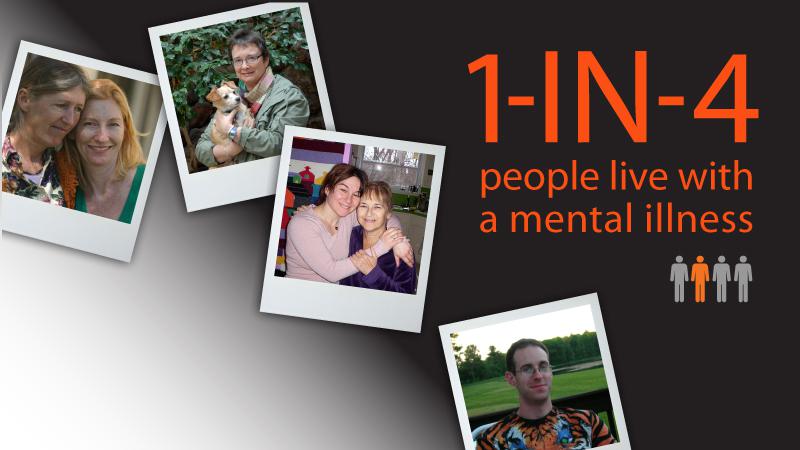
The answer to the question is, if your congregation is representative of the U.S. population, one in four households will struggle with someone’s mental health problems over their lifetime. That’s schizophrenia, bipolar disorder, obsessive compulsive disorder, disabling chronic depression, and various anxiety disorders.  Look at the faces seated around you this Sunday.  Someone is probably hurting. And they’re probably afraid to tell you.

The least acceptable disability

Schizophrenia2
Out of Control

A study where people ranked disabilities by their “acceptability” returned these results, in order–most acceptable: obvious physical disabilities, blindness, deafness, a jail record, learning disabilities, and alcoholism.

Least acceptable: mental health problems. People with mental health problems frighten us because when people become mental ill, they become someone we don’t know. A bright boy who was his family’s bright hope may find he just can’t cut it anymore as schizophrenia turns him paranoid, disoriented, unmotivated in the extreme, and overwhelmed by delusional voices that tell him, over and over, how worthless he is.

Or, in the case of bipolar disorder, a girl who was a well-liked and active member of her Teen Challenge group may suddenly turn promiscuous, run away from home, and make a new home in the streets of a strange city. Laziness. Promiscuity. Violence. Sin. That’s what many people see when they look at those with mental health problems. It’s hard to believe that people may behave in such unacceptable ways and not be in control of their behavior.

Having a mental health problem is a lot like being on alcohol or drugs, without being able to stop. Medications “work” for about two-thirds of us. That means that a third of us can’t ever get off the chemical ride that our brains produce.

For those of us who can use medications, the side effects can be daunting. I have lost about 20 percent of my small motor functionality as a result of one of the five medications I take for bipolar disorder. I prefer that to losing large motor control and having another auto accident, being so disoriented I can’t find my way home from the store, losing bowel control in a busy bookstore, gaining 45 pounds, or any of dozens of side effects I’ve experienced on other medications.

Many people become so frustrated with side effects that they stop taking medications. Only about half of us accept treatment. Even when we are treated, not everyone regains their status as a fully functioning adult. In our extended family, six people have diagnoses. Those with bipolar disorder and chronic depression are successfully medicated and work full-time. Those with panic disorder and schizophrenia are on permanent disability. Nothing has pulled them through.


What the Bible says

The Bible talks about mental illness, as well as physical illness.

  • It describes a king who was made mentally ill until he would recognize the sovereignty of God (Dan. 4:29-34).
  • It describes demonized men who lived among the tombs and terrorized everyone until Jesus set them free (Matt. 8:28-33).
  • It also describes as demonized a young boy that most scholars today say had epilepsy (Matt. 17:15-18). Jesus delivered him, too.
suicide_germs
What was once believed

What does this tell us about illness?

First, that God is able to heal. Second, that some physical and mental illnesses are caused by demons. Third, that some mental illnesses are caused by sin. But are all mental illnesses caused by demons or sin, and is seeking God our sole resource for physical and mental healing?

Since the 1950s, we have usually sent church members with epilepsy to doctors for effective treatment with anti-convulsant drugs. In a similar way, we’ve learned that medicines can effectively treat many cases of mental illness. So if all mental illnesses were caused by demons and sin, medicine would be exorcising demons and turning hearts to repentance. That is certainly untrue, for those are the works of the Holy Spirit.

Instead, we now know that most if not all mental illnesses are biological in origin, with environmental factors possibly triggering an existing genetic predisposition to the illness. Mental illnesses, just like epilepsy, are biological disorders of the brain.

What can the church do?

Compassionate service is one of our core charges as Christians. We observe it almost daily in the experience of one man we know with schizophrenia. His life is confined almost entirely to his home due to the fear, indecision, and lethargy that have become the shape of the illness in his body. But neighbors bring him occasional meals. The secretary of his small church talks to him by telephone every weekday. Several other members take weekly calls at designated times to help break his isolation. If he doesn’t feel up to driving to his Bible study meeting or Sunday services, some member will give him a ride. Nearby relatives help him plan and manage his finances, and come by to clean occasionally and for DVD “movie nights.” Phone cards given as gifts allow him to call his mother nightly. There’s much more that could be done—more frequent house cleaning and more meals and more visits—but he enjoys far more contact with many more loving people than many shut-ins.

The challenging good news is that when people with mental illness turn to someone outside “the system” for help, the church is first to get the call 40 percent of the time. Is your church ready?

…………………..

Carlene Hill Byron is the former Director of Communications for Vision New England. Through NAMI—the Nation’s Voice on Mental Illness, she and her husband, James, train churches to effectively serve people within the congregation with mental health problems and also teach NAMI’s class for families of people with mental health problems. They are members of Asbury United Methodist Church in Raleigh, North Carolina, where James serves on staff. First published by Vision New England’s Ministries with the Disabled, Acton, Massachusetts.

http://www.mentalhealthministries.net/index.html

Help! I Need a Doctor

“And when Jesus heard it, he said to them, “Those who are well have no need of a physician, but those who are sick. I came not to call the righteous, but sinners.” 

Mark 2:17, ESV

We get ‘schooled’ when we try to figure out Jesus.  It is a radical adjustment to process His thoughts and motives.  We watch and try to understand.  Jesus dictates a certain level, and we as His disciples will need to adjust.  Jesus declares that a select group will not need a doctors ministrations.  But the doctor does have a role.  There will be the ‘sick’, who need his attention.

The reality is that many are diseased and ill.  It is something that links and connects us to each  other.  We are desperately sick, and we have no medicine.  Jesus steps forward and intervenes.  He takes us and ministers to us in our desperate condition.  The diseased will be made healthy.

Jesus reaches ‘the sick’.  That is who He wants.  He makes the choice and that choice is us, full of infection and pain.  His Kingdom consists of those who understand their illness.  He bypasses the strong and the healthy.  He spends little time with them.  His heart is set on us who are broken and twisted.  Our cancerous bodies have absolutely nothing to give Him.

His Kingdom is full of sick people.  It, in a sense, is full with the ‘terminally ill’.  It is we who have ‘attracted’ Him.  Yet He has intensely sought us out.  We gather like little chicks to his protective wings.  We honestly do not have the ability even to protect ourselves.

Jesus declares that He has come for us.  Sin is very near to us.  We have the infection and we are completely vulnerable.  We are not strong spiritually.  There are many who excel before us.  We can make no claim to anything of significance.  But He has chosen us.  Sovereignly and specifically.  Strongly and decisively.  He has collected us and brought us to His heart.

*

ybic, Bryan